Table of Contents
Introduction
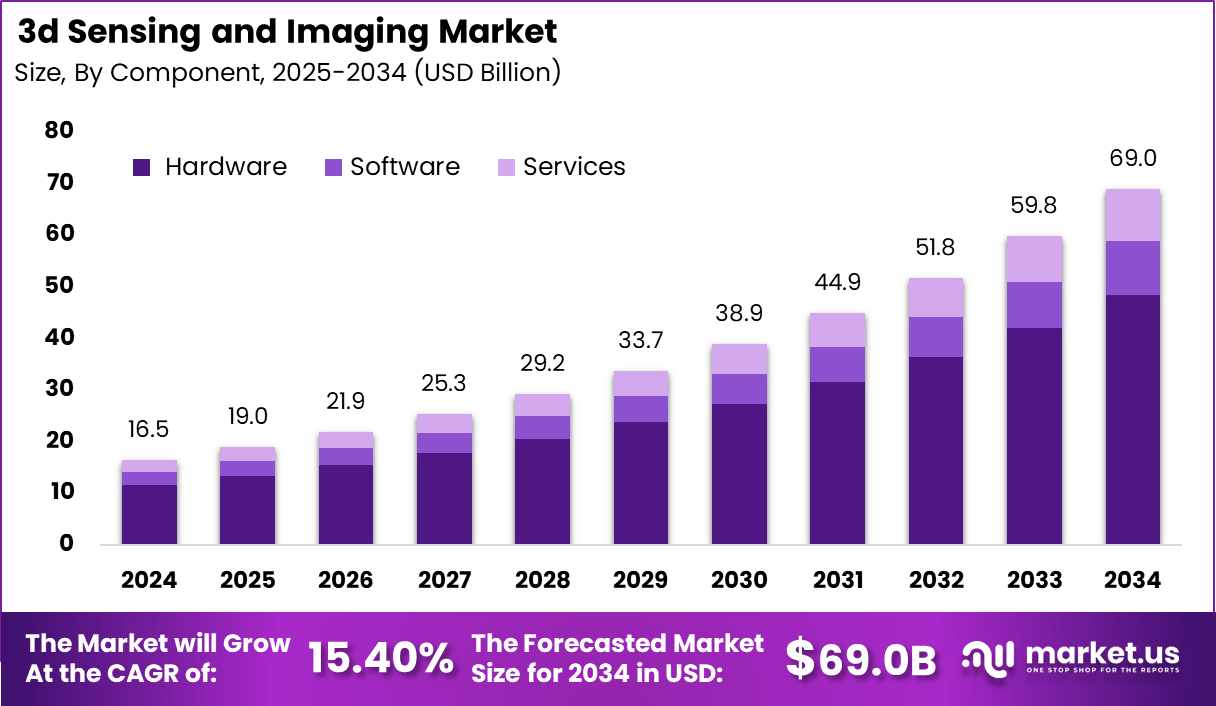
The Global 3D Sensing and Imaging Market generated USD 16.5 billion in 2024 and is projected to grow from USD 19 billion in 2025 to USD 69 billion by 2034, registering a CAGR of 15.40%. Asia Pacific dominated the landscape with a 45.3% share worth USD 7.46 billion, driven by the rapid adoption of smartphones with 3D cameras, automotive ADAS integration, industrial automation, and the expanding use of 3D imaging in healthcare diagnostics and robotics. Rising demand for depth-sensing technologies across consumer and enterprise applications is accelerating market expansion.
How Growth is Impacting the Economy
Growth in 3D sensing and imaging is significantly strengthening the global economy by fueling investments in advanced manufacturing, AI-powered imaging, semiconductor innovation, and automation infrastructure. As industries adopt depth-sensing for robotics navigation, autonomous vehicles, and quality inspection, productivity increases and operational costs decline. Smartphone manufacturers are integrating 3D sensing for biometrics and AR features, creating high-volume demand for sensors, VCSELs, and depth cameras that stimulate semiconductor and optical component production.
Healthcare systems benefit economically through improved diagnostic accuracy, reduced manual intervention, and enhanced surgical precision enabled by 3D imaging. The expansion of 3D technologies also supports job creation across hardware engineering, algorithm development, system integration, and software analytics. With governments investing in digital transformation and smart manufacturing, the 3D sensing ecosystem reinforces economic growth across consumer electronics, automotive, industrial, and medical technology sectors.
➤ Smarter strategy starts here! Get the sample – https://market.us/report/3d-sensing-and-imaging-market/free-sample/
Impact on Global Businesses
Businesses face rising costs due to the need for specialized optical components, precision manufacturing, advanced imaging software, and AI-based processing systems. Supply chains shift toward vendors providing semiconductor-grade lasers, sensors, micro-projectors, and integrated depth modules. Consumer electronics firms benefit from enhanced device capabilities such as facial recognition, gesture control, and AR applications. Automotive companies use 3D sensing for driver monitoring, autonomous navigation, and collision avoidance, improving safety and regulatory compliance. Industrial and logistics sectors implement 3D imaging for automation, inspection, and warehouse robotics, reducing manual labor and improving accuracy.
Strategies for Businesses
Businesses should invest in partnerships with semiconductor suppliers, sensor manufacturers, and AI software developers to strengthen their technology pipelines. Adopting modular 3D imaging architectures enables scalability across devices and applications. Firms must allocate resources toward R&D for faster, compact, and energy-efficient sensing systems. Developing multi-industry solutions for automotive, healthcare, and consumer electronics widens revenue opportunities. Continuous workforce training on AI imaging platforms and sensor calibration enhances implementation efficiency.
Key Takeaways
• Market expected to grow from USD 16.5 billion to USD 69 billion by 2034.
• Asia Pacific leads with over 45% market share.
• 3D sensing adoption is rising in smartphones, automotive, and industrial automation.
• AI, depth sensing, and semiconductor innovation are key market drivers.
• Growing cross-industry demand strengthens long-term market potential.
➤ Unlock growth secrets! Buy the full report – https://market.us/purchase-report/?report_id=166548
Analyst Viewpoint
The market is expanding rapidly due to the accelerating adoption of 3D imaging in consumer devices, robotics, autonomous vehicles, and healthcare diagnostics. Present growth is driven by the integration of depth cameras, structured light, and ToF sensors across high-volume electronics and industrial sectors. Future outlook remains highly positive as 3D sensing becomes essential for spatial computing, mixed reality, intelligent robotics, and advanced driver-assistance systems. Continued innovation in chips, algorithms, and optical components will position the market for sustained long-term development.
Use Case and Growth Factors
| Use Case | Growth Factor |
|---|---|
| Smartphone facial recognition | Rising adoption of secure biometric authentication |
| Automotive ADAS and driver monitoring | Increasing demand for autonomous and safety-enhanced vehicles |
| Industrial inspection and automation | Need for precision and reduced manual labor |
| Medical diagnostics and imaging | Growth of minimally invasive and AI-supported procedures |
| Logistics and warehouse robotics | Rising e-commerce and need for automated workflows |
Regional Analysis
Asia Pacific remains the dominant market due to strong electronics manufacturing, rapid adoption of 3D-enabled smartphones, and rising automotive automation across China, Japan, and South Korea. North America shows steady growth driven by investments in autonomous vehicles, robotics, and advanced healthcare imaging. Europe benefits from industrial automation and automotive OEM initiatives integrating 3D sensing. Latin America and the Middle East are gradually expanding adoption in security, consumer electronics, and logistics modernization.
➤ Want more market wisdom? Browse reports –
- AI Commentary Service Market
- AI Patent Search Market
- ESG-Linked Insurance Market
- Voice Picking Solution Market
Business Opportunities
Opportunities are strong in AI-integrated 3D sensing modules, ToF and structured-light cameras, 3D medical imaging systems, industrial robotics, and automotive depth sensors. Companies offering compact, energy-efficient, and high-accuracy solutions can capture fast-growing demand across smartphones, autonomous vehicles, and smart factories. The rise of mixed reality, drone navigation, and digital twins creates new avenues for innovation and service-based consulting models.
Key Segmentation
The market includes components such as sensors, cameras, lasers, projectors, and software algorithms. Technologies include Time-of-Flight, structured light, stereoscopic vision, and LiDAR-based imaging systems. Application segments span consumer electronics, automotive, healthcare, industrial automation, robotics, security, and logistics. End-user segments include smartphone manufacturers, automotive OEMs, hospitals, industrial enterprises, and research institutions, each adopting depth-sensing to enhance precision, automation, and real-time decision-making.
Key Player Analysis
Major participants focus on improving sensor accuracy, reducing power consumption, and enhancing real-time processing capabilities. Their strategies include developing integrated 3D sensing modules for mobile devices, expanding LiDAR and ToF solutions for automotive, and creating high-resolution imaging systems for medical and industrial applications. Many invest in AI-driven depth algorithms and collaborate with semiconductor foundries to optimize chip performance. Companies strengthen competitive positions by offering scalable platforms adaptable to multiple industries.
- STMicroelectronics N.V.
- Infineon Technologies AG
- Microchip Technology Inc.
- Viavi Solutions Inc.
- Rockwell Automation Inc.
- KEYENCE Corporation
- Suteng Innovation Technology Co. Ltd.
- Autodesk Inc.
- Cognex Corporation
- OMNIVISION Technologies Inc.
- SICK AG
- Panasonic Holdings Corporation
- Sony Group Corporation
- Lumentum Holdings Inc.
- FARO Technologies Inc.
- Occipital Inc.
- LMI Technologies Inc.
- Trimble Inc.
- Balluff GmbH
- Others
Recent Developments
• January 2024 – Launch of ultra-compact ToF modules for next-generation smartphones.
• April 2024 – Automotive LiDAR integrated into new ADAS platforms.
• July 2024 – AI-enhanced 3D inspection systems deployed in advanced manufacturing.
• September 2024 – High-resolution medical 3D imaging solutions introduced for diagnostics.
• December 2024 – New low-power structured-light sensors released for wearable devices.
Conclusion
The 3D sensing and imaging market is experiencing strong global growth driven by advanced electronics, automation, and AI integration. With significant adoption across Asia Pacific and expanding applications globally, the technology will remain pivotal to next-generation devices, industrial systems, and autonomous platforms.
Discuss your needs with our analyst
Please share your requirements with more details so our analyst can check if they can solve your problem(s)