Market Overview
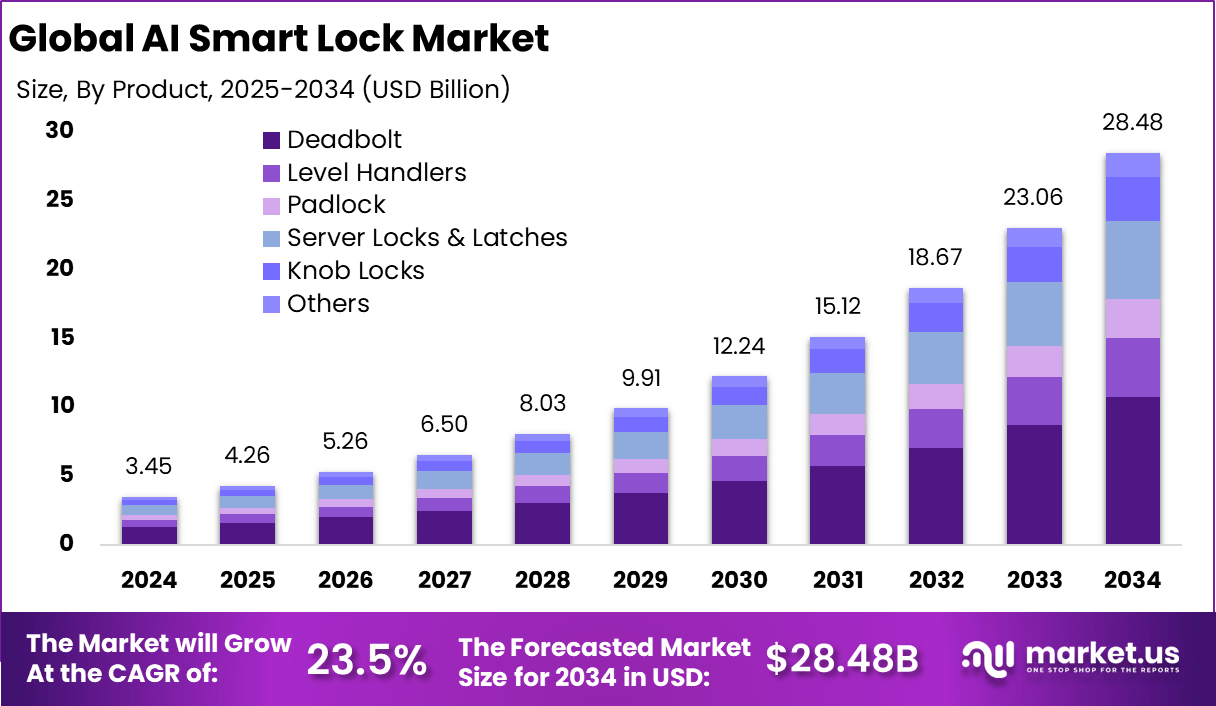
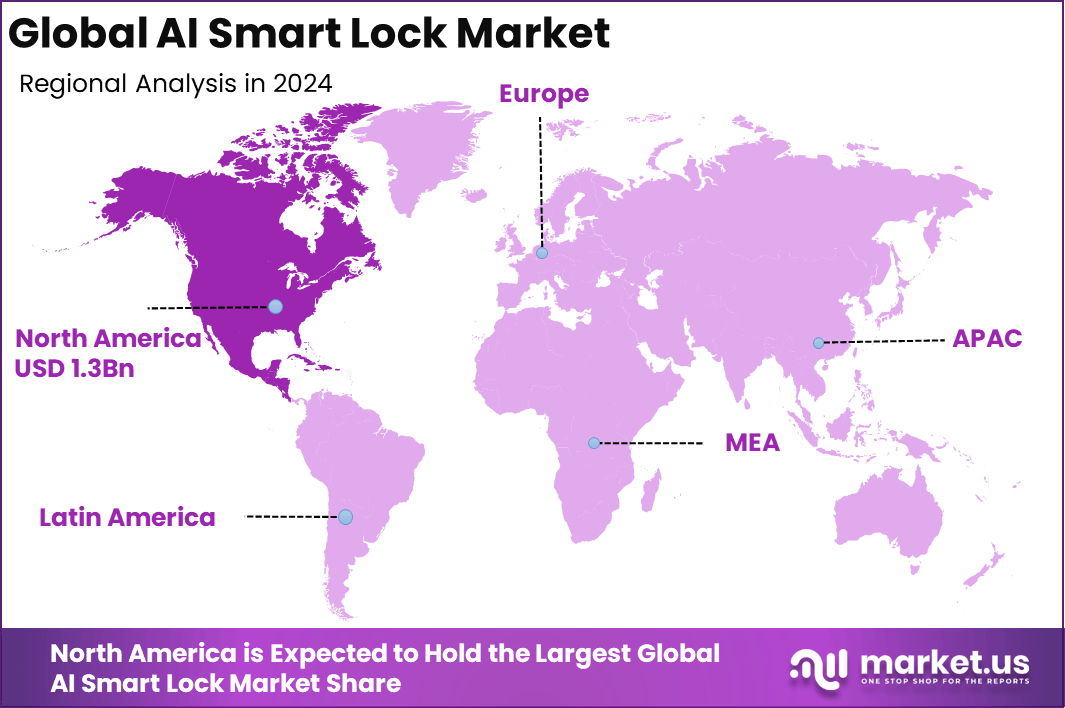
The Global AI Smart Lock Market represents a high-growth investment opportunity, expanding from USD 3.45 billion in 2024 to nearly USD 28.48 billion by 2034, growing at a CAGR of 23.5%. North America’s dominant market position in 2024, capturing more than 38.2% share and USD 1.3 billion in revenue, underscores the region’s leadership in intelligent security technologies and strong long-term upside for investors.
The AI Smart Lock Market refers to the ecosystem of intelligent access control devices that use artificial intelligence and connectivity technologies to enhance security and convenience. These locks combine electronic locking mechanisms with features such as facial or biometric recognition, adaptive learning of user patterns, and remote management via mobile apps or connected systems. AI-enabled smart locks are designed to integrate with smart home networks and broader Internet of Things platforms, enabling seamless control and monitoring. Their capabilities extend beyond traditional locks by providing intelligent authentication and situational awareness at entry points.
The adoption of AI smart locks reflects broader trends in digital security, user experience enhancement, and distributed access management. These devices serve residential, commercial, and institutional use cases, offering keyless entry, automated access control, and personalized security responses. The increasing penetration of wireless communication technologies such as Wi-Fi, Bluetooth, and near-field communication supports the connectivity and responsiveness of AI smart locks. As users demand higher security assurance and smarter automation, these products are becoming central to modern access control strategies.
One of the main driving factors for the AI Smart Lock Market is the increasing concern over physical security and controlled access. As urbanization continues and property access needs become more complex, users seek solutions that go beyond mechanical lock systems to provide visibility, control, and intuitive authentication. AI capabilities such as pattern recognition and behavior learning help anticipate user needs and reduce the risk of unauthorized entry. This shift in security expectations is supporting broader interest in intelligent lock systems.
Demand for AI smart locks is being propelled by rising interest in intelligent security solutions across residential and commercial environments. Homeowners are attracted to keyless entry, automated user recognition, and remote management features that simplify everyday access control. Small business and office spaces also value these systems for streamlined access tracking and reduced reliance on physical keys. The demand reflects a broader preference for connected devices that support both security and convenience.
Key Takeaways
- The deadbolt segment led the market with 37.8%, supported by strong adoption across residential and commercial buildings due to higher security strength and long-term durability.
- The commercial application segment accounted for 30.4%, driven by rising demand from offices, hotels, and retail spaces for AI enabled access control systems.
- Natural Language Processing technology dominated with 44.7%, reflecting increased use of voice based commands and AI driven authentication features in smart lock solutions.
- The Bluetooth protocol held 40.6% share, supported by ease of use, low energy consumption, and broad compatibility with smartphones for keyless access.
- The keypad authentication method captured 28.8%, favored for its reliability and suitability in environments with multiple users and access levels.
- North America represented 38.2% of the global market, driven by strong smart home adoption and well developed IoT infrastructure.
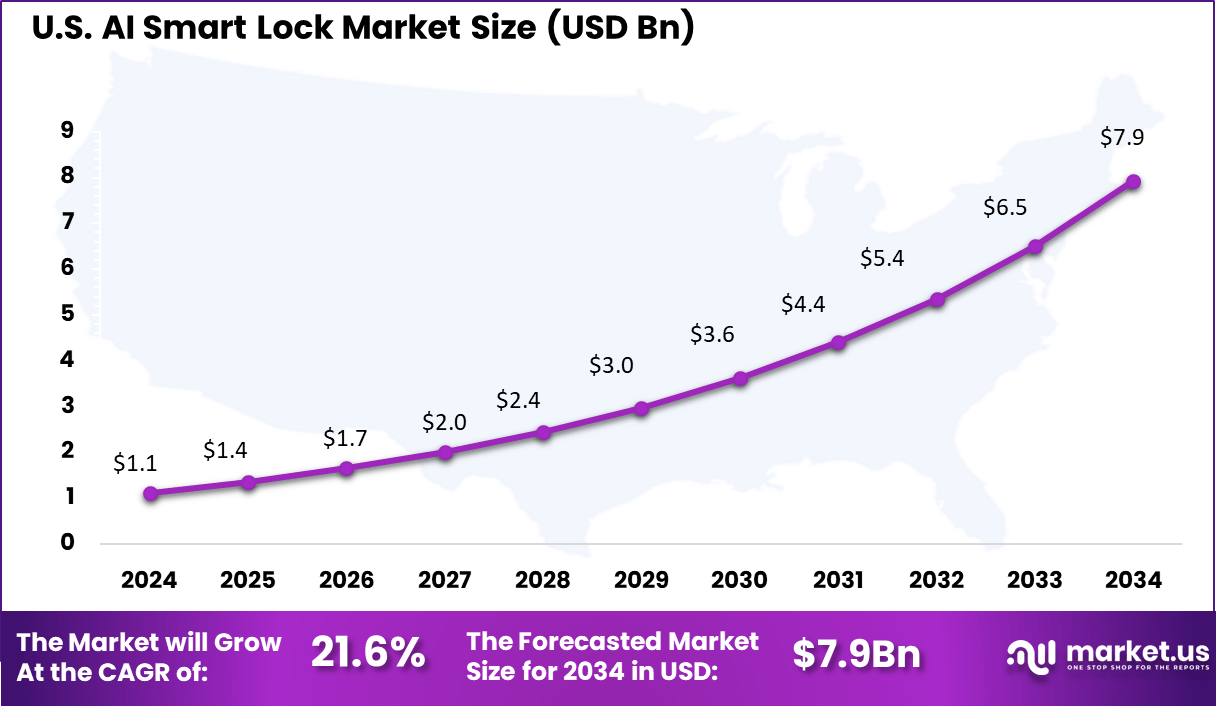
- The US market reached USD 1.12 billion in 2024 and is expanding at a 21.6% CAGR, supported by rising security awareness and growing use of AI based access management systems.
Investment Opportunities
Investment opportunities in the AI Smart Lock Market arise from the need for smarter authentication features and ecosystem interoperability. Developers and manufacturers can innovate by creating locks that support adaptive AI features, multi-factor authentication, and dynamic access policies tailored to different user needs. Demand for intuitive user experiences encourages investment in machine learning algorithms that refine access logic over time. These technology enhancements offer a path for product differentiation and higher value propositions in security devices.
Another area of opportunity is integration with smart city infrastructure and enterprise security platforms. As cities and commercial buildings adopt connected technologies for management and monitoring, AI smart locks can become part of unified access networks that support employee management, visitor tracking, and public safety initiatives. Investors and developers can focus on scalable solutions that align with broader digital transformation agendas in built environments. These strategic linkages present meaningful potential for long-term returns.
Business Benefits
AI smart locks offer significant business benefits by enhancing the security posture of properties while reducing operational friction. Intelligent authentication and adaptive learning reduce reliance on physical keys and manual lock management, minimizing the likelihood of lost keys and unauthorized duplicates. Remote management capabilities enable administrators to monitor access events in real time and respond proactively to potential security breaches. These benefits contribute to operational efficiency and stronger security assurance.
For residential users, the convenience of keyless entry, personalized user profiles, and integration with smart home platforms improves daily life. Users can grant temporary access to visitors, monitor entry logs, and automate locking schedules to meet lifestyle needs. This responsiveness and flexibility align with consumer expectations of digital convenience and security management in modern living spaces. Over time, these features strengthen user satisfaction and device loyalty.
Regional Analysis
In North America, the adoption of AI smart locks is strong, supported by high smartphone penetration, advanced residential automation, and heightened security awareness. Users in this region are early adopters of smart home devices that integrate seamlessly with digital ecosystems. These factors contribute to a robust market for AI-enhanced locking solutions. North American consumers often prioritize convenience and cutting-edge security features in access control systems.
In the United States, the market stands near USD 1.12 billion with an expected compound annual growth rate of 21.6%.
Europe also demonstrates significant interest in intelligent access control, especially in urban areas and commercial environments where security management is paramount. Regulatory emphasis on data protection and privacy encourages adoption of secure and authenticated access technologies. In Asia Pacific, rapid urban growth and smart infrastructure initiatives support interest in connected security solutions. Both residential and enterprise sectors in this region view AI smart locks as valuable enhancements to digital property management and safety.
Use Case Analysis
One notable use case for AI smart locks is in residential security where users seek enhanced convenience and tailored access control. Family members can unlock doors using facial recognition, biometric verification, or connected devices, reducing dependency on physical keys. Temporary access codes can be provided to guests, service personnel, or short-term renters, increasing flexibility without compromising security. This use case emphasizes user personalization and daily convenience.
Another important use case is in commercial access management, where AI locks support secure entry for employees, contractors, and visitors. These locks can integrate with building management systems to automate access privileges based on schedules or roles, reducing administrative overhead. Real-time monitoring and reporting provide valuable visibility into access events and help enforce compliance with internal security policies. In environments where controlled access is essential, these capabilities improve operational efficiency and risk mitigation.
Risk Analysis
One risk in deploying AI smart locks relates to cybersecurity vulnerabilities and unauthorized access threats. Smart locks are networked devices, and without robust encryption or secure protocols, they can be exposed to hacking, data interception, or unauthorized control. Security breaches could compromise user privacy and physical access control, undermining the perceived value of intelligent locking systems. Effective risk management requires strong authentication frameworks and ongoing software updates.
Another risk is compatibility fragmentation and lack of standardization across devices and ecosystems. Different communication protocols and access standards can limit interoperability between locks and other smart home or enterprise systems. This can lead to user frustration, implementation challenges, and higher integration costs. The absence of universal standards can also slow adoption as users hesitate to commit to solutions that may not align with future technologies.
Key Market Segments
By Product
- Deadbolt
- Level Handlers
- Padlock
- Server Locks & Latches
- Knob Locks
- Others
By Application
- Residential
- Individual Household
- Commonhold
- Commercial
- Hospitality
- Healthcare
- BFSI
- Enterprise
- Critical Infrastructure
- Educational Institution
- Industrial
- Manufacturing
- Energy & Utilities
- Oil & Gas
- Institutional & Government
- Transportation & Logistics
- Others
By Technology
- Natural Language Processing (NLP)
- Machine Learning
- Computer Vision
- Others
By Protocol
- Bluetooth
- Wi-Fi
- Z-Wave
- Zigbee
- Others
By Authentication Method
- Keypad
- Card Key
- Touch-based
- Key Fob
- Smartphone-based
- Biometric
- Others
Top Key Players in the Market
- August Home (ASSA ABLOY)
- Avent Security
- Cansec Systems Ltd.
- Danalock
- dormakaba International Holding AG
- FRIDAY Home
- Gate Labs
- HavenLock, Inc.
- Honeywell International Inc.
- Kwikset (ASSA ABLOY)
- RemoteLock
- MUL-T-LOCK TECHNOLOGIES LTD. (ASSA ABLOY)
- Nuki Home Solutions GmbH
- Onity, Inc. (Honeywell International, Inc.)
- Salto Systems, S.L.
- Schlage (Allegion Plc)
- SentriLock, LLC
- SMARTLOCK
- UniKey Technologies, Inc.
- Yale Locks (ASSA ABLOY)
- Zigbang Co., Ltd.
- Others
Report Scope
| Report Features | Description |
|---|---|
| Market Value (2024) | USD 3.45 Bn |
| Forecast Revenue (2034) | USD 28.48 Bn |
| CAGR(2025-2034) | 23.5% |
| Base Year for Estimation | 2024 |
| Historic Period | 2020-2023 |
| Forecast Period | 2025-2034 |
Discuss your needs with our analyst
Please share your requirements with more details so our analyst can check if they can solve your problem(s)