Crime Analytics Market Size
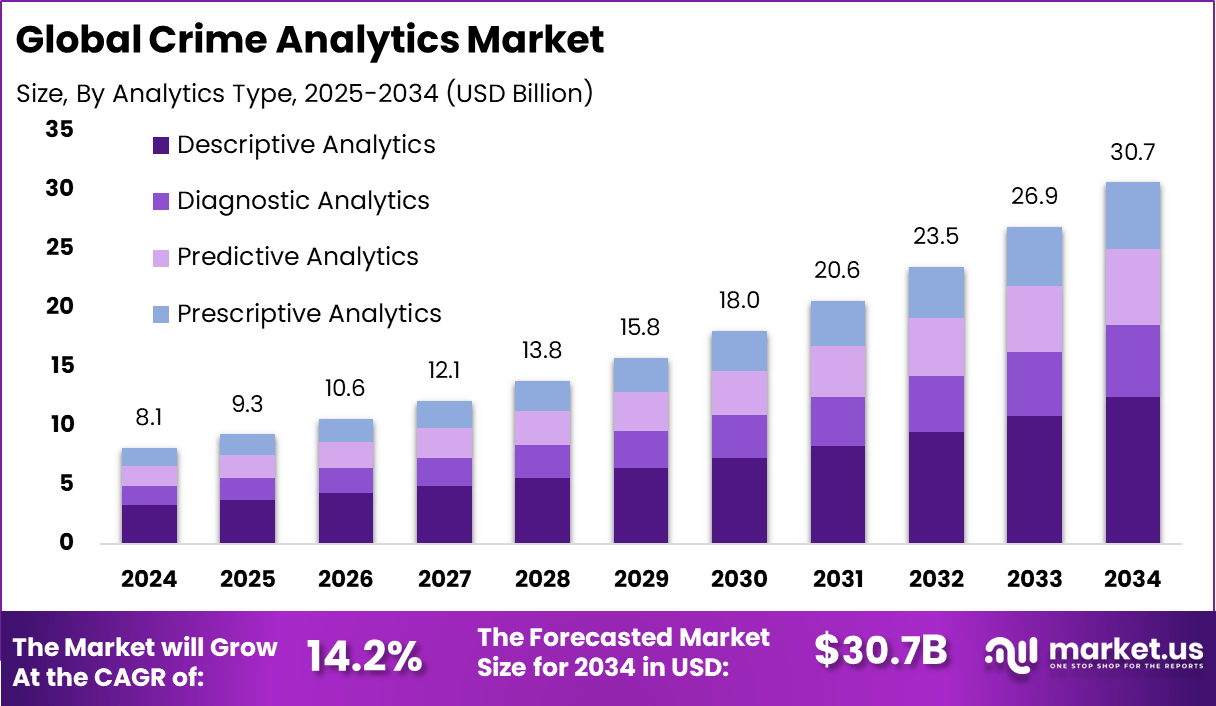
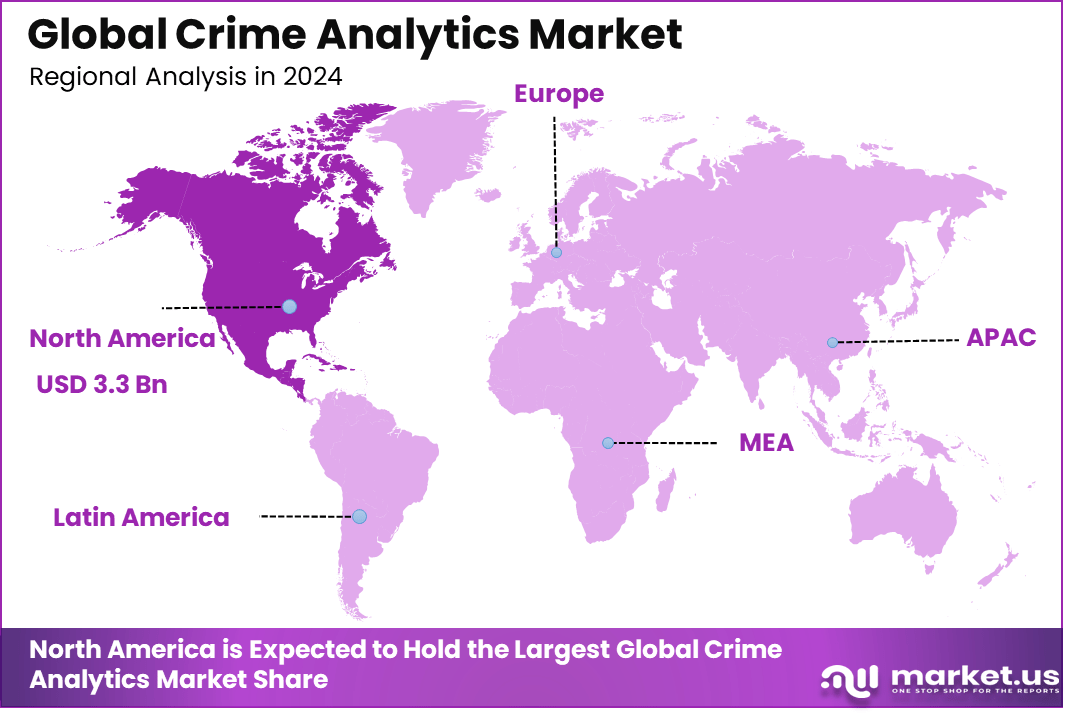
The Global Crime Analytics Market presents a compelling govtech and security analytics investment opportunity, having generated USD 8.1 billion in 2024 and expected to grow from USD 9.3 billion in 2025 to nearly USD 30.7 billion by 2034, at a CAGR of 14.2%. North America’s dominant position, accounting for more than 41.8% market share and USD 3.3 billion in revenue, reinforces the region’s role as a key growth engine for long-term capital deployment.
The crime analytics market refers to the application of advanced data analysis, machine learning, and statistical modelling to interpret crime data and guide law enforcement and public safety efforts. This market supports agencies and organisations in identifying crime patterns, predicting incidents, and allocating resources more efficiently.
Crime analytics integrates data from multiple sources such as surveillance feeds, incident reports, geographic information systems, and socio-demographic indicators to generate actionable insights. Stakeholders increasingly view these tools as critical for proactive policing, rapid investigation support, and improved public safety outcomes. Growth trends include the advancement of predictive models, integrated analytics platforms, and AI-enhanced visualization tools that support strategic decision making.
Quick Market Facts
- By component, solutions lead with 65.4%, driven by increasing use of advanced software for crime prediction, pattern recognition, and investigation support.
- By deployment model, on-premise systems account for 55.3%, reflecting preference for secure and locally managed platforms in sensitive law enforcement environments.
- By application, incident analysis holds 30.7%, highlighting strong reliance on analytics to detect links, trends, and recurring crime patterns.
- By end user, law enforcement and public safety agencies represent 42.9%, underscoring the importance of analytics in crime prevention and rapid response.
- By analytics type, descriptive analytics leads with 40.5%, supporting analysis of historical crime data and informed strategic planning.
- North America holds 41.8% share, supported by early adoption of data driven policing tools.
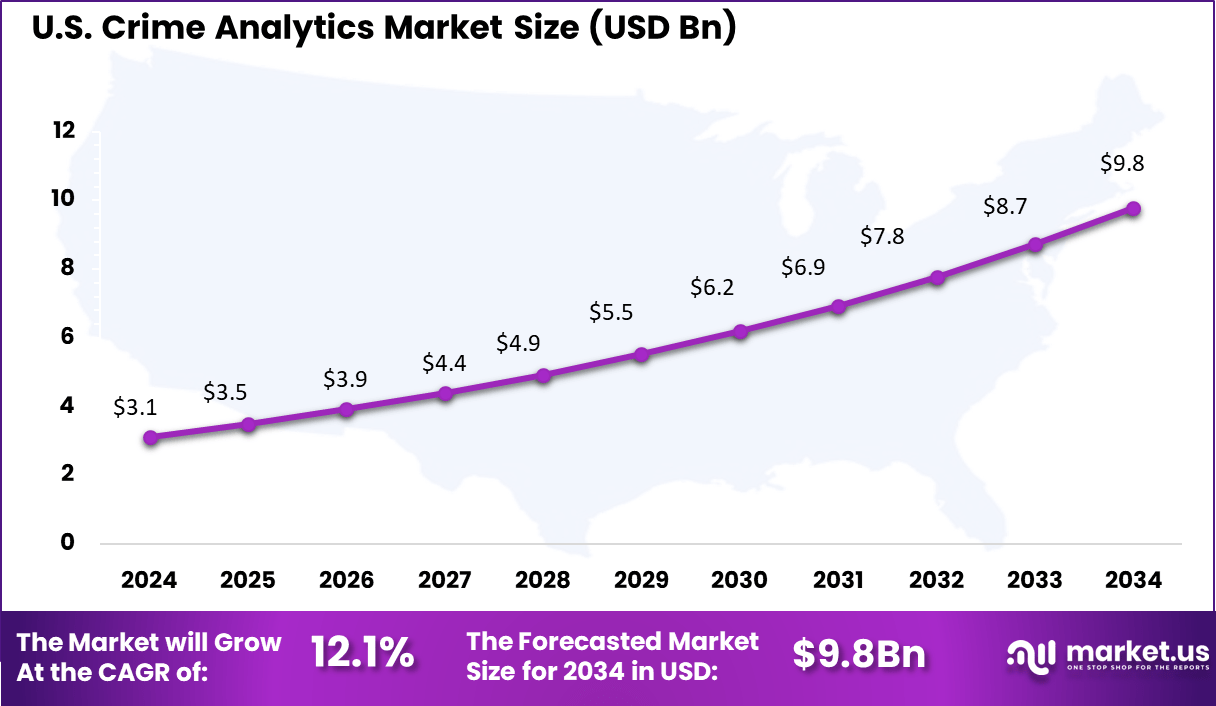
- The US market reached USD 3.12 billion and is growing at a 12.1% CAGR, driven by rising investment in smart public safety infrastructure.
Core Crime Statistics
- Crime rate: Measures the number of crimes per 100,000 people, enabling consistent comparison across regions and time periods.
- Total crime volume: Represents the absolute number of recorded criminal incidents, indicating the overall scale of crime within a jurisdiction.
- Crime type frequency: Breaks crime data into categories such as homicide, burglary, vehicle theft, sexual offenses, cybercrime, and economic crimes to identify priority risk areas.
- Geospatial and hotspot analysis: Maps crimes to specific locations such as districts or police beats, identifying high concentration areas for targeted policing.
- Temporal analysis: Examines crime patterns by time of day, day of the week, and season, supporting better patrol planning and resource allocation.
- Victim and offender demographics: Analyzes age, gender, and related characteristics to support profiling, risk assessment, and understanding of crime drivers.
US Market Size
The United States represents a significant portion of the crime analytics market, with an estimated market size of around USD 3.12 billion and a strong CAGR of approximately 12.1%
In 2024, North America led the global crime analytics market, accounting for about 41.8% of the total market share, supported by high adoption of data driven law enforcement and public safety technologies.
Drivers Impact Analysis
| Key Driver | Impact on CAGR Forecast (~%) | Geographic Relevance | Impact Timeline |
|---|---|---|---|
| Rising adoption of data-driven policing and public safety programs | +4.1% | North America, Europe | Short to medium term |
| Growth in urbanization and smart city initiatives | +3.3% | Asia Pacific, Middle East | Medium term |
| Increasing volume of crime data from CCTV, IoT, and digital sources | +2.9% | Global | Medium term |
| Demand for predictive policing and crime prevention tools | +2.4% | North America, Europe | Medium to long term |
| Government funding for law enforcement technology upgrades | +1.9% | North America, Europe | Long term |
The combined driver impact supports the ~14.2% CAGR, led by smart city deployments and predictive analytics adoption.
Restraints Impact Analysis
| Key Restraint | Impact on CAGR Forecast (~%) | Geographic Relevance | Impact Timeline |
|---|---|---|---|
| Data privacy and civil liberty concerns | −2.6% | Europe, North America | Short to medium term |
| High implementation and integration costs | −2.1% | Emerging Markets | Medium term |
| Limited analytics expertise within law enforcement agencies | −1.8% | Asia Pacific, Latin America | Medium term |
| Fragmented and unstructured crime data sources | −1.5% | Global | Medium term |
| Regulatory uncertainty around AI-driven surveillance | −1.2% | Europe | Medium to long term |
Restraints are governance- and capability-driven, indicating gradual mitigation through regulation clarity and skills development.
Investor Type Impact Matrix
| Investor Type | Growth Sensitivity | Risk Exposure | Geographic Focus | Investment Outlook |
|---|---|---|---|---|
| Public safety technology providers | High | Medium | North America, Europe | Stable demand from government contracts |
| AI and analytics platform investors | High | Medium | Global | Scalable software-led growth |
| System integrators and IT services firms | Medium | Low to Medium | Global | Long-term implementation revenues |
| Private equity firms | Medium | Medium | North America, Europe | Consolidation and platform expansion |
| Venture capital investors | High | High | North America | Innovation-led growth opportunities |
Investor interest is strongest in government-backed, long-duration contracts and scalable analytics platforms.
Technology Enablement Analysis
| Technology Enabler | Impact on CAGR Forecast (~%) | Primary Function | Geographic Relevance | Adoption Timeline |
|---|---|---|---|---|
| AI and machine learning-based predictive analytics | +4.5% | Crime pattern prediction | Global | Short to medium term |
| Video analytics and facial recognition systems | +3.8% | Real-time threat detection | North America, Asia Pacific | Medium term |
| Cloud-based crime data platforms | +3.1% | Scalable data storage and access | Global | Medium term |
| Big data integration and visualization tools | +2.6% | Actionable intelligence dashboards | Global | Medium to long term |
| Edge analytics for real-time surveillance | +2.0% | Low-latency response | North America | Long term |
Emerging Trend Analysis
A significant emerging trend in the Crime Analytics market is the incorporation of artificial intelligence and machine learning to enable predictive insights and automated pattern detection. Modern crime analytics systems are moving beyond descriptive reporting to offer real-time anomaly detection and predictive modelling that can indicate potential crime hotspots or emerging patterns. These capabilities support law enforcement and public safety agencies in anticipating incidents rather than solely responding after the fact. The trend reflects a broader shift in public safety strategy toward data driven intelligence and proactive resource allocation.
Another important trend is the integration of diverse data sources, including social media feeds, sensor networks, public records, and surveillance footage, into unified analytics platforms. This holistic data integration enhances situational awareness and improves the accuracy of analytical outcomes by providing a richer contextual basis for analysis. The combined use of structured and unstructured data is enabling more comprehensive crime insights. This expanded data landscape supports both tactical decision making and strategic planning in crime prevention and investigation.
Key Market Segments
By Component
- Solutions
- Crime Data Management
- Predictive Analytics
- Pattern Detection
- Geolocation Analytics
- Investigative Leads Management
- Video Analytics
- Social Media Analytics
- Services
- Professional Services
- Consulting
- Implementation
- Training
- Managed Services
- Professional Services
By Deployment Model
- On-Premise
- Cloud-Based
By Application
- Predictive Policing
- Incident Analysis
- Investigative Leads Management
- Forensic Analysis
- Others
By End-User
- Law Enforcement & Public Safety
- Government & Defense
- Enterprise & Commercial
- Homeland Security & Intelligence Agencies
By Analytics Type
- Descriptive Analytics
- Diagnostic Analytics
- Predictive Analytics
- Prescriptive Analytics
Top Key Players in the Market
- IBM Corporation
- Accenture PLC
- SAS Institute Inc.
- Palantir Technologies Inc.
- LexisNexis Risk Solutions
- Motorola Solutions, Inc.
- BAE Systems plc
- Hexagon AB
- Esri (Environmental Systems Research Institute)
- Verisk Analytics, Inc.
- Nice Ltd.
- Capgemini SE
- Cognizant Technology Solutions Corporation
- Wynyard Group
- PredPol, Inc.
- Others
Report Scope
| Report Features | Description |
|---|---|
| Market Value (2024) | USD 8.1 Bn |
| Forecast Revenue (2034) | USD 30.7 Bn |
| CAGR(2025-2034) | 14.2% |
| Base Year for Estimation | 2024 |
| Historic Period | 2020-2023 |
| Forecast Period | 2025-2034 |
| Report Coverage | Revenue forecast, AI impact on Market trends, Share Insights, Company ranking, competitive landscape, Recent Developments, Market Dynamics and Emerging Trends |
Discuss your needs with our analyst
Please share your requirements with more details so our analyst can check if they can solve your problem(s)