Report Overview
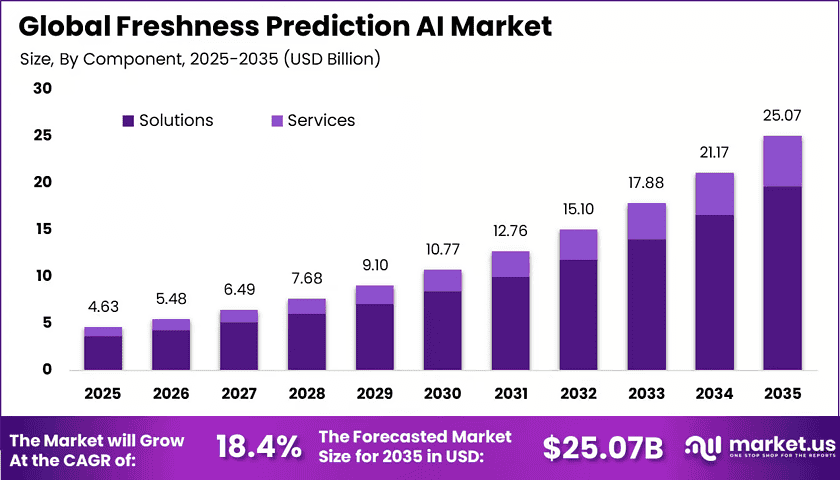
The Freshness Prediction AI Market is projected to grow from USD 4.63 billion in 2025 to USD 25.07 billion by 2035, expanding at a CAGR of 18.4%, with North America leading at a 41.26% share and USD 1.91 billion in revenue.
The Freshness Prediction AI market can be understood as an emerging segment of food intelligence and supply chain technology focused on using artificial intelligence to estimate product freshness, remaining shelf life, spoilage risk, and quality changes across storage, transport, retail, and food service environments.
While “Freshness Prediction AI” is not yet a widely standardized standalone market label, the underlying category is well established in research and industry through AI based shelf life prediction, food spoilage detection, and real time food quality monitoring. These systems use data from sensors, imaging, spectroscopy, machine vision, and environmental records to predict how fresh a product is and how long it can remain safe or commercially usable.
The top driving factors behind this market are food waste reduction, food safety pressure, and the need for better visibility across perishable supply chains. McKinsey notes that food loss during or just after harvest is a major economic problem, while FDA traceability requirements are pushing the industry toward faster identification and removal of risky food products from the market. In practice, this creates strong demand for AI systems that can move beyond static expiry assumptions and provide more dynamic freshness estimates based on actual conditions.
Demand analysis suggests that interest is rising across grocery retail, cold chain logistics, food processing, food service, and agriculture. The demand is especially strong where businesses manage highly perishable products and need to reduce shrink, improve stock rotation, and make faster quality decisions. Research reviews published in 2025 and 2026 show that AI based freshness and shelf life prediction is moving from experimental work into practical implementation, especially where real time sensing and predictive analytics are combined.
By Component: Solutions
In 2025, the Solutions segment led the Freshness Prediction AI market, capturing 78.4% share. This leadership is driven by the increasing demand for complete platforms that combine analytics, predictive modeling, and decision support in a single system. Organizations prefer integrated solutions that can manage data from multiple sources and deliver actionable insights in real time. These platforms help improve operational efficiency while reducing product loss across supply chains.
The adoption of solution-based platforms is also supported by their ability to automate freshness tracking and forecasting processes. Businesses are focusing on reducing manual intervention and improving accuracy in decision making. As supply chains become more data-driven, solutions that offer end to end visibility and control are gaining strong preference. This trend continues to strengthen the position of the solutions segment across industries.
By Deployment: Cloud Based and SaaS
In 2025, cloud based and SaaS deployment dominated the market with a 68.7% share. Organizations are increasingly shifting toward cloud infrastructure due to its scalability, flexibility, and ease of integration with existing systems. These deployment models allow businesses to access freshness prediction tools without heavy upfront infrastructure investments. This makes them suitable for both large enterprises and growing retail networks.
Cloud and SaaS platforms also support centralized updates and continuous improvement of AI models. Businesses can quickly adapt to changing data patterns without complex system upgrades. The ability to connect seamlessly with retail platforms, logistics systems, and supply chain tools further enhances their value. As digital transformation accelerates, cloud deployment remains a key enabler of AI adoption in freshness prediction.
By Application: Retail and Grocery
In 2025, the retail and grocery segment led the market with a 52.8% share. This dominance is linked to the increasing need to reduce food waste and improve shelf life management. Retailers are using AI-based freshness prediction tools to monitor product conditions and make better inventory decisions. This helps in maintaining product quality while minimizing losses due to spoilage.
The growing focus on operational efficiency and sustainability is also supporting adoption in this segment. Retailers aim to optimize stock levels and improve turnover rates through accurate demand forecasting. AI-driven insights allow better planning of storage, distribution, and pricing strategies. As consumer expectations for fresh products increase, the role of AI in retail operations continues to expand.
By Data Source: IoT Sensor Data
In 2025, IoT sensor data accounted for 41.6% share in the Freshness Prediction AI market. The use of sensors to capture real time data such as temperature, humidity, and handling conditions has become critical for accurate predictions. This data provides continuous visibility into product conditions throughout the supply chain. It enables early detection of risks that may affect product freshness.
The integration of IoT data with AI models enhances prediction accuracy and operational control. Businesses can take timely actions to prevent spoilage and maintain quality standards. This is especially important in industries dealing with perishable goods where small variations can lead to significant losses. As sensor technology becomes more accessible, its role in freshness prediction is expected to grow further.
By End User: Supermarkets and Grocery Chains
In 2025, supermarkets and grocery chains dominated the market with a 58.3% share. Large retail networks benefit significantly from automated freshness monitoring across multiple store locations. These organizations handle high volumes of perishable goods, making efficient freshness management essential. AI solutions help them track product conditions and reduce waste at scale.
The adoption is also driven by the need to improve customer satisfaction and maintain consistent product quality. Supermarkets are investing in advanced systems to ensure better inventory control and minimize losses. Automated monitoring reduces dependency on manual checks and improves operational efficiency. As competition in retail increases, these technologies are becoming a key differentiator.
North America
In 2025, North America led the Freshness Prediction AI market, capturing more than 41.26% share. This leadership is supported by strong adoption of AI technologies in the retail sector and a well-developed cold chain infrastructure. Businesses in the region are focusing on improving food quality and meeting strict compliance standards. The presence of advanced digital systems further supports the adoption of AI-driven solutions.
The U.S. market was valued at USD 1.73 billion in 2025 and is expanding at a CAGR of 16.55%. Growth is driven by increasing use of advanced retail analytics and data-driven supply chain management. Organizations are investing in technologies that enhance operational efficiency and reduce waste. As innovation in AI continues, North America is expected to maintain its strong position in this market.
Emerging Trend Analysis
Multi-Modal AI for Real-Time Freshness Assessment
A major emerging trend in the Freshness Prediction AI market is the use of multi-modal AI models that combine image data, sensor readings, storage conditions, and historical patterns to estimate product freshness in real time. Recent academic and industry materials show that AI is being applied to analyze visual quality, temperature, humidity, microbial indicators, and handling conditions to improve shelf-life prediction for perishable goods. This is moving the market beyond fixed expiry-date logic toward more dynamic freshness assessment.
This trend is important because freshness can change quickly across transport, warehousing, and retail environments. AI systems are now being designed to support faster quality decisions through non-invasive methods such as machine vision, spectroscopy, and IoT-connected monitoring. As these capabilities improve, freshness prediction tools are becoming more practical for food producers, retailers, and logistics operators that need better visibility into product condition.
Driver Analysis
Strong Need to Reduce Food Waste and Improve Quality Control
One of the main drivers of the Freshness Prediction AI market is the growing need to reduce food waste while improving quality control across the supply chain. Market descriptions and industry commentary consistently point to spoilage reduction, inventory optimization, and food safety improvement as core reasons for adoption. Businesses handling fresh and perishable products are under pressure to make faster and more accurate decisions on replenishment, storage, and sell-through.
This driver is becoming stronger as fresh food operations become more data-intensive and margin-sensitive. Grocery and fresh-category operators are using AI-based forecasting and freshness tools to improve ordering and lower shrink in high-turn product categories. When freshness prediction becomes more reliable, companies can better balance stock availability with waste reduction, which directly supports profitability and operational control.
Restraint Analysis
Data Quality, Standardization, and Deployment Complexity
A key restraint in this market is the difficulty of building reliable AI models from fragmented and inconsistent freshness data. Freshness prediction depends on many variables, including temperature exposure, product type, packaging, handling, and storage conditions. If the data collected from these points is incomplete or inconsistent, prediction accuracy can decline, which reduces confidence in deployment. This is an evidence-based inference from the technical literature describing multi-factor freshness modeling and sensor-dependent systems.
Another restraint is deployment complexity across real-world supply chains. AI freshness systems often require integration with sensors, imaging tools, store operations, and inventory workflows, which can be difficult for organizations with limited technical readiness. The need for calibration, model validation, and ongoing monitoring can slow adoption, especially where infrastructure is uneven or processes are still manual.
Opportunity Analysis
Wider Use Across Retail, Logistics, and Smart Packaging
A major opportunity in the Freshness Prediction AI market lies in expanding from isolated testing use cases into broader retail, logistics, and packaging applications. Available sources show growing interest in applying AI to shelf-life optimization, quality control, and in-store or in-transit decision-making. This creates room for platforms that connect freshness prediction with replenishment, routing, markdown planning, and waste prevention.
There is also strong opportunity in combining freshness prediction with smart packaging and connected sensors. Recent technical literature points to AI-driven packaging and portable freshness platforms as promising directions for more continuous monitoring. As sensor costs decline and cloud connectivity improves, freshness prediction can move closer to real-time operational use rather than periodic inspection alone.
Challenge Analysis
Real-World Accuracy Across Different Products and Conditions
One of the biggest challenges in the Freshness Prediction AI market is maintaining consistent accuracy across different food categories, storage conditions, and handling environments. A model that works well for one product under one set of conditions may perform less effectively in another context. Research in this space highlights that freshness prediction is influenced by multiple biological, environmental, and visual variables, making generalization difficult.
Another challenge is turning technically strong models into trusted operational tools. Businesses need predictions that are not only accurate, but also timely, interpretable, and easy to use within existing workflows. If the output is difficult to explain or cannot be linked to clear actions such as discounting, rerouting, or removing stock, adoption may remain limited. This is an inference based on the operational focus described in industry and research sources on freshness management and AI-enabled food quality systems.
Discuss your needs with our analyst
Please share your requirements with more details so our analyst can check if they can solve your problem(s)