Introduction
The Global ESG-Linked Insurance Market generated USD 4.3 billion in 2024 and is predicted to register growth from USD 5.2 billion in 2025 to about USD 30.1 billion by 2034, recording a CAGR of 21.6% throughout the forecast span. In 2024, North America held a dominan market position, capturing more than a 45% share, holding USD 1.9 Billion revenue.
ESG-Linked Insurance market refers to insurance products and underwriting approaches that connect coverage terms, pricing, risk assessment, or policy features with environmental, social, and governance considerations. These solutions are designed to align insurance services with broader sustainability goals and changing risk conditions. The market is gaining importance as insurers and policyholders increasingly view sustainability related factors as part of long term risk management rather than a separate reporting issue.
Get a comprehensive report summary that describes the value and forecast along with methodology. Download the PDF brochure
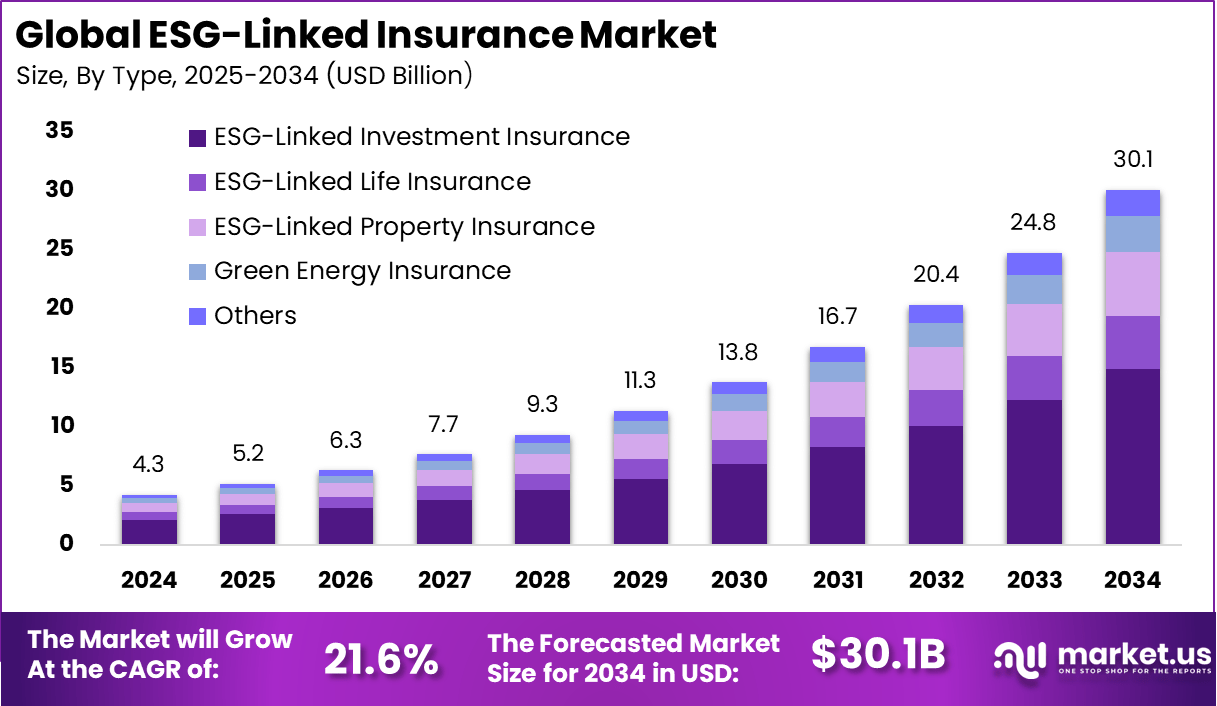
One of the main factors driving this market is the growing need to address climate related and sustainability linked risks more clearly in insurance decisions. Insurers are paying closer attention to how environmental exposure, governance standards, and responsible operating practices affect overall risk quality. Another important driver is the rising focus on prevention and resilience, as insurance models are increasingly being used to encourage better risk management and more sustainable business behavior.
Demand for ESG-Linked Insurance is increasing among businesses, asset owners, and institutions that want insurance solutions aligned with their sustainability priorities and risk improvement efforts. These buyers are looking for policies that not only provide financial protection but also support stronger resilience, better risk profiling, and closer alignment with internal ESG strategies. Demand is also rising because sustainability related risk management is becoming a more regular part of corporate decision making across many industries.
Keytake away
- ESG-Linked Investment Insurance led the market with a 49.6% share, reflecting strong interest in insurance products tied to sustainable investment performance and responsible portfolio strategies.
- Corporate ESG Compliance accounted for 37.2%, driven by rising regulatory expectations and the need for organizations to insure against ESG-related operational and disclosure risks.
The Direct Sales channel dominated with 72.3%, indicating that businesses prefer direct engagement with insurers for specialized, compliance-focused ESG products. - North America captured 45% of global demand, supported by advanced sustainability frameworks and strong adoption of ESG-aligned financial instruments.
- The U.S. market reached USD 1.73 billion in 2024, expanding at a robust 18.9% CAGR, reflecting increasing corporate commitments to sustainability and risk mitigation across ESG dimensions.
How AI is Reshaping the Future of this market?
AI is reshaping the future of the ESG-linked insurance market by making risk assessment more accurate and more dynamic. Instead of depending mainly on historical loss records and broad assumptions, insurers are increasingly using AI to evaluate environmental exposure, governance quality, operational resilience, and sustainability-related behavior in greater detail. This helps them design ESG-linked policies that are better aligned with the real risk profile of businesses and allows pricing, coverage terms, and incentives to reflect actual performance more effectively.
AI is also pushing the market toward a more preventive insurance model. It helps insurers detect early risk signals, monitor changes in exposure, and support clients with better risk management before losses happen. This is especially valuable in ESG-linked insurance, where businesses are looking for coverage that not only protects them financially but also encourages stronger environmental practices, better governance, and long-term resilience. As a result, the market is becoming more data-driven and more focused on measurable outcomes.
At the same time, AI is improving claims processing, fraud detection, and decision speed, which strengthens the overall value of ESG-linked insurance products. However, future growth will also depend on how responsibly insurers use AI, especially in areas such as transparency, fairness, and governance. Companies that combine strong AI capabilities with responsible oversight are expected to be better positioned as the ESG-linked insurance market continues to evolve.
Regional Analysis
In 2024, North America held a dominan Market position, capturing more than a 45% share, holding USD 1.9 Billion revenue. This leadership was mainly supported by the region’s mature insurance ecosystem, strong ESG integration across financial services, and early adoption of sustainability-linked underwriting models. Insurers in the US and Canada have been more active in aligning insurance offerings with climate risk assessment, corporate governance standards, and broader sustainability goals, which has created a favorable environment for ESG-linked insurance solutions.
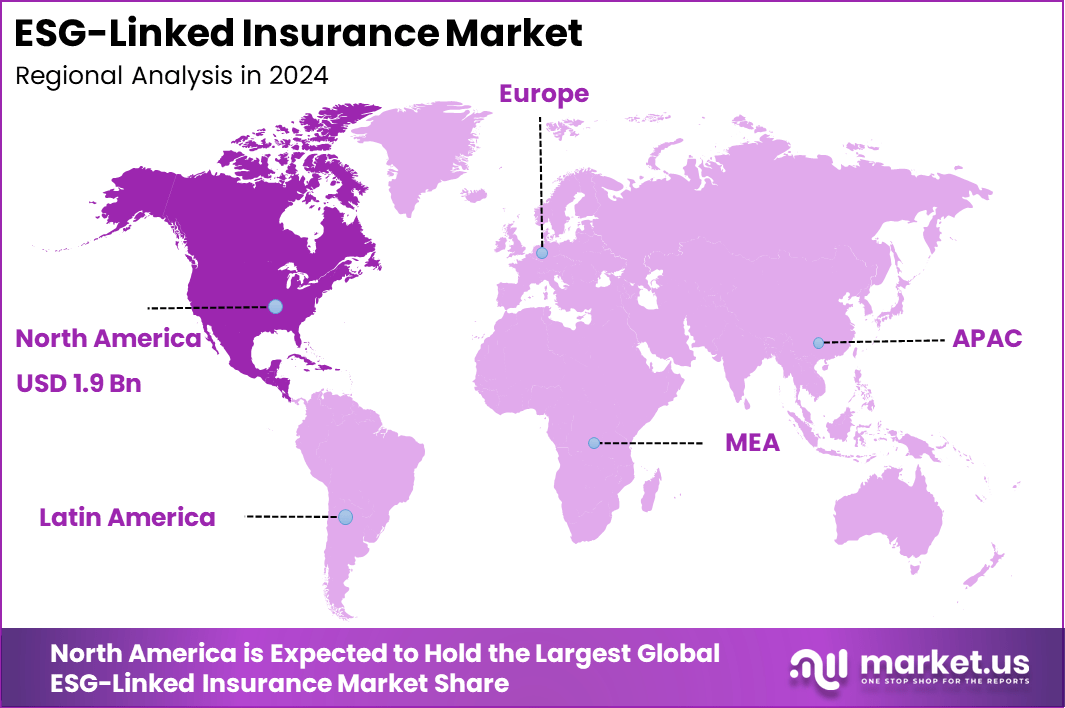
Another key reason behind North America’s dominance is the strong presence of large insurers, reinsurers, institutional investors, and technology-driven insurance platforms that are actively building products around risk transparency and responsible business practices. The region also benefits from growing enterprise demand for coverage solutions that reflect ESG performance, especially among companies facing pressure from investors, regulators, and customers to improve sustainability reporting and operational resilience. This has helped insurers in North America move faster in product design, pricing innovation, and risk evaluation linked to ESG factors.
North America also leads because of its advanced data infrastructure and wider use of analytics in underwriting and claims management. Insurers in the region are increasingly using climate data, governance metrics, and social risk indicators to better assess exposure and build more tailored insurance models. In addition, the market has seen stronger collaboration between insurers, brokers, and corporate clients in developing policies that reward better ESG practices. This combination of market maturity, innovation capacity, and strong demand has kept North America ahead of Europe, Latin America, and the Middle East and Africa in the ESG-linked insurance market.
Driver
Rising Regulatory Pressure and Climate Risk Awareness
Insurance companies are increasingly being guided by regulatory bodies to include environmental, social, and governance factors in their risk assessment and reporting practices. Governments and financial authorities are encouraging transparency around climate risks and sustainability exposure. This has pushed insurers to evaluate how environmental changes, such as natural disasters and climate variability, affect underwriting decisions and long-term financial stability.
This regulatory push is also influencing insurers to redesign their product offerings and investment strategies. ESG-linked insurance allows companies to align with sustainability goals while improving their risk management approach. It also helps build stronger trust with stakeholders, as policyholders and investors prefer companies that show responsibility toward environmental and social issues. As a result, ESG integration is becoming a core part of business strategy rather than an optional initiative.
Restraint
Lack of Standardization and Data Complexity
A major restraint in this market is the absence of standardized ESG frameworks and consistent measurement metrics. Different organizations use varied criteria to evaluate ESG performance, making it difficult for insurers to compare data or apply it uniformly in underwriting. This lack of alignment creates uncertainty and limits the ability to make accurate risk-based decisions.
Additionally, ESG data is often complex and involves qualitative factors such as governance practices and social responsibility. Collecting and interpreting this data requires specialized tools and expertise. Many insurers still face challenges in building strong data systems and integrating ESG insights into their operations, which slows down adoption and increases operational burden.
Opportunity
Development of Innovative Sustainable Insurance Products
The growing focus on sustainability is creating opportunities for insurers to introduce innovative ESG-linked products. Customers are increasingly interested in insurance solutions that support environmentally responsible practices. This includes coverage for renewable energy projects, green buildings, and businesses that follow sustainable operations. Such offerings are helping insurers tap into new and evolving market segments.
Insurers can also use ESG data to design more customized policies that reward responsible behavior. For example, companies with better environmental practices may receive favorable terms or incentives. This not only strengthens customer relationships but also encourages risk reduction. As awareness around sustainability continues to grow, demand for ESG-linked insurance products is expected to expand further.
Challenge
Complexity in ESG Risk Assessment and Integration
Evaluating ESG risks remains a significant challenge due to their dynamic and interconnected nature. Environmental, social, and governance risks often influence each other, making it difficult to assess their overall impact on insurance portfolios. Traditional risk models are not fully equipped to handle such complexities, leading to uncertainties in pricing and risk evaluation.
Integrating ESG considerations into core business functions requires major changes in systems, processes, and organizational structure. Insurers need to adopt advanced analytics tools and build internal expertise to manage ESG data effectively. This transformation involves time, investment, and strategic alignment across departments, which can be challenging for many companies, especially those at an early stage of ESG adoption.
Key Market Segment
By Component
- Platform
- Services
By Application
- Automotive
- Consumer Electronics
- Healthcare
- Industrial
- Energy & Utilities
- Transportation & Logistics
- Others
By Deployment Mode
- On-Premises
- Cloud
By Enterprise Size
- Small and Medium Enterprises
- Large Enterprises
By End-User
- Telecommunications
- Manufacturing
- Healthcare
- Automotive
- Others
Competetive Analysis
The competitive landscape of the ESG-Linked Insurance market includes global insurers and reinsurers that are expanding their focus on sustainability aligned coverage, risk assessment, and underwriting strategies. Allianz, AXA, Swiss Re, Munich Re, Zurich Insurance Group, Generali, Chubb, AIG, Liberty Mutual, and Hartford hold strong positions because they have broad insurance portfolios, global client reach, and growing experience in linking insurance solutions with environmental, social, and governance priorities. These companies compete by developing products that support climate risk management, responsible investment goals, and corporate sustainability commitments.
Other players such as Sompo, Tokio Marine, SCOR, Beazley, and RenaissanceRe add competition through specialized underwriting, reinsurance support, and risk advisory capabilities. The market is shaped by sustainability expertise, regulatory alignment, product innovation, and the ability to help clients manage emerging ESG related risks. Overall, competition remains strong as insurers work to improve responsible risk coverage and strengthen their position in a changing insurance environment.
Recent Development
- February, 2026 – Allianz launches green property insurance with 15% discounts for solar panels. Targets EU SMEs and links premiums to energy scores. Exits NZIA but keeps net-zero underwriting.
- January, 2026 – AXA rolls out ESG-linked motor for hybrid cars with telematics discounts. France EV drivers save 12% and climate risk pool grows 30%. Also exits NZIA amid US pressure.
Conclusion
The ESG-linked insurance market is expected to witness steady expansion as insurers align their products with sustainability goals and evolving regulatory expectations. Growing awareness among businesses and investors about environmental risks, social responsibility, and governance standards is driving demand for tailored insurance solutions that integrate ESG criteria. Insurers are increasingly embedding ESG frameworks into underwriting, risk assessment, and portfolio strategies to enhance long-term resilience and transparency. As climate-related risks intensify and disclosure requirements become more structured, the market is anticipated to strengthen further, supported by innovation in data analytics, collaboration with stakeholders, and the integration of sustainable finance principles across the insurance value chain.
Discuss your needs with our analyst
Please share your requirements with more details so our analyst can check if they can solve your problem(s)