Introduction
The Global Innovation Management Market generated USD 1.6 billion in 2024 and is predicted to register growth from USD 1.8 billion in 2025 to about USD 4.1 billion by 2034, recording a CAGR of 9.80% throughout the forecast span. In 2024, North America held a dominant market position, capturing more than a 9.8% share, holding USD 0.65 Billion revenue.
Innovation management is becoming a structured approach for organizations that want to continuously generate, evaluate, and implement new ideas. It involves using digital platforms and processes to capture ideas from employees, partners, and customers, and then turning those ideas into practical outcomes. Companies are no longer relying on informal methods for innovation, as competition and fast changing markets require a more organized system. These platforms help track ideas, measure impact, and align innovation efforts with business goals, making innovation a repeatable and manageable process.
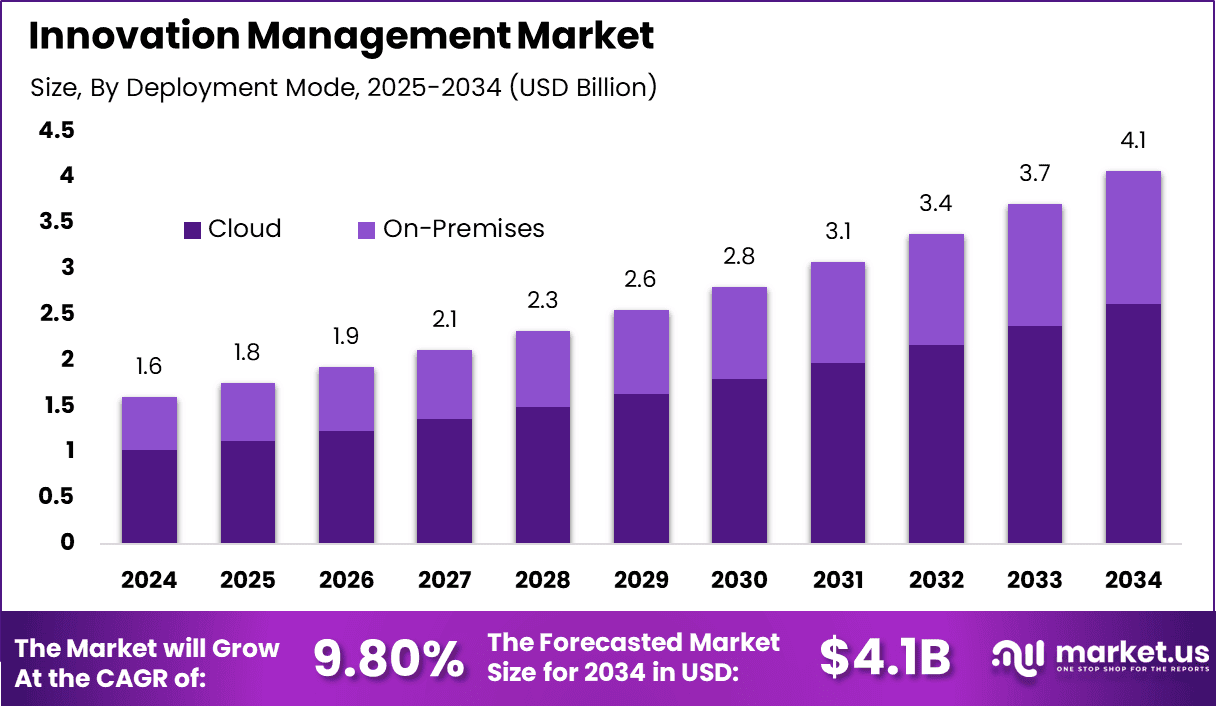
One of the key driving factors is the increasing pressure on organizations to stay competitive and adapt quickly to changing market conditions. Businesses are focusing on faster product development, improved services, and new business models, which requires a steady flow of ideas and structured evaluation. In addition, companies are encouraging collaboration across teams and departments, and innovation platforms make it easier to share and refine ideas at scale.
Demand for innovation management solutions is rising as organizations look for better visibility and control over their innovation processes. Companies are seeking tools that can manage large volumes of ideas, prioritize them based on impact, and track their progress through different stages. There is also a growing preference for platforms that integrate with existing business systems and provide clear insights into outcomes and performance.
Top Market Takeaways
- Software commands 64.2% market share, delivering collaborative ideation portals, roadmap visualization, and analytics-driven idea prioritization for enterprise innovation pipelines.
- Cloud deployment captures 60%, enabling real-time co-creation, cross-functional access, and scalable IP protection across global R&D teams without infrastructure costs.
- Product development functions hold 54.7%, powering agile prototyping cycles, customer co-innovation portals, and market validation workflows from concept to commercialization.
- Product research & development platforms claim 31.2%, facilitating digital twin simulation, design collaboration, and predictive success scoring for disruptive innovation projects.
- BFSI sector represents 27%, leveraging innovation platforms for fintech sandboxing, regtech development, and customer experience transformation initiatives.
- North America drives 41% global value, with U.S. market at USD 0.70 billion and 12.3% CAGR, fueled by venture capital ecosystems and Silicon Valley-BFSI convergence.
How AI is Reshaping the Future of this market?
Artificial Intelligence is reshaping the innovation management market by shifting it from experience-driven processes to data-driven and intelligence-led decision making. Traditionally, innovation depended on internal ideas and manual research, which often limited visibility into real market needs. AI enables organizations to analyze large volumes of customer data, market signals, and industry trends to identify innovation opportunities with higher precision. This allows companies to focus on ideas that are more aligned with demand, improving success rates and reducing the risk associated with new initiatives.
A key transformation is the acceleration of the ideation process. AI tools can quickly scan patterns, identify gaps, and suggest new concepts based on existing data and emerging trends. This helps innovation teams generate ideas faster and explore possibilities that may not be obvious through conventional methods. Rather than replacing human creativity, AI enhances it by providing data-backed insights, allowing teams to make more informed and strategic decisions during early-stage innovation.
AI is also improving how organizations evaluate and prioritize innovation projects. Through predictive analytics, businesses can assess the potential success of ideas by analyzing feasibility, market relevance, and expected outcomes. This leads to better resource allocation and ensures that time and investment are directed toward high-impact initiatives. As a result, companies are able to reduce inefficiencies and bring products or solutions to market more effectively.
Regional Analysis
In 2024, North America held a dominant Market position, capturing more than a 41% share, holding USD 0.65 Billion revenue. This leadership is mainly driven by the strong culture of innovation and early adoption of structured innovation management platforms across enterprises. Organizations in the US and Canada actively focus on continuous product development, digital transformation, and internal idea generation programs, which creates sustained demand for innovation management solutions.
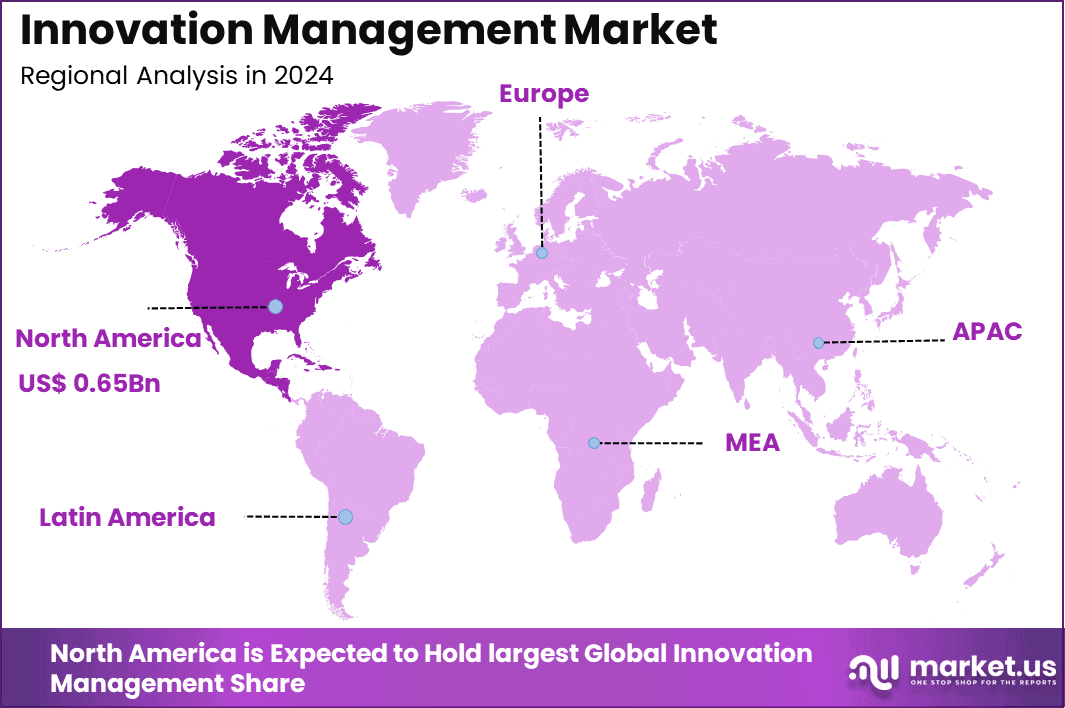
The presence of advanced digital infrastructure and widespread use of cloud-based tools further supports seamless integration of these platforms into enterprise workflows. Another key factor supporting North America’s dominance is the high concentration of large enterprises and technology-driven organizations that prioritize research, collaboration, and strategic innovation.
Europe is expected to witness steady growth in the innovation management market, supported by increasing emphasis on sustainability, digital transformation, and collaborative innovation. Organizations across countries such as Germany, the UK, and France are focusing on structured innovation processes to enhance competitiveness and comply with evolving industry standards. Government-backed innovation programs and funding initiatives are also encouraging enterprises to adopt innovation management platforms.
The Asia Pacific region is projected to grow at a significant pace due to rapid industrialization and increasing focus on digital transformation across emerging economies. Countries such as China, India, and Japan are investing in smart technologies, research activities, and startup ecosystems, which are driving the demand for innovation management solutions. Enterprises in the region are increasingly adopting these platforms to streamline idea generation and accelerate product development cycles.
Driver
The growing need for continuous innovation across industries is a key driver for the innovation management market. Organizations are under constant pressure to develop new products, improve services, and stay competitive in changing market conditions. This is pushing companies to adopt structured approaches that help capture ideas, evaluate them, and bring them to execution in a systematic way.
At the same time, businesses are focusing more on collaboration and knowledge sharing within teams. Innovation management platforms support this by connecting employees, partners, and stakeholders, allowing ideas to flow more freely and improving decision making. This is increasing the demand for organized innovation processes.
Restraint
One of the main restraints is resistance to change within organizations. Many companies still rely on traditional methods and may hesitate to adopt new systems for managing innovation. This slows down implementation and reduces the effectiveness of innovation programs.
Another challenge is the difficulty in measuring the direct value of innovation initiatives. Organizations often struggle to link innovation efforts with clear outcomes, which makes it harder to justify investments and maintain long term commitment.
Opportunity
The increasing adoption of digital tools and cloud-based platforms is creating strong opportunities in the innovation management market. These solutions make it easier for organizations to collect, track, and analyze ideas across different teams and locations, improving overall efficiency.
In addition, the rise of open innovation models is expanding the scope of innovation management. Companies are now engaging external stakeholders such as customers, startups, and research communities, which creates new pathways for idea generation and accelerates innovation cycles.
Challenge
A key challenge in this market is managing a large volume of ideas and selecting the most valuable ones. Organizations often receive many inputs, but filtering and prioritizing them effectively requires strong evaluation frameworks and governance processes.
Another challenge is ensuring employee engagement in innovation programs. Without active participation, even well designed systems may fail to deliver results. Maintaining motivation and aligning innovation efforts with business goals remains a critical concern for organizations.
Key Market Segment
By Component
- Software
- Services
By Deployment
- Cloud
- On-premises
By Function
- Product Development
- Business Process
By Application
- Product Research & Development Platforms
- Marketing
- Design & Idea Platforms
- Collective Intelligence & Prediction Platforms
- Human Resources & Freelance Platforms
By End User
- BFSI
- Healthcare
- Education
- Media & Entertainment
- IT & Telecommunication
- Retail
- Government
- Others
Competetive Analysis
The Innovation Management Market is led by global consulting firms that support strategy development and digital transformation initiatives. Accenture, Boston Consulting Group, Deloitte Touche Tohmatsu Limited, and KPMG International Limited provide innovation frameworks and advisory services. These firms help organizations manage ideation and execution processes. Their expertise supports business model transformation. This strengthens enterprise innovation capabilities across industries.
Technology and platform providers play a key role in enabling structured innovation workflows. Salesforce, Inc. and SAP SE deliver integrated platforms for collaboration and innovation tracking. Miro supports visual ideation and team collaboration. Qmarkets provides dedicated innovation management solutions. These platforms improve idea generation and evaluation. This enhances decision-making efficiency.
Specialized solution providers contribute to intellectual property management and innovation analytics. Questel and Sopheon Corporation offer tools for portfolio management and product development. These companies focus on data-driven innovation strategies. Their solutions support long-term planning and risk assessment. Increasing demand for structured innovation processes is driving adoption. This competitive landscape continues to evolve with technological advancements.
Top Key Players in the Market
- Accenture
- Boston Consulting Group
- Deloitte Touche Tohmatsu Limited
- KPMG International Limited
- Miro
- Qmarkets
- Questel
- Salesforce, Inc.
- SAP SE
- Sopheon Corporation
Recent Development
January, 2026 – Salesforce IdeaExchange evolved into Agentforce for innovation workflows. AI agents triage 10,000 monthly submissions and predict commercial viability 85% accurately. B2B teams launched 300 products from crowdsourced ideas.
February, 2026 – SAP Innovation Management within Signavio suite added generative AI for concept prototyping. ERP-integrated pipelines validate against supply chain constraints. Manufacturers accelerated NPD cycles 40%.
March, 2026 – Miro AI whiteboarding expanded to collaborative innovation boards. Teams co-create 1,000 canvases daily with real-time clustering. Design firms cut ideation meetings 50%.
Conclusion
The innovation management market is expected to grow steadily as organizations focus on building structured processes to generate, manage, and implement new ideas. Companies are increasingly looking for ways to stay competitive by encouraging collaboration, improving product development, and responding quickly to changing customer needs.
The use of digital platforms and data-driven tools is helping businesses track ideas, measure outcomes, and improve decision making. At the same time, challenges such as resistance to change and difficulty in aligning innovation with business goals are pushing organizations to adopt more flexible and integrated approaches. Overall, the market outlook remains strong, supported by the continuous need for creativity, efficiency, and long-term business growth.
Discuss your needs with our analyst
Please share your requirements with more details so our analyst can check if they can solve your problem(s)