Introduction
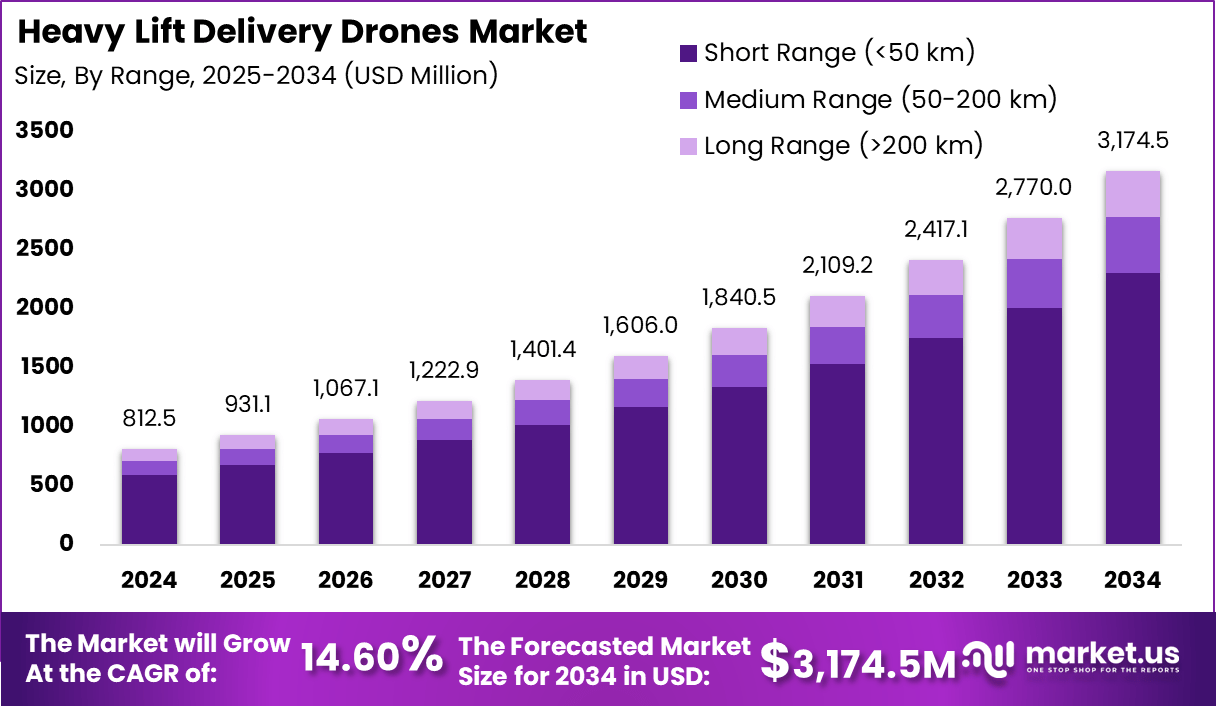
The Global Heavy Lift Delivery Drones Market generated USD 812.5 million in 2024 and is predicted to register growth from USD 931.1 million in 2025 to about USD 3,174.5 million by 2034, recording a CAGR of 14.60% throughout the forecast span. In 2024, North America held a dominan market position, capturing more than a 38.5% share, holding USD 312.81 Million revenue.
Heavy lift delivery drones are emerging as a new solution for transporting large and heavy payloads over short to medium distances without relying on traditional ground logistics. These drones are designed with higher payload capacity and stronger propulsion systems, allowing them to carry goods such as industrial equipment, medical supplies, and bulk materials.
They are being explored across sectors such as logistics, construction, defense, and emergency response where timely delivery is critical and access can be challenging. As industries look for faster and more flexible transport options, heavy lift drones are gaining attention as a practical alternative in specific use cases.
One of the key driving factors is the need to improve delivery efficiency in areas where ground transportation is slow or limited. Remote locations, disaster zones, and congested urban environments create challenges for traditional logistics, and drones provide a direct route with fewer delays.
In addition, industries are focusing on reducing operational costs and improving turnaround time, which is encouraging the use of automated delivery systems. Advancements in battery technology, propulsion systems, and navigation software are also supporting the development of drones capable of carrying heavier loads safely. The growing interest in unmanned systems for defense and emergency operations is further contributing to adoption.
Demand for heavy lift delivery drones is increasing as organizations seek reliable and flexible transport solutions for specialized operations. There is a strong preference for drones that can handle higher payloads, operate over longer distances, and maintain stability under different environmental conditions.
Companies are also looking for systems that can be integrated into existing logistics workflows and provide real time tracking of deliveries. The demand is particularly strong in industries that require quick movement of goods to hard to reach areas, where traditional methods are less efficient. As technology continues to improve and regulatory frameworks evolve, the use of heavy lift delivery drones is expected to expand steadily across multiple sectors.
Top Market takeaway
- Up to 10 kg payload capacity commands 38.7% market share, enabling efficient transport of small parcels, medical supplies, and grocery orders without excessive battery drain.
- Short range (<50 km) captures 52.6%, powering suburban distribution hubs, campus deliveries, and rural medical logistics with frequent return-to-base operations.
- E-commerce & retail applications claim 51.7%, facilitating same-hour fulfillment, reverse logistics, and high-density urban drop-offs beyond traditional vehicle reach.
- Logistics companies hold 72.6%, leveraging heavy lift drones for B2B palletization, warehouse-to-warehouse bridging, and peak-season surge capacity.
- North America drives 38.5% global value, with U.S. market at USD 281.5 million and 12.9% CAGR, fueled by FAA beyond-visual-line-of-sight approvals and Amazon/Walmart pilots.
How AI is Reshaping the Future of this market?
AI is reshaping the Heavy Lift Delivery Drones Market by improving how these drones plan, fly, and complete complex delivery missions. Heavy lift drones operate under stricter load, range, and safety requirements than small commercial drones, so AI is becoming important for route optimization, payload balancing, energy management, and obstacle avoidance. It also helps drones adjust to changing weather, airspace conditions, and landing environments in real time. This makes operations more reliable, especially for time-sensitive deliveries in logistics, healthcare supply transport, industrial sites, offshore locations, and remote regions.
AI is also pushing the market toward higher autonomy and better fleet efficiency. In the future, heavy lift delivery drones are expected to rely more on AI for automated dispatching, predictive maintenance, traffic coordination, and real-time risk assessment. This is helping operators reduce delays, improve asset use, and lower the need for constant human control. As delivery networks become larger and more complex, AI is expected to play a central role in making heavy lift drone systems safer, more scalable, and more commercially practical across both civilian and industrial applications.
Regional Analysis
In 2024, North America held a dominant market position, capturing more than a 38.5% share, holding USD 312.81 Billion revenue. This regional lead was mainly supported by strong investment in advanced drone platforms for cargo transport, defense logistics, emergency response, and industrial supply missions. The region has a strong base of aerospace innovation, high-value drone manufacturing, and early testing of beyond-visual-line-of-sight operations, which has helped heavy lift delivery drones move from pilot projects into more practical deployment environments. Demand has also remained strong because organizations across the US and Canada are looking for faster and more flexible ways to move heavy payloads to remote, congested, or hard-to-reach locations.
Another major reason North America leads is the presence of a well-developed ecosystem that connects drone hardware developers, software providers, aviation authorities, logistics operators, and defense agencies. This creates a more favorable environment for testing, certification, and commercial adoption of heavy lift drone systems. Use cases such as military resupply, offshore delivery, infrastructure support, disaster relief, medical logistics, and industrial transport have expanded the commercial value of these drones. The region also benefits from strong demand for automation in logistics and supply chains, where heavy lift drone solutions are increasingly seen as a practical option for reducing transport delays, labor dependence, and operational risk.
Europe is developing as a steady market, supported by growing interest in sustainable cargo transport, industrial automation, and drone-based logistics for infrastructure and remote delivery applications. Regulatory progress and public-private trials are helping the region build a structured path for commercial deployment, especially in healthcare, energy, and cross-border logistics use cases.
Latin America is emerging gradually, with demand linked to mining operations, oil and gas support, agricultural logistics, and delivery access in geographically challenging areas, although adoption remains uneven due to infrastructure and regulatory limitations. The Middle East and Africa are also gaining attention, particularly in energy logistics, defense support, humanitarian delivery, and transport across remote desert and off-grid locations. Growth in these regions is supported by the need for alternative transport solutions, but wider commercialization is still shaped by investment capacity, airspace regulation, and local operating readiness.
Driver
A key driver in the Heavy Lift Delivery Drones Market is the growing need for faster cargo movement in areas where ground transport is slow, costly, or difficult. These drones are becoming useful for moving goods across remote locations, industrial sites, hilly terrain, offshore zones, and areas with weak transport access. Their ability to follow direct routes helps reduce delivery time and supports faster supply movement for urgent operations. This makes them attractive for industries that depend on timely material transfer.
Another reason this driver is strengthening is the growing pressure on logistics systems to become more flexible and responsive. Heavy lift drones can support delivery of tools, spare parts, medical supplies, and operational materials without depending fully on roads or large transport vehicles. This improves supply continuity in locations where conventional delivery methods face delays. As a result, end users are showing greater interest in drone based cargo systems for specialized logistics tasks.
Restraint
A major restraint in this market is the strict regulatory environment surrounding large drone operations. Heavy lift drones carry more weight and often need to operate over longer routes, which creates greater safety concerns than smaller drones. Because of this, operators may need approvals, route permissions, trained personnel, and strong compliance procedures before starting regular services. These requirements can slow market entry and limit expansion into new areas.
Another restraint is the high level of operational planning needed before each mission. Heavy lift delivery flights must consider airspace rules, landing safety, payload security, and local use restrictions. In many cases, these conditions make deployment more complex than expected, especially for organizations with limited drone experience. This can cause hesitation among potential users who may still rely on traditional transport systems that are already established in their operations.
Opportunity
A strong opportunity in this market lies in serving industries that need dependable cargo delivery in remote or hard to reach locations. Heavy lift drones can support movement of essential goods for healthcare, mining, energy, disaster response, construction, and defense related activities. These sectors often work in places where transport gaps create delays or high operating costs. This gives drone delivery a clear role in improving supply access and field support.
There is also a major opportunity in developing regular route based delivery networks instead of using drones only for occasional transport. As systems improve, heavy lift drones can become part of scheduled logistics operations for repeated cargo movement between facilities, field bases, and support centers. This can help reduce reliance on slower delivery channels and improve planning efficiency. Over time, this shift can create stronger commercial value for drone cargo services.
Challenge
One key challenge in this market is maintaining stable and reliable performance while carrying heavy payloads in real operating environments. These drones must perform safely in changing weather, uneven terrain, cross winds, limited landing space, and long distance routes. Small changes in operating conditions can affect balance, flight control, battery use, and overall mission safety. This makes consistent performance harder to achieve across different use cases.
Another challenge is building trust in the complete delivery process. Users need confidence not only in the drone itself, but also in route management, cargo handling, communication systems, and safety response procedures. If any part of the system appears weak, users may hesitate to depend on drone delivery for important cargo movement. The market therefore faces the challenge of proving that heavy lift drones can operate as a reliable part of everyday logistics rather than only as a limited trial solution.
Key Market Segment
By Payload Capacity
- Up to 10 kg
- 10-50 kg
- 50-100 kg
- 100+ kg
By Range
- Short Range (<50 km)
- Medium Range (50-200 km)
- Long Range (>200 km)
By Application
- E-commerce & Retail
- Healthcare & Medical Supply
- Industrial Supply
- Food Delivery
- Others
By End-User
- Logistics Companies
- Healthcare
- Retail
- Defense
- Others
Competetive Analysis
The competitive landscape of the Heavy Lift Delivery Drones Market includes a mix of aerospace companies, logistics providers, and drone technology firms. Companies such as Airbus, Boeing, Lockheed Martin, and Kaman focus on developing large-scale drone systems with high payload capacity and long-range capabilities.
These players use their strong expertise in aviation engineering to build reliable and safe delivery platforms for cargo transport. At the same time, logistics-driven companies like Amazon Prime Air and UPS Flight Forward work on integrating heavy lift drones into delivery networks, aiming to improve speed and efficiency in last-mile and mid-mile logistics operations.
In addition, drone-focused companies such as Zipline, Wing (Alphabet), EHang, Volocopter, Matternet, Swoop Aero, Elroy Air, and Dronamics are developing specialized solutions for medical supply delivery, urban air mobility, and cargo transport. These companies focus on autonomous flight, route optimization, and regulatory compliance to expand commercial use cases. DJI also plays a role by offering advanced drone technologies that support industrial applications. Competition in this market is driven by innovation in payload capacity, flight range, and automation, as companies aim to deliver reliable and scalable aerial delivery solutions.
Top Key Players in Market
- Zipline
- Wing (Alphabet)
- DJI
- EHang
- Volocopter
- Matternet
- Airbus
- Boeing
- Amazon Prime Air
- UPS Flight Forward
- Kaman
- Lockheed Martin
- Swoop Aero
- Elroy Air
- Dronamics
- Others
Recent Development
- March, 2026 – Zipline raises $200M more for Series H totaling $800M to expand Houston, Phoenix, Seattle in 2026. Platform 2 drones carry 8lbs within 10-mile radius hovering at 300ft for tethered delivery. Passes 2M total deliveries with 15% weekly US growth and 125M autonomous miles flown.
- April, 2026 – Wing autonomous drones deliver up to 5lbs groceries/meals to Bay Area homes in under 30 minutes. Expands from Australia pilots to dense US suburbs with FAA Part 135 certification. Alphabet X lab backs dense urban BVLOS operations using millimeter-wave radar avoidance.
- January, 2026 – Boeing MQ-25 Stingray adapts for 3,000lb ISR/cargo missions with aerial refueling. Navy unmanned tanker gains logistics role and 500nm combat radius. Military-to-commercial transition.
Conclusion
The Heavy Lift Delivery Drones Market is expected to grow steadily as industries look for faster and more flexible ways to transport heavy goods over short and medium distances. These drones are becoming more important in logistics, construction, defense, healthcare, and emergency response, where quick delivery in difficult or remote locations is often necessary.
Market growth is mainly supported by improvements in payload capacity, battery systems, navigation technology, and autonomous flight control. Demand is also rising because businesses want to reduce delivery time, lower labor dependency, and improve access to areas where traditional transport is slow or costly. Although the market still faces challenges such as airspace regulations, safety concerns, limited battery endurance, and high development costs, the overall outlook remains positive as technology continues to improve and commercial use expands.
Discuss your needs with our analyst
Please share your requirements with more details so our analyst can check if they can solve your problem(s)