Introduction
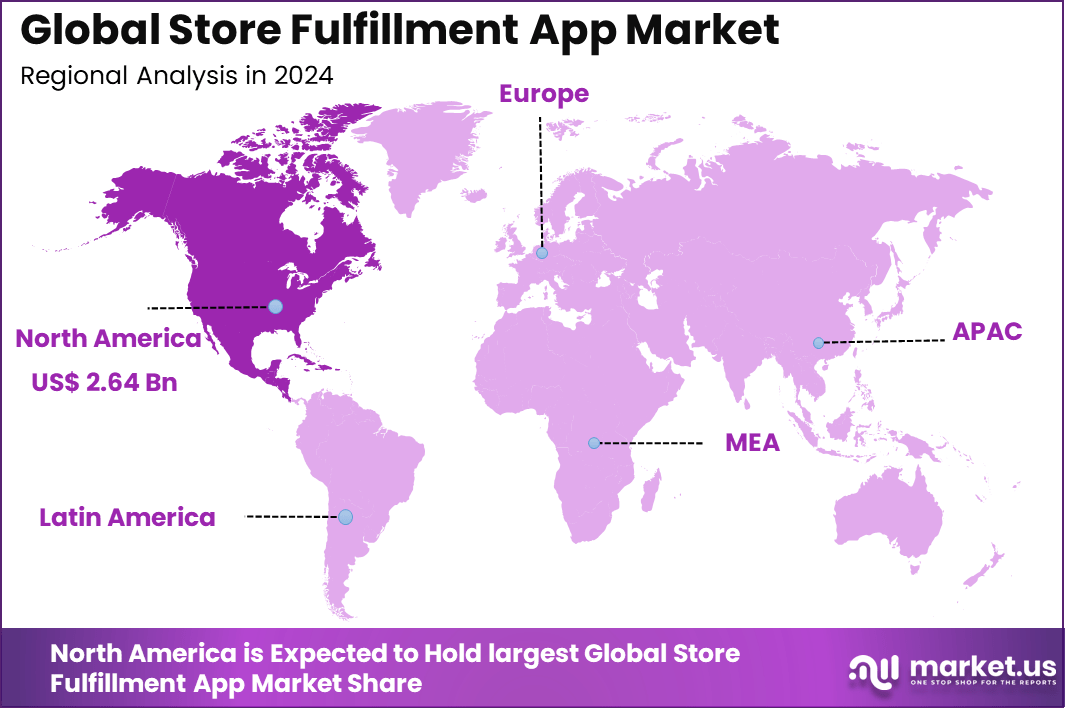
The Global Store Fulfillment App Market generated USD 6.7 billion in 2024 and is predicted to register growth from USD 7.9 billion in 2025 to about USD 35.2 billion by 2034, recording a CAGR of 18% throughout the forecast span. In 2024, North America held a dominan market position, capturing more than a 39.4% share, holding USD 2.64 Billion revenue.
Store fulfillment apps are becoming an important tool for retailers managing online and in store order operations. These applications help store staff pick, pack, stage, and hand over customer orders directly from retail locations. They connect inventory, order management, and staff workflows in one system, allowing stores to function as local fulfillment centers. As retail shifts toward faster and more flexible delivery models, these apps are helping businesses improve order accuracy and shorten fulfillment time.
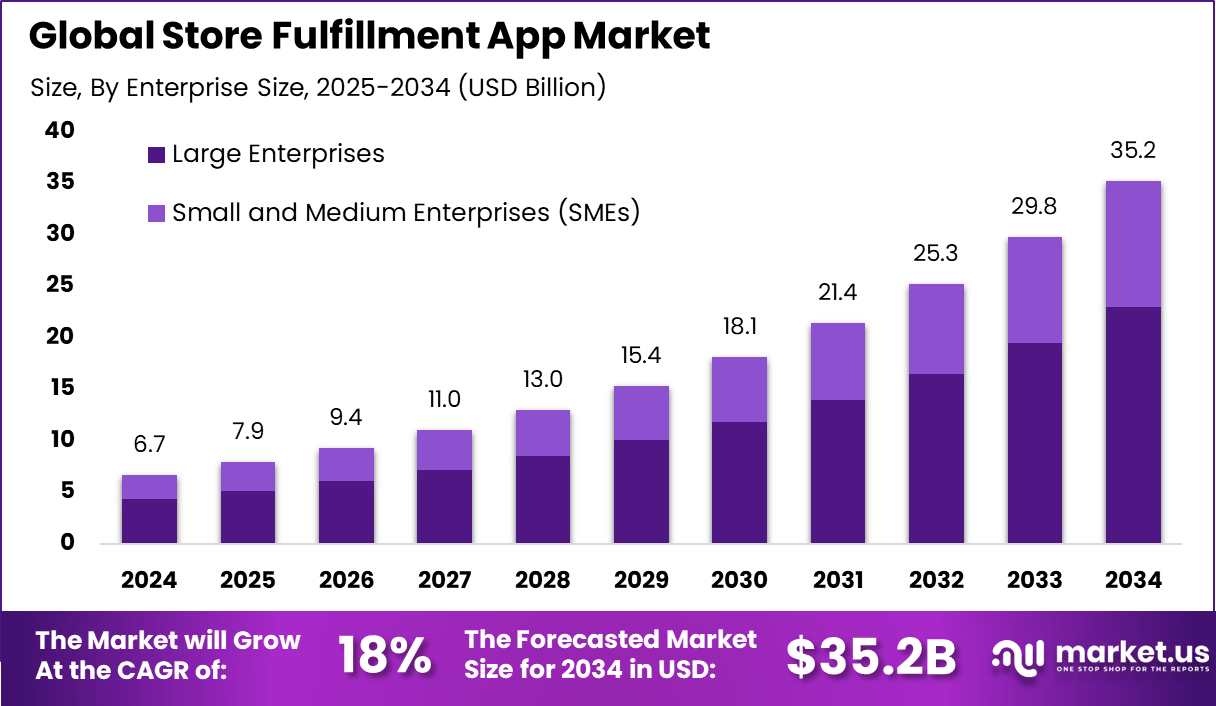
One of the main driving factors is the rapid growth of omnichannel retailing, where customers expect to buy online and receive products through pickup, same day delivery, or ship from store options. Retailers are under pressure to use existing store networks more efficiently, and fulfillment apps help turn physical locations into active distribution points.
In addition, rising customer expectations for real time order updates and quick service are encouraging adoption of mobile workflow tools for store teams. Labor efficiency is also a major factor, as retailers seek systems that can guide staff tasks, reduce errors, and improve productivity during peak demand periods.
Demand for store fulfillment apps is increasing as retailers look for scalable solutions that improve both customer experience and operational control. There is a strong preference for apps that provide real time inventory visibility, barcode scanning, task prioritization, and smooth integration with ecommerce and point of sale systems.
Businesses are also seeking mobile friendly tools that are easy for store staff to learn and use. The demand is particularly strong among grocery, apparel, electronics, and general merchandise retailers managing high order volumes. As fulfillment speed becomes a key competitive advantage, the need for efficient and reliable store fulfillment applications is expected to grow steadily.
Top Key Market Segment
- Order fulfillment services command 40.1%, streamlining picking, packing, shipping, and returns with real-time inventory synchronization across store and warehouse networks.
- Large enterprises hold 65.4% by size, leveraging scalable platforms for multi-location coordination, EDI integration, and automated compliance labeling.
- B2B sales channels capture 58.4%, enabling wholesale order processing, scheduled deliveries, and bulk purchase order management for retailer replenishment.
- Retail applications lead at 28.4%, powering in-store pickup, ship-from-store, and same-day delivery through mobile-first associate tools.
- North America drives 39.4% global value, with U.S. market at USD 2.25 billion and 15.3% CAGR, fueled by big-box retailer adoption and logistics automation.
How AI is Reshaping the Future of this market?
AI is reshaping the future of the store fulfillment app market by making store based order processing faster, more accurate, and more adaptive to real time demand. These apps were mainly used to manage picking, packing, pickup, and delivery workflows, but AI is helping them move into smarter decision making. It can identify the best store to fulfill an order, improve pick paths inside the store, reduce out of stock issues, and support better substitution choices when items are unavailable. This helps retailers handle high order volumes more efficiently while reducing delays and fulfillment errors.
AI is also improving labor use and customer service in this market. Store fulfillment apps can use AI to predict order peaks, assign tasks based on store workload, and improve delivery or pickup time estimates. This is important as retailers try to balance speed, cost control, and customer satisfaction across both online and physical channels.
In the future, AI is expected to make these apps more predictive and automated, allowing them to recommend actions before problems happen. As omnichannel retail becomes more complex, store fulfillment solutions with stronger AI driven forecasting, orchestration, and real time execution support are expected to gain stronger demand.
Regional Analysis
In 2024, North America held a dominant market position, capturing more than a 39.4% share, holding USD 2.64 Billion revenue. The region led the Store Fulfillment App market because retailers across the US and Canada have been faster in adopting digital tools that support omnichannel operations. Many retail chains in North America already run large store networks, advanced e-commerce platforms, and integrated supply chain systems, which makes the use of store fulfillment apps more practical and scalable. These apps help retailers manage buy online pick up in store, curbside pickup, ship from store, real-time inventory tracking, and store-level order routing, all of which are now important for improving delivery speed and customer convenience.
Another major reason for North America’s lead is the strong focus on operational efficiency and customer service. Retailers in the region are under pressure to reduce fulfillment delays, lower last-mile costs, and make better use of store inventory. Store fulfillment apps support these goals by turning physical stores into active fulfillment points rather than only sales locations. This is especially useful in a retail environment where same-day and next-day delivery expectations are rising. In addition, the region benefits from strong investment in cloud systems, mobile workforce tools, and retail automation, which supports faster deployment of fulfillment applications across both large enterprises and mid-sized chains.
Europe followed with stable growth, supported by established retail networks, growing click-and-collect demand, and increased investment in digital commerce infrastructure. However, market expansion across Europe remained somewhat uneven due to differences in retail formats, labor structures, and country-level technology adoption.
Latin America showed emerging potential as retailers in key urban markets continued modernizing store operations, though budget limitations and uneven logistics capabilities slowed wider implementation. The Middle East and Africa also presented long-term opportunities, driven by retail expansion, rising smartphone-led shopping behavior, and ongoing investment in modern commerce systems, but the market remained at an earlier stage of development. Overall, North America stayed ahead because it combined stronger digital retail maturity, better fulfillment infrastructure, and faster adoption of store-based order management tools than other regions.
Driver
A major driver in the Store Fulfillment App Market is the growing need for faster and more accurate order handling across retail channels. Retailers are under pressure to fulfill online orders, in-store pickup requests, and same day delivery expectations without creating delays at the store level. Store fulfillment apps help staff manage picking, packing, inventory checks, and order routing in a more organized way.
This matters because stores are no longer used only for walk-in sales. They are now part of the broader fulfillment network. As retailers try to use existing store locations to serve digital demand, they need tools that improve coordination, reduce manual work, and support a smoother flow of orders from shelf to customer.
Restraint
A key restraint in this market is the difficulty of integrating store fulfillment apps with older retail systems. Many retailers still depend on separate platforms for inventory, point of sale, warehouse operations, and order management. When these systems do not connect well, the fulfillment app may not provide real time visibility or consistent workflows.
This creates delays in adoption and limits the full value of the software. Store staff may also face confusion when they need to switch between systems or correct data manually. For many retailers, the challenge is not only buying the app but also making sure it works properly within a complex and sometimes outdated technology environment.
Opportunity
A strong opportunity in the Store Fulfillment App Market lies in the rising demand for omnichannel retail operations. Consumers now expect flexible buying options such as buy online pick up in store, curbside collection, local delivery, and easy returns. This shift is creating room for solutions that help stores manage multiple fulfillment tasks from one platform.
There is also growing opportunity in mid-sized and regional retail chains that want to improve store productivity without investing heavily in new physical infrastructure. A store fulfillment app can help these businesses use their existing locations more effectively, improve customer service, and respond faster to changing buying patterns.
Challenge
One major challenge in this market is managing real time inventory accuracy at the store level. A fulfillment app can only perform well when product availability is correct and updated across channels. In many retail environments, stock differences happen because of shrinkage, delayed updates, misplaced items, or gaps between store and online inventory records.
This challenge becomes more serious during peak sales periods or promotional events, when order volumes increase and inventory moves quickly. If the system shows an item as available when it is not actually on the shelf, retailers face canceled orders, customer dissatisfaction, and added pressure on store employees. As a result, maintaining clean and reliable inventory data remains a core challenge for effective store fulfillment.
Key Market Segment
By Type of Service
- Order Fulfillment Services
- Warehousing and Storage Fulfillment Services
- Bundling Fulfillment Services
- Shipping Fulfillment Services
- Others
By Enterprise Size
- Large Enterprises
- Small and Medium Enterprises (SMEs)
By Sales Channel
- Business-to-Business (B2B)
- Business-to-Customer (B2C)
By Application
- Retail
- Telecom
- Pharmaceuticals and Healthcare
- Manufacturing
- Consumer electronics
- Automotive
- Beauty & Personal Care
- Books & Stationery
- Clothing & Footwear
- Home & Kitchen
- Sports & Leisure
- Other
Competetive Analysis
The competitive landscape of the Store Fulfillment App Market is driven by a mix of enterprise supply chain software providers and retail commerce technology companies. Companies such as Manhattan Associates, Oracle Corporation, SAP SE, IBM Corporation, Blue Yonder, and Infor focus on advanced fulfillment platforms that support order management, inventory visibility, and omnichannel retail operations. These players serve large retailers with scalable solutions that improve store-based picking, ship-from-store, and click-and-collect services. Their strong enterprise presence and broad software capabilities help them maintain a leading position in the market.
At the same time, companies such as Zebra Technologies, Softeon, Kibo Commerce, Radial Inc., Tecsys, Epicor Software Corporation, HighJump (Körber), Salesforce Commerce Cloud, Shopify, SPS Commerce, Descartes Systems Group, JDA Software, Vinculum Group, and Deposco compete by offering flexible fulfillment applications tailored to different retail sizes and business models. These players focus on real-time inventory updates, faster deployment, and easy integration with e-commerce and warehouse systems. Competition in this market is driven by speed of fulfillment, automation, and the ability to deliver seamless omnichannel customer experiences.
Top Key Players
- Manhattan Associates
- Oracle Corporation
- SAP SE
- IBM Corporation
- Zebra Technologies
- Softeon
- Blue Yonder
- Kibo Commerce
- Radial Inc.
- Infor
- Tecsys
- Epicor Software Corporation
- HighJump (Körber)
- Salesforce Commerce Cloud
- Shopify
- SPS Commerce
- Descartes Systems Group
- JDA Software
- Vinculum Group
- Deposco
- Others
Recent Development
- April, 2026 – Manhattan Active Omni adds AI store labor optimization scheduling pickers by skill. Voice-directed picking boosts accuracy 99% while ship-from-store cuts costs 25%. Enterprise OMS leader.
- March, 2026 – Oracle Retail Xstore fulfillment routes orders across 10K stores using ML demand sensing. Clienteling connects associates to online carts while curbside optimizes parking slots. Cloud retail giant.
Conclusion
The store fulfillment app market is expected to grow steadily as retailers continue to improve order processing, inventory visibility, and delivery speed across both online and offline channels. These apps are becoming important for managing buy online pick up in store, curbside pickup, same day delivery, and in store inventory coordination with better accuracy and less manual work. Demand is being supported by the shift toward omnichannel retail, rising customer expectations for fast and flexible fulfillment, and the need for store staff to handle orders more efficiently. As retailers focus more on real time stock tracking, labor productivity, and customer satisfaction, store fulfillment apps are anticipated to play a larger role in daily retail operations.
Discuss your needs with our analyst
Please share your requirements with more details so our analyst can check if they can solve your problem(s)