
Market Overview
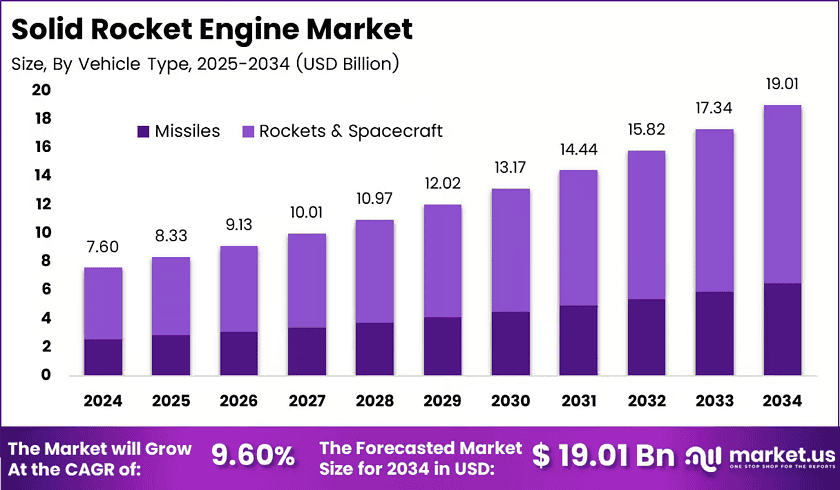
New York, NY – August 31, 2026 – The Global Solid Rocket Engine Market reached USD 7.6 billion in 2024. Analysts expect a 9.6% CAGR from 2025 to 2034, lifting revenue to USD 19.01 billion. Rising missile orders drive this climb because defense buyers need dependable propulsion for interceptors and strike weapons. North America led the market in 2024 with more than 40.3% share and about USD 3.06 billion in revenue.
The U.S. Department of Defense requested USD 167.5 billion for procurement and USD 143.2 billion for research and testing in FY2025. Military and defense applications alone received USD 28.4 billion. Therefore, motor makers see firm demand across interceptors, tactical missiles, and strategic systems.
The same request added USD 35.7 billion for missile and munitions buying and development. The U.S. Army funded 5,974 rockets with USD 1.168 billion in base FY2026 money. Additionally, these orders create repeat demand for motor cases, propellants, nozzles, and igniters.
NATO reported that European Allies and Canada raised defense spending by nearly 20% during 2025, adding over USD 90 billion. This lift widens export demand for American missile-defense systems. Moreover, Northrop Grumman signed framework deals above USD 3 billion for PAC-3 MSE motor output.
Key Takeaways
- The market stood at USD 7.6 billion in 2024 and should reach USD 19.01 billion by 2034 at a 9.6% CAGR.
- Ballistic missiles held a 34.2% share, supported by intercontinental and submarine-launched missile development.
- Missiles led by vehicle type with a 67.5% share, helped by propulsion advances and government defense investment.
- Military and defense applications dominated with a 72.4% share in 2024, driven by missile modernization programs.
- North America held the top regional position at USD 3.06 billion in 2024, backed by NASA and private missions.
- The U.S. market should grow from USD 2.67 billion in 2024 to USD 5.35 billion by 2034 at a 7.2% CAGR.
➤ Download the Detailed Sample Report with TOC, Tables, and Visual Figures – https://market.us/report/data-center-busways-market/request-sample/
Market Segmentation
By Application
Ballistic missiles held 34.2% of revenue in 2024. Long-range and intercontinental programs across major defense economies explain this lead. Space launch vehicles followed with 27.8%, supported by frequent satellite missions. Therefore, defense and space buyers together keep motor factories well utilized.
Tactical missiles contributed 22.8%, helped by rapid-response strategies and precision-guided weapons. Orbital maneuvering and satellite propulsion took 9.5%, reflecting orbit-shifting needs. Other uses, including experimental propulsion, held 5.7%. Consequently, suppliers widen product families to serve smaller, emerging mission types.
By Vehicle Type
Missiles captured 67.5% of the market in 2024. Defense modernization, tactical missile buying, and domestic production goals drive this dominance. Moreover, the segment should add 6.3% growth through 2030, because solid propulsion offers instant launch readiness for deterrence duties.
Rockets and spacecraft represented 32.5%, aided by reusable boosters and higher launch frequency. Forecasts show 4.2% expansion for this group. Additionally, private firms and national agencies now share low-Earth orbit missions, which spreads development costs and speeds booster adoption.
By End-User
Military and defense users accounted for 72.4% of global revenue in 2024. Heavy investment in missiles, tactical weapons, and deterrence programs supports this share. Furthermore, the segment should rise 5.8% by 2030 as cross-border security needs grow.
Government space agencies held 18.3%, backed by satellite deployment and planetary missions, with 3.9% growth expected. Commercial space entities took 9.3% and may grow 4.5% by 2030. Therefore, private launch providers steadily broaden the buyer base for propulsion suppliers.
Regional Analysis
North America posted USD 3.06 billion in 2024 revenue, the largest regional total. Strong defense budgets and active NASA and private missions explain this position. The United States market alone should climb from USD 2.67 billion to USD 5.35 billion by 2034.
Asia Pacific should record the fastest growth, because governments raise defense budgets and build local propulsion plants. Europe also gains momentum as countries seek supply chain independence. Consequently, new qualified sources appear outside the United States, which lowers single-region risk for allied buyers.
Drivers
Missile stockpile replenishment drives near-term demand. NATO members in Europe and Canada spent more than USD 571 billion during 2025, almost 20% above 2024. This refill cycle improves factory utilization and could add roughly 2.6% to the baseline growth rate.
Integrated air defense procurement adds an estimated 1.8% CAGR impact across Europe, the Middle East, and Asia-Pacific. Nations order interceptors in layered sets rather than single units. Therefore, each new battery multiplies motor volume and pushes suppliers to expand casting and curing capacity.
Use Cases
Armed forces use solid motors inside interceptors that protect cities, bases, and critical plants. Crews value sealed motors because these units stay ready for years without fueling. Therefore, air defense teams can launch within seconds, which supports fast national response.
Space companies fit solid boosters to launch vehicles that lift satellites and science payloads. Boosters deliver strong thrust at liftoff, so operators need simpler main stages. Additionally, satellite builders use small solid motors to shift orbits and extend mission life.
Business Opportunities
Manufacturers can build automated, digitally tracked propellant factories. Robotic mixing, casting, and inspection lines cut scrap and improve quality records. Moreover, digital traceability speeds audits and customer approvals, which shortens delivery time and strengthens margins once production settles into a stable rhythm.
Allied second-source production opens another path. Partner nations in Europe, Australia, and the Indo-Pacific want local plants that support joint programs. Therefore, established firms can license designs, share tooling, and earn service income while customers gain shorter, safer supply chains.
Major Challenges
Long qualification cycles slow growth. New propellant blends, cases, and insulation need heavy testing before serial output begins. Consequently, engineering budgets rise, test stands stay busy, and delivery dates slip. Faster testing methods and shared standards would ease this bottleneck for propulsion makers.
Skilled workforce gaps also limit expansion. Energetics handling demands trained chemists, technicians, and safety specialists, and training takes years. However, apprenticeships, university partnerships, and automation can close part of the gap and protect steady output at newly built facilities.
Top Key Players in the Market
- Northrop Grumman Corporation
- L3Harris Technologies
- ArianeGroup
- Aerojet Rocketdyne
- Nammo
- Lockheed Martin Corporation
- Raytheon Technologies (Raytheon Missiles & Defense)
- BAE Systems
- MBDA
- Avio S.p.A.
- Roketsan
- Avibras
- Mitsubishi Heavy Industries (MHI)
- CASIC (China Aerospace Science & Industry Corporation)
- Ursa Major Technologies
- Anduril Industries
- General Dynamics
- Others
Conclusion
Defense modernization, missile refills, and busier launch schedules keep the solid rocket engine market on a firm growth path. North America leads today, while Asia Pacific and Europe build fresh capacity. Suppliers that automate propellant lines, shorten qualification, and secure oxidizer supply will hold the strongest positions. Therefore, buyers and investors should track capacity expansions and allied production partnerships closely.
Supporting industry facts align with public disclosures: Northrop Grumman expects solid rocket motor output to rise from about 13,000 units in 2024 to over 25,000 per year by 2029, and L3Harris agreed in January 2026 to a proposed 1 billion dollar Pentagon convertible-preferred investment in its Missile Solutions business ahead of a planned second-half 2026 IPO.
Discuss your needs with our analyst
Please share your requirements with more details so our analyst can check if they can solve your problem(s)