Two findings from Verizon’s 2026 Data Breach Investigations Report explain why security budgets look different this year. Exploitation of software vulnerabilities became the leading way attackers get in, accounting for 31% of breaches and overtaking stolen credentials for the first time. At the same time, the median window for fully fixing a known exploited vulnerability stretched from 32 days to 43.
Attackers got faster. Defenders got slower. And the gap is widest exactly where budgets are thinnest: the same report counted more than 7,000 confirmed breaches at small and mid-sized companies, and found that the large majority of ransomware victims were SMBs.
None of that means a 40-person company needs a security operations centre. It means the money has to land in the right order. A company that buys an endpoint agent before anyone has looked at its firewall rules, its backup design or its admin accounts has spent real money on partial coverage.
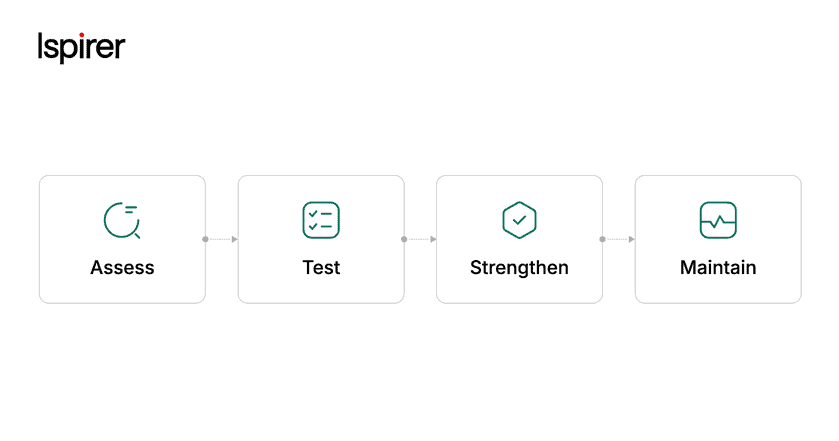
This guide ranks ten cybersecurity services for small business teams by what each one contributes, what it typically costs, and how often it should run. Services one through four form the backbone. The rest fill in around them.
How to Read This Ranking
Ranking security services is not like ranking laptops. Position here reflects sequence and leverage, meaning how much the rest of your program depends on that service being done first and done properly.
Three questions are worth holding in mind for each entry:
- What does it produce? A service that ends in a PDF and a phone call has a different value than one that ends in a reconfigured firewall.
- Who operates it afterwards? Tools create work. Somebody has to read the alerts, apply the patches, and answer the questionnaires.
- How often does it need to repeat? One-time projects and monthly subscriptions belong in different budget lines.
Top 10 Cybersecurity Services for Small Business in 2026
1. Security Assessment
A security assessment is the map. External specialists review your IT environment as a whole, covering infrastructure, cloud systems, endpoints, remote access, backups and access controls, then report where the real risks sit.
The deliverable matters more than the scan. A useful assessment ends with a security report, a vulnerability list prioritised by CVSS severity and exploitability, a remediation roadmap, an executive summary written for the people who approve budgets, and a set of quick wins your or their team can apply immediately.
Timeline is measurable: scoping usually takes one to two weeks, followed by active assessment, with the report delivered within about two weeks after that. Four to six weeks end to end is a realistic plan for a company under 300 employees.
Run it first, before any purchase decision. Run it again after a merger, an office move, a cloud migration or any year in which your headcount changed materially.
2. Penetration Testing
An assessment tells you what looks weak. A penetration test tells you what an attacker can actually reach. Ethical hackers use the same techniques intruders rely on, then document how they got in, or where they were stopped.
This distinction is worth paying for. Automated scanners flag isolated issues. Testers chain them together, and chains are how breaches happen: an exposed admin panel plus a reused password plus a flat network becomes a domain compromise.
Scope typically covers five areas:
- web and mobile applications and APIs
- networks and endpoints including Wi-Fi, VPNs and firewalls
- cloud environments across AWS, Azure and Google Cloud
- how sensitive data is stored and transmitted
- how employees respond to phishing and other social engineering
You also choose a knowledge level. Black box testing starts with nothing, mirrors an opportunistic outside attacker and costs least. Gray box gives testers credentials or network diagrams and buys depth for a moderate increase in effort. White box grants full access including source code and architecture documents, takes longest, and surfaces the widest range of issues.
Most small and mid-sized engagements involve one to three weeks of active testing, with the full cycle from discovery through reporting running roughly three to eight weeks depending on scope. Annual testing is the common cadence, plus a test after any major system launch.
3. Security Hardening
Reports arrive, findings get filed, and six months later the same issues appear in the next report. Hardening is the service that converts findings into changed configuration.
Concretely, that means implementing MFA, configuring firewalls, improving access controls, rebuilding backup architecture, setting up servers and workstations properly, optimising network segmentation, deploying endpoint protection, establishing patch management, turning on logging and monitoring, fixing cloud security configurations, improving email security, restricting privileged access, and writing the security policies that hold it all together.
Two notes:
- First, sequence hardening against the assessment’s severity ranking rather than against whatever is easiest to schedule.
- Second, ask any provider directly whether they implement or only advise.
Plenty of firms hand over a vulnerability list and step back. If your team has no capacity to execute, an advisory-only engagement produces documents rather than change.
4. Identity and Access Management
Identity has quietly become the perimeter. Most SMB environments now run on cloud email, a handful of SaaS platforms and remote access, which means an account is often the only thing standing between an attacker and your data.
Four controls carry most of the weight:
- Multi-factor authentication everywhere, including email, VPN, admin consoles and any SaaS platform holding customer data.
- Privileged access restrictions, so daily work happens under standard accounts and administrative rights are granted deliberately.
- Joiner-mover-leaver discipline, with access reviewed when roles change and revoked the day someone leaves.
- Service and integration accounts under review, since third parties now appear in a large share of breaches and OAuth grants tend to accumulate unnoticed.
This is hardening work, so it usually arrives inside a hardening engagement rather than as a separate purchase. Treat it as its own line item anyway, because it is the one area where partial coverage is common and dangerous. MFA on 80% of accounts protects 80% of accounts.
5. Endpoint Protection and Managed Detection
Laptops remain the softest entry point in small companies, particularly in hybrid teams where devices spend half their life outside the office network.
Modern endpoint protection goes past signature-based antivirus. It watches process behaviour, flags encryption activity typical of ransomware, and allows an infected machine to be isolated remotely. Managed detection and response adds people to that: an outside team that reviews alerts around the clock and calls you when something needs a decision.
Pricing is per device per month, which makes it one of the more predictable subscriptions on this list. The question worth asking is not which agent to buy but who reads the alerts at 2am. If the answer is nobody, the managed option is worth its premium. If your provider has already deployed endpoint protection as part of hardening, confirm who owns ongoing alert triage before you assume it is covered.
“In our experience, the problem is not simply how many security tools a company has, but how effectively they are deployed and maintained. We see companies running products with out-of-the-box configurations that were never properly hardened, investing in technologies that address lower-priority risks, or deploying several solutions that their teams simply do not have the time or expertise to operate effectively.
That is why we start with a security assessment and penetration test: before recommending another tool, we need to understand what is actually deployed, how well it is configured, which weaknesses are genuinely exploitable, and where the organization has the capability to operate the controls it already owns. Only then can we recommend improvements that are both technically justified and realistic for the organization to maintain.”
— Nikita Bakulia, Ispirer Security Lab
6. Email Security and Phishing Defense
Email remains the workhorse of social engineering, and the human element still shows up in around 62% of breaches according to the 2026 DBIR. Business email compromise costs SMBs more per incident than most ransomware events, because it produces voluntary wire transfers rather than encrypted servers.
Effective email security for a small company usually combines three things: advanced filtering that inspects links and attachments in context, authentication records (SPF, DKIM and DMARC) configured and enforced so your domain is harder to spoof, and a written payment verification rule that no invoice or bank detail change is actioned on email alone.
That last item costs nothing and prevents the most expensive category of email fraud. Write it down, tell finance, and test it once a quarter.
7. Patch and Vulnerability Management
Given that exploitation of vulnerabilities is now the top initial access vector, this is the service with the strongest 2026 case. It is also the least glamorous, which is precisely why it gets deferred.
Patch management as a service covers inventory (knowing every system that exists), monitoring (knowing which of them have newly published vulnerabilities), prioritisation (knowing which of those are actually exploited in the wild), and scheduled deployment with rollback plans.
Internet-facing systems deserve a separate, faster track. Firewalls, VPN appliances, remote desktop gateways and public web applications are scanned by attackers within hours of a disclosure. Everything else can follow a monthly cycle. The 43-day median remediation time in the DBIR is the benchmark to beat, and SMBs can beat it easily once someone owns the calendar.
8. Backup and Recovery Architecture
Backups are the control that determines whether ransomware is an incident or a catastrophe. They are also frequently misconfigured in ways nobody discovers until recovery day.
Three properties define a backup design worth having:
- Copies are isolated from the production network, so credentials stolen on a workstation cannot reach them.
- Copies are immutable for a defined retention window, so they cannot be encrypted or deleted.
- Restoration is tested on a schedule, with a documented recovery time for your most critical systems.
Backup architecture sits inside hardening work rather than being a standalone service, but it deserves its own review meeting. Ask your provider what your current recovery time objective actually is. If nobody can answer with a number, that is the finding.
9. Security Awareness Training
Training gets dismissed as a compliance checkbox, largely because so much of it is delivered as an annual video nobody watches. Short, frequent and specific works better: a ten-minute session on the invoice fraud pattern your industry is seeing, followed by a simulated phishing campaign, followed by a debrief that names no individuals.
These two adjustments make training measurably more useful:
- Include the finance and executive teams rather than exempting them, since they are the targets in payment fraud.
- Measure reporting rate rather than click rate, because a workforce that flags suspicious mail quickly gives you time to respond.
Awareness training is commonly bundled into ongoing advisory subscriptions, which is the more affordable route than licensing a standalone platform for a small headcount.
10. Ongoing Security Advisory
Everything above degrades. New systems get added, staff change, vendors get onboarded, cloud permissions drift. Ongoing advisory is the service that keeps a hardened environment hardened.
A virtual security advisor subscription typically covers vulnerability monitoring and response, expert guidance on security decisions as they come up, review of new systems and changes before they go live, support during incidents, and employee security awareness training. The commercial logic is straightforward: a predictable monthly fee instead of a full-time security hire.
The underrated benefit is speed of access. When a prospect sends a 60-question security questionnaire, or when something odd shows up in your logs on a Friday afternoon, having someone who already knows your environment answer within hours rather than after a two-week onboarding is worth more than the retainer.
All-in-One Cybersecurity Services Small Business Teams Can Actually Run
Bundling is popular for a good reason. All-in-one cybersecurity services small business buyers get from a single provider remove the handoff problem, where the firm that found the issue is not the firm responsible for fixing it and neither is accountable for the outcome.
What a genuine bundle should include:
- Assessment, testing, hardening and advisory from the same team, so findings flow directly into implementation without a second discovery phase.
- Named methodologies. Established frameworks such as the OWASP Web Security Testing Guide, NIST SP 800-115 and PTES make findings consistent and defensible to auditors. For structuring your own program, CIS Controls are the gentler entry point: 18 prioritised safeguards, with the Implementation Group 1 tier written specifically for organisations that have limited security staff. The NIST Cybersecurity Framework covers broader governance ground once that foundation is in place.
- Compliance fluency in ISO 27001, so findings are mapped to recognised control requirements rather than delivered as a loose list of technical issues.
- Confidentiality terms in writing, with an NDA signed before technical work begins.
The counterweight is concentration risk. One provider holding assessment, testing and remediation means one provider marking its own homework. Larger SMBs sometimes split testing to a second firm for independence. For a 60-person company, the coordination cost of splitting usually outweighs the benefit.
Key takeaways
- Sequence beats spend. Assessment, then testing, then hardening, then continuous advisory produces better coverage per dollar than buying tools in whatever order vendors reach you.
- Vulnerability exploitation leads breaches in 2026. Patch discipline on internet-facing systems is the single highest-return habit available to a small team.
- Ask who implements. Services that end in a report change nothing until someone reconfigures the systems.
- Identity is the perimeter. MFA, privileged access limits and access reviews cover the ground attackers use most.
- Third parties are now a major breach path. Vendor access and OAuth integrations belong in your review cycle.
- Predictable pricing is available. Published assessment tiers and fixed pentest quotes let you plan security spend like any other operating cost.
Frequently Asked Questions
Which cybersecurity service should a small business buy first?
A security assessment. It costs less than most remediation projects and tells you which remediation projects to run, preventing spending on partial coverage.
How often should a small business run penetration testing?
At least once a year, and after any major change such as a new application launch or a cloud migration. Regular testing also supports compliance evidence for auditors and enterprise customers.
What is the difference between a vulnerability scan and a penetration test?
A scan is automated and reports known weaknesses based on signatures and configuration. A test involves engineers attempting to exploit those weaknesses the way a real attacker would, which surfaces issues automated tools miss and eliminates false positives.
Will penetration testing disrupt daily operations?
Usually not. Testing windows and methods are agreed in advance so critical systems are protected during business hours, and testing can be paused if anything unexpected occurs.
Can we get enterprise-grade, affordable cybersecurity services for small business without an internal team?
Yes, through a combination of scoped project work and an advisory subscription. That model gives you access to security specialists and standards used in regulated industries without the cost of building a department.
How long does a security assessment take?
Roughly four to six weeks in total: one to two weeks of scoping, active assessment, and the report delivered within about two weeks of completion.
Next step?
Cybersecurity services for small business work best when they follow one another in order rather than arriving as separate purchases. Ispirer Security Lab covers all four stages, from assessment and penetration testing through hardening and ongoing advisory, for companies of 20 to 300 employees.
Thirty minutes on a call is usually enough to work out where your business stands today and which stage to run first. Explore Ispirer’s cybersecurity services and make 2027 your most secure year yet.