Table of Contents
Introduction
The Global AI Infrastructure Security Market reached USD 8.63 billion in 2024 and is projected to achieve USD 79.73 billion by 2034 at a CAGR of 32.2%. North America dominated in 2024 with a 38.5% share, valued at USD 3.32 billion, driven by large-scale AI adoption, rising cyber risks, and accelerated deployment of GPU-based data centers.
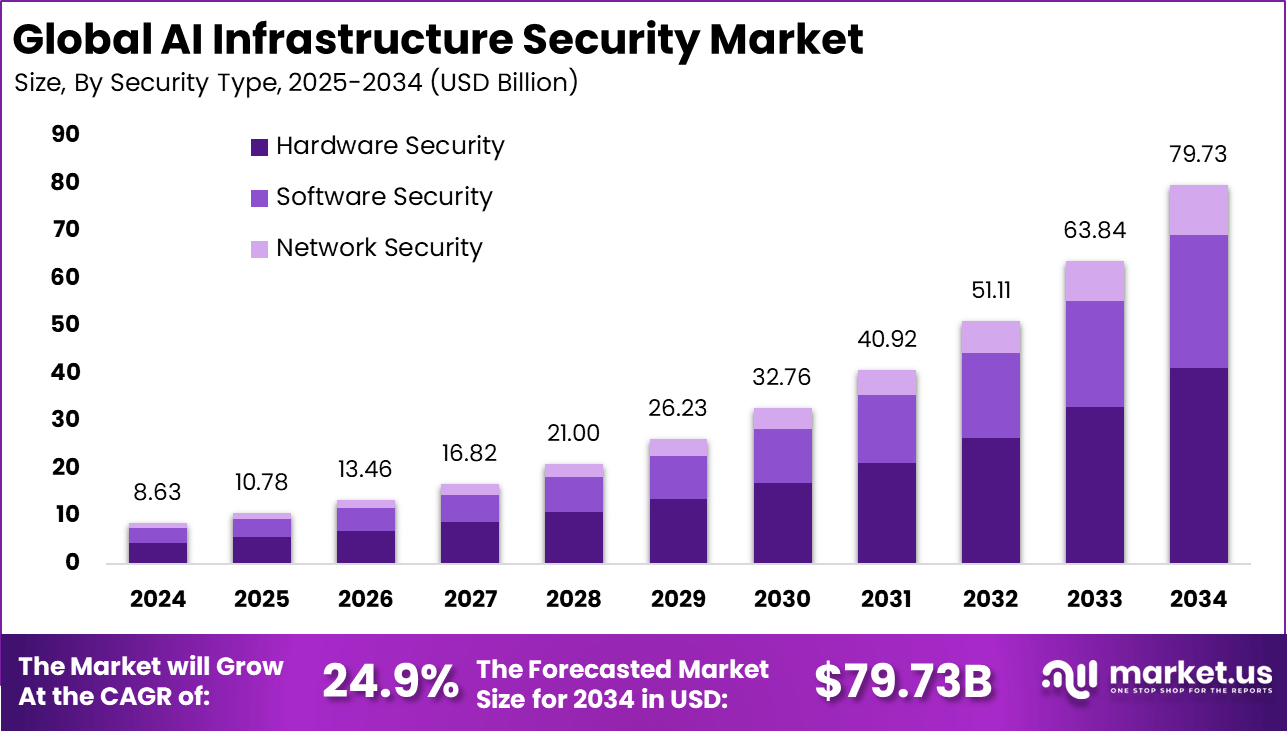
How Growth Is Impacting the Economy
Rapid expansion in AI infrastructure security fuels strong economic activity by increasing investment across cloud platforms, cybersecurity tools, semiconductor ecosystems, and managed services. This surge creates high-value employment in fields such as AI engineering, zero-trust architecture, and threat intelligence. Governments in key economies allocate strategic funds to secure critical digital infrastructure, which positively influences national resilience and digital competitiveness.
Moreover, the growth stimulates demand for advanced chips, secure hardware modules, and data-center energy systems, strengthening industrial output. As AI models scale, enterprises invest heavily in secure compute clusters, boosting IT spending and improving productivity across industries. The economic impact extends to SMEs through improved access to secure AI frameworks, enabling broader innovation and supporting GDP expansion.
➤ Smarter strategy starts here! Get the sample – https://market.us/report/ai-infrastructure-security-market/free-sample/
Impact on Global Businesses
Global businesses experience rising operational costs due to the need for secure model training, encrypted data pipelines, and regulatory compliance. Supply chains shift toward trusted hardware suppliers as geopolitical concerns intensify around AI chips, cloud servers, and secure networking devices. Sector-level impacts include heightened security investment in BFSI, healthcare, retail, logistics, and manufacturing as AI models require stronger protection against data poisoning, IP theft, and inference attacks.
Strategies for Businesses
• Adopt zero-trust security architecture
• Deploy encrypted model training and federated learning
• Invest in secure GPUs and hardware-root-of-trust systems
• Build multi-layered cloud security frameworks
• Strengthen compliance with emerging AI governance laws
• Integrate automated threat detection for AI pipelines
➤ Unlock growth secrets! Buy the full report – https://market.us/purchase-report/?report_id=168034
Key Takeaways
• Market to hit USD 79.73 billion by 2034
• CAGR of 32.2% signals hyper-growth
• North America leads with 38.5% share
• AI security is now a board-level priority
• Supply chains shift toward secure compute infrastructure
Analyst Viewpoint
The market shows strong present-day momentum due to rising AI adoption and escalating cyber threats across enterprises. Organizations prioritize secure infrastructure as foundation models expand and AI workloads intensify. Over the next decade, growth is expected to accelerate further as zero-trust models, sovereign AI environments, and secure multi-cloud ecosystems become global standards. The future outlook remains highly positive, supported by regulatory clarity and continuous innovation in secure hardware.
Use Case & Growth Factors
| Use Case | Description | Growth Factors |
|---|---|---|
| Secure AI Training | Protecting models from tampering and data poisoning | Rise in foundation models, regulatory pressure |
| Cloud AI Security | Safeguarding cloud-based AI workloads | Multi-cloud adoption, remote operations |
| Hardware-Level Security | GPU/TPM-based protection for AI compute | Demand for secure chips & edge devices |
| Model Governance | Ensuring compliant AI deployments | Global AI regulations & audits |
Regional Analysis
North America leads due to large hyperscale data-center investments, regulatory initiatives, and rapid industry digitalization. Europe expands steadily, driven by GDPR-aligned AI governance and sovereign cloud programs. Asia Pacific experiences the fastest acceleration as China, India, Japan, and South Korea invest heavily in secure AI infrastructure and semiconductor capacity. Latin America and the Middle East strengthen adoption fueled by smart-city projects, fintech growth, and digital transformation strategies. Africa gradually progresses with government-led cybersecurity modernization efforts.
➤ Want more market wisdom? Browse reports –
- 3d Printed Electronics Market
- Insurance Rating Software Market
- Data Acquisition Equipment Market
- RoCE for AI Workloads Market
Business Opportunities
Major opportunities emerge in secure AI training environments, encrypted data-flow management, and hardware-root-of-trust solutions for AI workloads. Companies can capitalize on demand for sovereign AI clouds, regulatory-compliant security frameworks, and automated threat-detection tools tailored for large models.
Edge-AI security, secure inference pipelines, and AI governance platforms present additional growth pathways. Rapid expansion of multi-cloud ecosystems creates strong prospects for managed AI security services, GPU security modules, and AI-native firewalls. Vendors focusing on low-latency secure architectures gain a long-term advantage as AI becomes embedded in all enterprise functions.
Key Segmentation
The market is segmented by security type (network security, cloud security, endpoint security, data security, model security), by deployment (on-premises, cloud, hybrid), by component (hardware modules, software, services), and by industry (BFSI, healthcare, IT & telecom, retail, manufacturing, government). Network and cloud security represent the most widely adopted segments as enterprises scale AI workloads across distributed systems. Hardware security gains traction with the rise of secure GPUs and AI chips. Industry adoption remains highest in BFSI and healthcare due to strict compliance needs.
Key Player Analysis
Leading companies in this market focus on expanding secure AI compute capabilities, enhancing encrypted workload protection, and integrating zero-trust principles into AI pipelines. Their strategies include launching advanced security tools for AI model training, partnering with cloud providers, and investing in hardware-based protection features.
Many players strengthen global footprints through data-center expansions and strategic alliances. Innovation priorities revolve around secure inference engines, threat-detection algorithms, and scalable governance frameworks. R&D investments intensify to address real-time risks linked to large-scale AI deployments.
- NVIDIA Corporation
- Palo Alto Networks, Inc.
- CrowdStrike Holdings, Inc.
- Microsoft Corporation
- Amazon Web Services, Inc.
- Google LLC
- International Business Machines Corporation (IBM)
- Intel Corporation
- Fortinet, Inc.
- Check Point Software Technologies Ltd.
- Broadcom Inc.
- Cisco Systems, Inc.
- McAfee Corp.
- Trend Micro Incorporated
- Tenable Holdings, Inc.
- Others
Recent Developments
• Expansion of secure AI cloud data centers
• Launch of new encrypted training platforms
• Introduction of hardware-based AI protection chips
• Agreements supporting sovereign AI initiatives
• Regulatory alignment tools for AI governance
Conclusion
The AI Infrastructure Security Market is entering a high-growth era driven by expanding AI usage, rising cyber threats, and strong global investments. With advanced security frameworks becoming essential, businesses adopting resilient AI-security architectures will unlock competitive benefits and long-term value as the market scales rapidly.
Discuss your needs with our analyst
Please share your requirements with more details so our analyst can check if they can solve your problem(s)