Table of Contents
Introduction
The Global Ambient Light Sensor Market generated USD 3.2 billion in 2024 and is predicted to register growth from USD 3.6 billion in 2025 to about USD 9.2 billion by 2034, recording a CAGR of 11.10% throughout the forecast span. In 2024, North America held a dominan market position, capturing more than a 40% share, holding USD 1.28 Billion revenue.
Ambient light sensors are widely used in electronic devices to detect surrounding light levels and adjust screen brightness or system functions automatically. These sensors are commonly integrated into smartphones, laptops, televisions, automotive displays, and smart lighting systems to improve visibility and reduce power consumption.
As devices become more user focused and energy efficient, ambient light sensing is playing a key role in enhancing user comfort while also extending battery life. The technology is also being adopted in industrial and commercial settings where lighting conditions need to be monitored and controlled in real time.
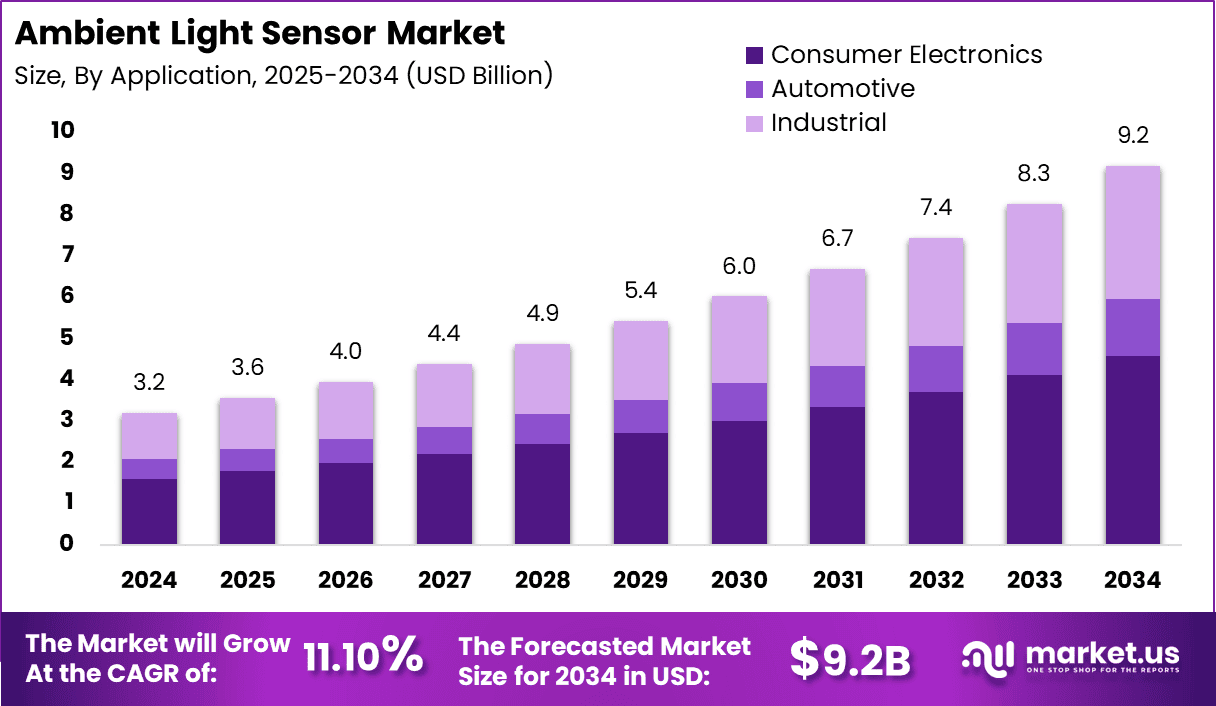
One of the main driving factors is the increasing demand for energy efficient and adaptive electronic devices. Consumers expect devices to automatically adjust brightness based on their environment, which improves usability and reduces eye strain. In addition, manufacturers are focusing on optimizing battery performance, and ambient light sensors help reduce unnecessary power usage by controlling display output.
The expansion of smart homes and connected lighting systems is also supporting adoption, as these sensors enable automated lighting control based on natural light conditions. In the automotive sector, growing use of digital dashboards and in cabin displays is further driving the need for sensors that can adjust brightness for better visibility and safety.
Demand for ambient light sensors is rising as more devices become connected and intelligent. There is a clear shift toward compact and highly sensitive sensors that can deliver accurate readings in different lighting environments. Device manufacturers are looking for solutions that can be easily integrated into smaller form factors without affecting design.
At the same time, industries are adopting these sensors to improve automation and reduce energy consumption in buildings and infrastructure. The demand is also supported by the growing focus on user comfort, as adaptive lighting improves the overall experience across devices and environments. As technology continues to evolve, the need for reliable and efficient light sensing solutions is expected to increase steadily.
Keytake away
- Consumer electronics segment commands 49.96% market share, powering automatic brightness adjustment in smartphones, tablets, laptops, and TVs for optimal viewing and battery conservation.
- Photoresistors capture 41%, delivering cost-effective light intensity detection with simple analog voltage output for legacy and budget device integration.
- Analog sensors dominate at 35%, providing direct photocurrent measurement without digital conversion overhead for real-time display control applications.
- Residential end-use holds 55%, enabling smart lighting systems, automated blinds, and circadian rhythm lighting in connected home environments.
- North America drives 40% global value, with U.S. market at USD 1.2 billion and 10% CAGR, fueled by IoT device proliferation and regulatory energy efficiency mandates.
How AI is Reshaping the Future of this market?
Artificial intelligence is changing how ambient light sensors are used in devices. Earlier, these sensors only measured light and adjusted screen brightness in a basic way. Now, with AI, they can understand user behavior and environment more deeply. For example, AI can learn how a person prefers brightness at different times of the day and automatically adjust settings without manual input. This makes devices more comfortable to use and improves battery efficiency, especially in smartphones, laptops, and smart home devices.
AI is also helping these sensors work better in complex lighting conditions. In real-world situations, light can change quickly due to shadows, reflections, or mixed lighting sources. AI algorithms can process this data in real time and make more accurate adjustments. This is very useful in areas like automotive displays, where visibility is critical for safety, and in smart lighting systems that aim to create better indoor environments.
Another important impact is in automation and smart ecosystems. Ambient light sensors combined with AI can connect with other systems like IoT devices, smart lighting, and building management systems. This allows automatic control of lighting based on occupancy, time, and natural light availability. As a result, energy consumption is reduced and overall efficiency improves. AI is also supporting new applications such as adaptive displays in wearable devices and advanced camera systems, where lighting conditions play a key role in performance.
Regional Analysis
In 2024, North America held a dominant market position, capturing more than a 40% share, holding USD 1.28 Billion revenue. This dominance is mainly supported by the strong presence of advanced consumer electronics and automotive industries across the US and Canada. High adoption of smartphones, wearable devices, and smart home systems has created steady demand for ambient light sensors. In addition, the region benefits from early adoption of display technologies in devices such as tablets, laptops, and televisions, where automatic brightness adjustment is now a standard feature. This widespread integration has strengthened the regional market position.
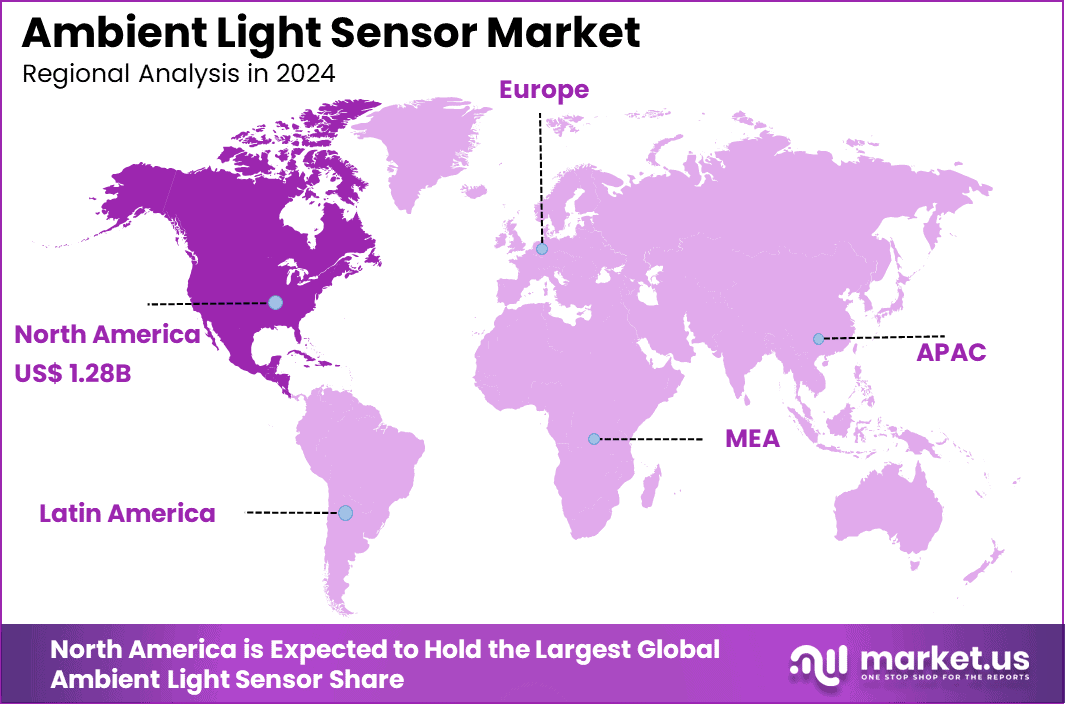
Another key factor behind North America’s leadership is the strong focus on automotive innovation, especially in connected and autonomous vehicles. Ambient light sensors are increasingly used in vehicle dashboards, infotainment systems, and adaptive lighting systems to improve driver comfort and safety.
The presence of leading semiconductor and sensor technology developers also supports continuous product innovation. Research and development investments, along with favorable regulatory standards for energy-efficient devices, are expected to sustain demand in the region.
Europe follows with steady growth driven by strong automotive manufacturing hubs and increasing adoption of energy-efficient lighting systems. Countries such as Germany, France, and the UK are focusing on smart mobility and green technologies, which is supporting the use of ambient light sensors in vehicles and building automation systems.
Latin America is gradually expanding due to rising consumer electronics demand, although growth remains moderate due to economic constraints and slower technology adoption in some areas. The Middle East and Africa region is also witnessing gradual uptake, supported by increasing investments in smart infrastructure and urban development projects, particularly in countries focusing on smart city initiatives.
Driver Analysis
The growing use of smartphones, tablets, and wearable devices is a key driver for the ambient light sensor market. These sensors help screens adjust brightness automatically based on surrounding light conditions. This improves user comfort and reduces eye strain, which is important for devices used throughout the day. As consumers expect better display quality and longer battery life, manufacturers are increasingly integrating these sensors into their products.
In addition, the rise of smart homes and connected lighting systems is supporting demand. Ambient light sensors are used in automated lighting to adjust indoor brightness based on natural light availability. This helps reduce energy consumption and improves user convenience. The shift toward energy efficient buildings and smart infrastructure is further strengthening the role of these sensors across residential and commercial environments.
Restraint Analysis
One major restraint is the variation in sensor performance under different environmental conditions. Factors such as shadows, reflections, and rapid light changes can affect the accuracy of ambient light sensors. This can lead to inconsistent brightness adjustments, which may reduce user satisfaction in some devices. Ensuring stable performance across different use cases remains a challenge for manufacturers.
Another limiting factor is cost sensitivity in low and mid range devices. While ambient light sensors add value, they also increase component costs. In price competitive markets, manufacturers may choose to exclude these sensors to maintain affordability. This can restrict market penetration, especially in developing regions where cost plays a critical role in purchasing decisions.
Opportunity Analysis
The expansion of automotive applications presents a strong opportunity for ambient light sensors. These sensors are increasingly used in vehicles for automatic dashboard lighting, adaptive headlights, and interior ambient lighting systems. As vehicles become more connected and user focused, the demand for intelligent lighting solutions is expected to increase. This creates new growth avenues beyond traditional consumer electronics.
Another opportunity lies in industrial and outdoor applications. Ambient light sensors are being used in street lighting systems to control brightness based on natural light levels. This supports energy saving initiatives and reduces operational costs for municipalities. The push toward smart cities and sustainable infrastructure is expected to drive wider adoption in these segments.
Challenge Analysis
A key challenge is the integration of ambient light sensors with other sensing technologies in compact devices. Modern devices often require multiple sensors to work together, such as proximity and motion sensors. Ensuring smooth coordination without interference can be complex and requires careful design. This adds to development time and increases technical complexity.
Another challenge is maintaining sensor reliability over long periods of use. Exposure to dust, heat, and environmental changes can affect sensor performance. Devices used outdoors or in harsh conditions are particularly vulnerable. Manufacturers need to focus on durability and consistent calibration to ensure long term functionality, which can increase production complexity and cost.
Key Market Segment
By Application
- Consumer Electronics
- Automotive
- Industrial
By Sensor Type
- Photodiode
- Photoresistor
- Phototransistor
By Technology
- Analog
- Digital
By End-use
- Residential
- Commercial
- Industrial
Competetive Analysis
The competitive landscape of the Ambient Light Sensor Market is driven by strong participation from global semiconductor companies with deep expertise in sensing technologies. Companies such as AMS, STMicroelectronics, Vishay Intertechnology, Infineon Technologies, Analog Devices, Texas Instruments, and ON Semiconductor focus on developing high-performance sensors with low power consumption and high accuracy.
These players invest in advanced chip design and integration capabilities to meet growing demand from smartphones, automotive systems, and consumer electronics. Their strong research capabilities and global distribution networks help them maintain a leading position in the market.
At the same time, companies like ROHM Semiconductor, Toshiba, NXP Semiconductors, Maxim Integrated, Bourns, Honeywell, Broadcom, and Sharp compete by offering specialized and cost-effective sensor solutions for different applications. These players focus on compact designs, improved sensitivity, and easy integration into electronic devices.
Competition in this market is driven by continuous innovation, miniaturization of components, and the need for energy-efficient solutions, as manufacturers aim to support evolving requirements across automotive, industrial, and smart device applications.
Recent Development
- February, 2026 – ADI ADPD188GG adds spectral sensing to ambient light for health monitoring wearables. Medical-grade accuracy with low-power always-on mode. Heart rate variability tracking.
- January, 2026 – Maxim MAX30102 pulse oximeter fuses ALS data for fitness trackers. SpO2 accuracy boost with Apple Health integration. Sleep apnea detection added.
Conclusion
The ambient light sensor market is expected to witness steady growth driven by the rising use of smart devices, energy-efficient lighting systems, and advanced automotive features. Increasing focus on user comfort, battery optimization, and automatic brightness control is strengthening demand across consumer electronics, automotive, and industrial applications.
At the same time, integration with intelligent systems and adaptive technologies is enhancing sensor performance and expanding use cases. However, factors such as pricing pressure and design complexity continue to influence adoption in cost-sensitive segments. Overall, the market is anticipated to progress with continuous innovation, wider application scope, and growing emphasis on smart and sustainable solutions across industries.