Table of Contents
Introduction
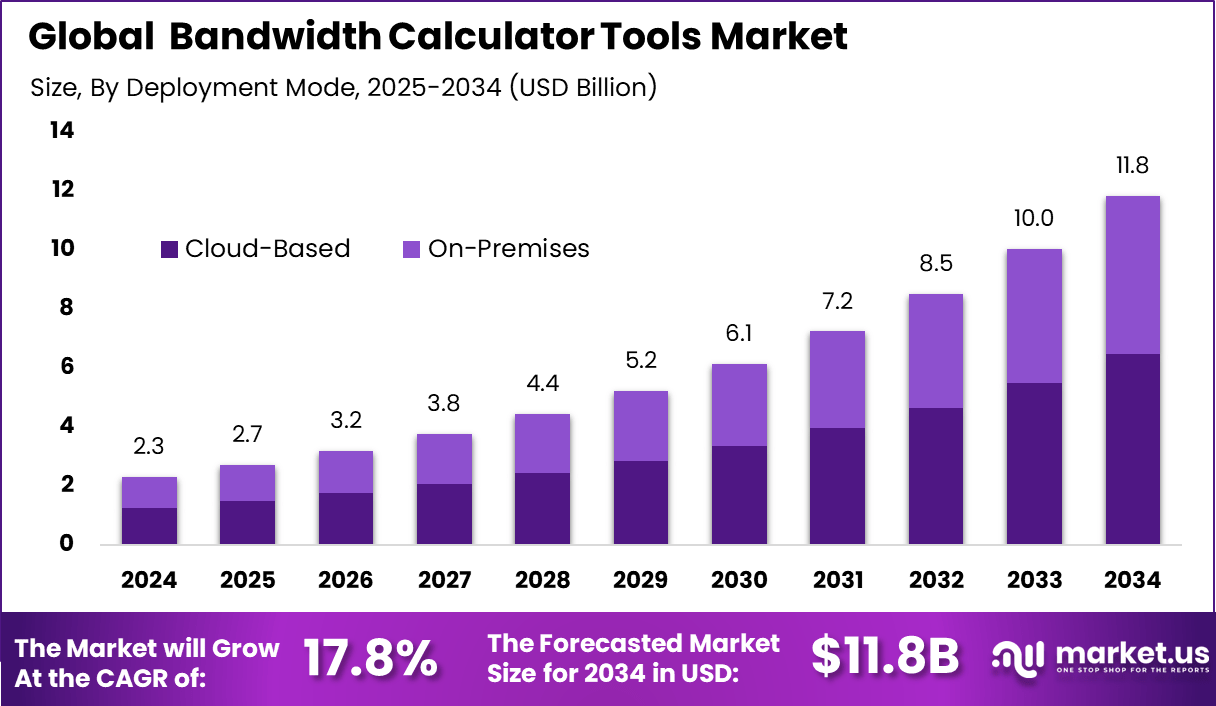
The Global Bandwidth Calculator Tools Market generated USD 2.3 billion in 2024 and is projected to expand from USD 2.7 billion in 2025 to nearly USD 11.8 billion by 2034, registering a strong 17.8% CAGR. Rising data traffic, cloud adoption, streaming platforms, and enterprise digital transformation drive growth. North America dominated with a 34.2% share and USD 0.7 billion revenue, supported by advanced networks and heavy enterprise bandwidth planning requirements.
How Growth Is Impacting the Economy
The expanding bandwidth calculator tools market contributes significantly to economic modernization by advancing digital infrastructure planning and improving network efficiency. As enterprises optimize bandwidth for cloud computing, AI workloads, and streaming services, operational costs decline, and productivity improves, enabling stronger economic performance.
This growth encourages investments in telecom infrastructure, data centers, and fiber-optic networks, generating high-value jobs in engineering, software development, and analytics. National economies benefit as telecom operators accelerate network scalability to support 5G and enterprise cloud adoption. With increasing digital dependence across industries, improved bandwidth planning enhances competitiveness, reduces downtime costs, and strengthens global digital resilience.
➤ Smarter strategy starts here! Get the sample – https://market.us/report/bandwidth-calculator-tools-market/free-sample/
Impact on Global Businesses
Rising data consumption and higher performance demands increase operational costs as companies upgrade infrastructure. Supply chain shifts in semiconductor components and networking hardware create procurement delays, pushing businesses to diversify sourcing. Sector-wise, telecom benefits from improved capacity planning, IT services gain accurate workload mapping, e-commerce reduces page latency, BFSI enhances secure transactions, and healthcare improves telemedicine reliability. These tools help industries forecast data demand, prevent bottlenecks, and maintain service quality in high-traffic environments.
Strategies for Businesses
Adopt predictive bandwidth modeling, prioritize cloud-native tools, optimize traffic routing, diversify hardware supply chains, enhance network monitoring, integrate AI-driven analytics, and build scalable multi-cloud bandwidth strategies for long-term resilience and performance improvement.
Key Takeaways
- Strong 17.8% CAGR signals sustained demand.
- Rising digital workloads accelerate the adoption of bandwidth planning tools.
- North America leads due to mature telecom and cloud adoption.
- Businesses face rising infrastructure costs and shifting hardware supply chains.
- Tools improve performance, reduce latency, and enhance operational continuity.
➤ Unlock growth secrets! Buy the full report – https://market.us/purchase-report/?report_id=169397
Analyst Viewpoint
The market shows strong current demand driven by cloud migration, remote work expansion, and AI-driven applications. Bandwidth calculator tools are increasingly essential for maintaining uninterrupted digital operations and planning for future data spikes. Looking ahead, growth is expected to accelerate as enterprises focus on automation, low-latency environments, multi-cloud optimization, and 5G expansion. Continuous innovation in analytics and real-time monitoring will further strengthen the market’s long-term outlook.
Use Case and Growth Factors
| Use Case | Description | Growth Driver |
|---|---|---|
| Telecom Capacity Planning | Forecasting network demand and preventing congestion | Rapid 5G rollout |
| Cloud Migration | Determining bandwidth needs for cloud workloads | Rising enterprise cloud adoption |
| Video Streaming Optimization | Ensuring smooth playback and traffic balancing | Surge in OTT platforms |
| Remote Work Infrastructure | Supporting secure, scalable connectivity | Distributed workforce growth |
| Data Center Planning | Mapping traffic flows for infrastructure upgrades | Increasing data consumption |
Regional Analysis
North America leads the market due to advanced telecom networks, high enterprise digitization, and cloud-first adoption strategies. Europe follows with strong regulatory-driven digital transformation and rising bandwidth planning in BFSI, healthcare, and manufacturing. Asia Pacific records the fastest growth as large-scale cloud deployments, streaming demand, and fiber expansion accelerate adoption. Latin America and the Middle East show steady growth driven by telecom modernization and emerging data center investments.
➤ Want more market wisdom? Browse reports –
- Loan Servicing QA Platform Market
- VR Esports Venue Insurance Market
- Robotics in Semiconductor Market
- PCB Manufacturer Insurance Market
Business Opportunities
Rising OTT adoption creates demand for traffic optimization tools. Telecom operators need advanced capacity planning solutions for 5G and fiber expansion. Enterprises seeking cloud-cost optimization generate opportunities for intelligent bandwidth modeling platforms. SMEs adopting SaaS-based services open growth prospects for lightweight bandwidth tools. Emerging markets offer untapped potential as digital transformation accelerates and network infrastructures scale rapidly.
Key Segmentation
The market can be segmented by deployment mode (cloud-based, on-premise), enterprise size (SMEs, large enterprises), application (telecom planning, cloud migration, streaming optimization, remote connectivity management), and end-use industry (IT & telecom, BFSI, healthcare, retail, government, education). Each segment contributes uniquely to market expansion as industries emphasize performance efficiency, latency reduction, and uninterrupted digital service delivery.
Key Player Analysis
Leading participants focus on improving algorithm accuracy, offering real-time analytics, and enhancing scalability for large enterprises. They invest in AI-enabled forecasting engines, multi-cloud optimization features, and API-integrated planning modules. Competitive differentiation is driven by user-friendly interfaces, automation capabilities, cybersecurity integration, and strong customer support ecosystems. Continuous enhancements in predictive modeling and bandwidth simulation tools strengthen their global presence.
- Cisco Systems, Inc.
- Juniper Networks, Inc.
- Broadcom Inc.
- Keysight Technologies
- Spirent Communications
- VIAVI Solutions Inc.
- EXFO Inc.
- Anritsu Corporation
- NetScout Systems, Inc.
- SolarWinds Worldwide, LLC
- Fluke Corporation
- Ixia (Keysight Technologies)
- Riverbed Technology
- Paessler AG
- Nagios Enterprises, LLC
- OpManager (ManageEngine)
- BMC Software, Inc.
- CA Technologies (Broadcom)
- LogicMonitor, Inc.
- Zabbix LLC
- Others
Recent Developments
• 2024: Launch of cloud-native bandwidth forecasting modules for multi-cloud environments.
• 2024: Introduction of AI-enhanced traffic simulation engines for telecom operators.
• 2025: Partnerships formed to integrate bandwidth tools with enterprise network monitoring platforms.
• 2025: Expansion of edge-ready bandwidth planning solutions for IoT ecosystems.
• 2025: Rollout of advanced SaaS-based bandwidth calculators for SMEs.
Conclusion
The Bandwidth Calculator Tools Market is expanding rapidly as global digital demands intensify. Strong growth, rising cloud adoption, and 5G expansion ensure long-term opportunities, making these tools vital for future-ready network planning and enterprise performance optimization.
Discuss your needs with our analyst
Please share your requirements with more details so our analyst can check if they can solve your problem(s)