Introduction
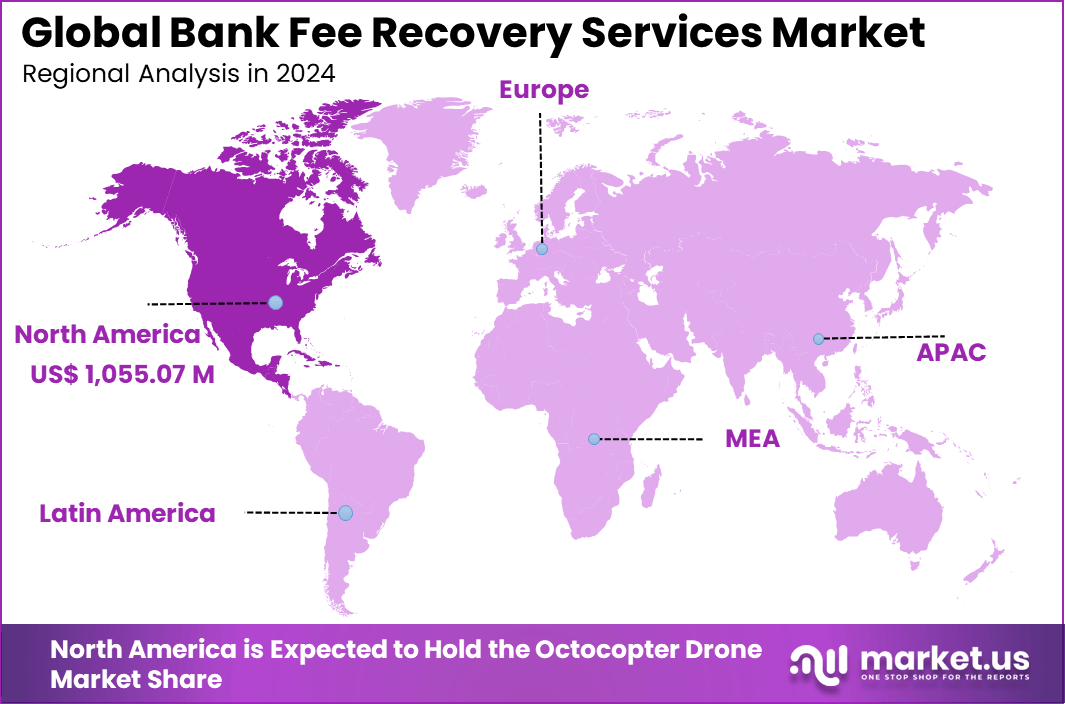
The Global Bank Fee Recovery Services Market generated USD 2,476.7 million in 2024 and is predicted to register growth from USD 2,736.8 million in 2025 to about USD 6,722.0 million by 2034, recording a CAGR of 10.50% throughout the forecast span. In 2024, North America held a dominant market position, capturing more than a 42.6% share, holding USD 1,055.07 Million revenue.
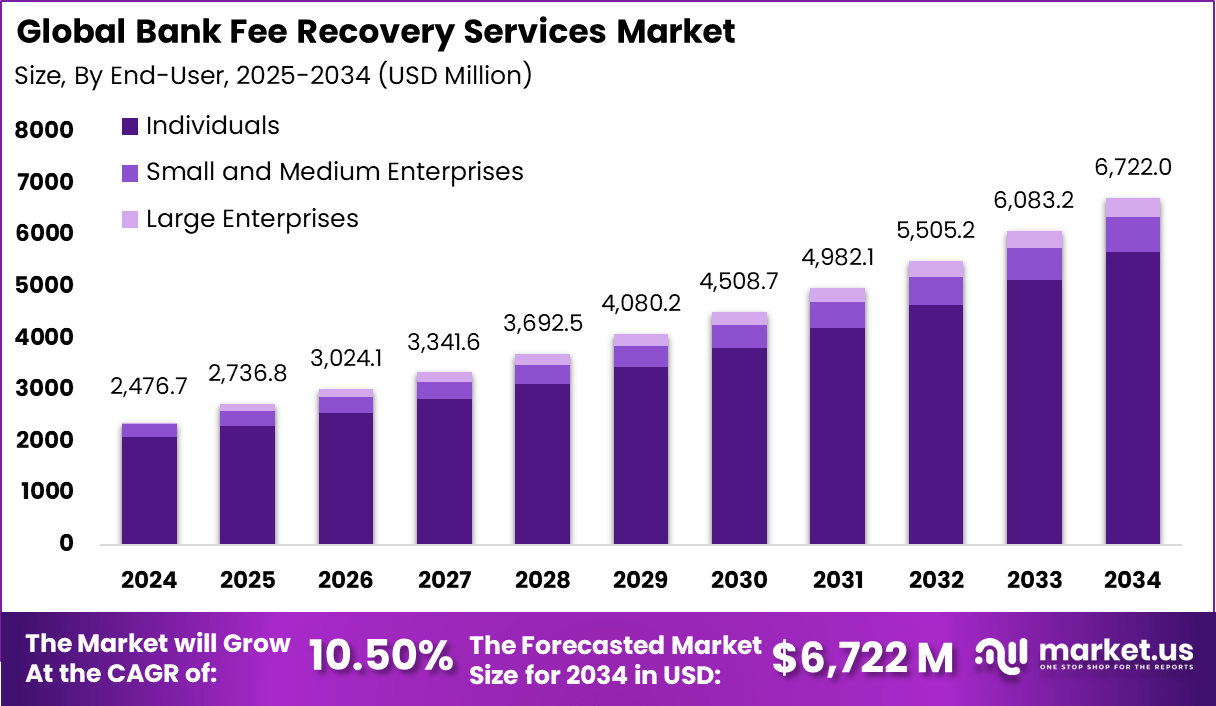
Bank fee recovery services help financial institutions identify, validate, and recover charges that were incorrectly billed or overpaid to third parties such as payment networks, vendors, processors, and service providers. These services review complex fee structures, contracts, transaction records, and settlement data to detect errors that may go unnoticed in high volume banking operations. As banks manage large numbers of transactions across multiple channels, fee recovery has become an important operational function for improving cost control and financial accuracy.
One of the main driving factors is the growing complexity of banking fee structures and external service relationships. Banks rely on many partners for payments, technology, cash management, and processing support, which creates a wide range of recurring charges that can be difficult to monitor manually.
In addition, rising pressure to improve efficiency and protect margins is encouraging institutions to recover avoidable costs. Stronger regulatory expectations around financial controls and audit readiness are also supporting the use of specialist recovery services. The expansion of digital banking and transaction volumes further increases the need for continuous fee validation.
Demand for bank fee recovery services is rising as financial institutions seek expert support and faster identification of billing discrepancies. There is a strong preference for providers that can combine data analysis, contract review, and recovery management while working with minimal disruption to internal teams.
Banks are also looking for services that provide clear reporting, root cause analysis, and recommendations to prevent future overcharges. The demand is particularly strong among mid sized and large institutions with multiple vendors, diverse payment channels, and high transaction activity. As cost discipline remains a priority across the banking sector, the need for reliable fee recovery solutions is expected to grow steadily.
Top Key Market Segment
- Service Type Overdraft fee recovery holds 42.3% of the market, because many customers want help recovering the overdraft charges taken by their banks.
- End-User Individuals account for 84.5% of the market, since most fee recovery cases involve personal bank accounts rather than business accounts.
- Channel Online platforms make up 41.8% of the market, as more people use websites and apps to review, track, and claim back bank fees.
- Region North America represents 42.6% of the global market, driven by a large banking sector and strong awareness of bank fees among customers.
- Country The U.S. market is valued at about USD 964.3 million and is expected to grow at a CAGR of 8.7%, as more people use services that help them recover unfair or unexpected bank charges.
How AI is Reshaping the Future of this market?
AI is reshaping the future of the bank fee recovery services market by helping service providers recover fees in a more targeted and efficient way. Traditional recovery models often depend on fixed rules, manual account reviews, and standard reminder cycles. AI changes this by analyzing payment behavior, account history, response patterns, and customer risk profiles in a more detailed way. This helps recovery teams decide which accounts need immediate action, which customers may respond to softer outreach, and which cases need a different recovery plan.
AI is also improving customer engagement, which is becoming very important in fee recovery. In many cases, the success of recovery depends not only on follow-up speed but also on message timing, channel selection, and communication tone. AI can support more personalized outreach through email, SMS, chat, or digital banking channels, making recovery efforts more relevant to each customer. This is expected to improve response rates while reducing customer frustration and lowering the risk of account closure or brand dissatisfaction.
Another major impact is on workflow automation and decision support. AI can review large volumes of account data, flag high-priority cases, identify repeat non-payment trends, and support agents with the next best action. This reduces manual workload and helps recovery teams handle more accounts with better consistency. It also supports faster escalation, better tracking, and stronger operational control, which is important for banks and third-party service providers working in high-volume fee recovery environments.
Over time, AI is anticipated to make the bank fee recovery services market more predictive and preventive rather than only reactive. Instead of waiting until fees become difficult to recover, service providers may increasingly use AI to identify early warning signs, segment customers more accurately, and recommend intervention before accounts become more complex. The future of this market is likely to favor firms that combine AI-driven efficiency with compliance, human oversight, and customer-sensitive recovery strategies.
Driver
A key driver in the bank fee recovery services market is the growing focus on cost control and financial accuracy among businesses and institutions. Many organizations process a large number of banking transactions across accounts, payment systems, and service agreements. In this environment, unnoticed charges, duplicate fees, incorrect deductions, and contract mismatches can build up over time. This is increasing demand for specialized services that review bank charges and identify recoverable amounts.
Another reason this driver is strengthening is the need for better oversight in treasury and finance operations. Internal teams often focus on cash flow, reconciliation, vendor payments, and reporting, which leaves limited time for detailed fee reviews. Bank fee recovery service providers help clients examine account structures, service billing, and historical statements in a more focused way. This support is becoming valuable for companies that want to improve financial discipline without adding pressure on internal staff.
Restraint
A major restraint in the bank fee recovery services market is the limited visibility many clients have into their own banking agreements and fee structures. In many cases, fee schedules are complex and spread across different documents, account types, and service terms. This makes it difficult to confirm whether a charge is actually incorrect or simply poorly understood. As a result, some organizations delay using recovery services because they are unsure about the likely outcome.
Another restraint is the sensitivity involved in questioning bank charges and maintaining banking relationships. Some companies may hesitate to pursue recovery claims too aggressively because they do not want to create tension with their banking partners. This is especially true when the bank also provides lending, cash management, or strategic financial support. The need to balance fee recovery with relationship management can slow adoption and reduce the willingness of some clients to act on identified issues.
Opportunity
A strong opportunity in this market lies in expanding services beyond fee recovery into broader bank relationship optimization. Many clients are not only looking to recover past charges but also to prevent future errors and improve how their banking services are structured. This creates room for service providers to offer ongoing fee monitoring, contract benchmarking, account rationalization, and billing review support as part of a wider advisory model.
There is also an opportunity to use automation and data tools to improve service quality and scale. Large organizations often deal with multiple banks, payment systems, and account locations, which creates a high volume of billing data. Service providers that can organize and analyze this information efficiently are better placed to identify patterns, recurring errors, and contract gaps. This can make the service more proactive, more accurate, and more attractive to clients seeking long term value.
Challenge
A key challenge in the bank fee recovery services market is the complexity of verifying claims across different banking systems and service arrangements. Banks may apply fees using different descriptions, billing methods, and reporting formats. This makes it hard to compare charges across accounts or confirm whether the billing matches the agreed terms. Recovery providers must invest time in reviewing records carefully, which can make the process slow and resource intensive.
Another challenge is proving value clearly to potential clients before engagement begins. Some businesses may believe their banks are already charging correctly, while others may assume that possible recoveries are too small to justify outside support. This creates a trust and education issue for service providers. They need to explain the problem, show where errors can occur, and demonstrate that careful review can lead to meaningful operational and financial benefits.
Regional Analysis
In 2024, North America held a dominant Market position, capturing more than a 42.6% share, holding USD 6,722 Million revenue. The region led the bank fee recovery services market because of its highly developed banking system, large volume of retail and commercial transactions, and strong focus on financial compliance.
Banks and financial institutions in the US and Canada handle complex fee structures across credit cards, loans, deposit accounts, wire transfers, and treasury services. This creates a strong need for recovery services that can identify incorrect charges, missed refunds, duplicated fees, and billing-related leakage. The mature structure of the banking sector also supports faster adoption of specialized recovery tools and external service providers.
Another major reason behind North America’s leadership is the region’s strong regulatory culture and customer protection environment. Banks are under constant pressure to maintain transparent fee practices, improve dispute resolution, and reduce revenue leakage without harming customer trust.
As a result, many institutions invest in recovery systems that help review historical transactions, detect fee errors, and improve internal controls. The growing use of digital banking and automated payment platforms has further increased transaction complexity, which makes fee recovery services more important for both large banks and regional institutions.
North America also benefits from early adoption of data analytics, audit automation, and outsourced financial review services. Banks in the region are more likely to use advanced platforms to trace hidden fee losses and improve revenue assurance. At the same time, customers are more aware of fee accuracy and more likely to challenge charges, which pushes banks to strengthen their recovery capabilities. This combination of banking scale, regulatory discipline, digital maturity, and operational complexity is the key reason North America remained the leading regional market.
Europe holds a significant position in the bank fee recovery services market due to its well-established banking networks and strong regulatory oversight. Financial institutions across countries such as Germany, the UK, France, and the Netherlands operate in a highly structured environment where fee transparency, consumer rights, and compliance monitoring are taken seriously. This supports demand for fee recovery services that can help banks review account charges, service fees, and cross-border transaction costs. The region’s focus on operational accuracy and financial accountability continues to create steady opportunities for service providers.
Latin America is an emerging market in this space, supported by the modernization of banking systems and the growing use of digital financial services. Banks across the region are expanding their retail and business banking offerings, which is increasing transaction volumes and creating more room for fee-related errors and reconciliation gaps. As financial institutions work to improve customer retention and strengthen internal controls, demand for fee recovery services is gradually rising. The market remains less mature than North America and Europe, but the need for better fee monitoring is becoming more visible.
The Middle East and Africa region is developing steadily, driven by banking expansion, rising financial inclusion, and growing investment in digital payment infrastructure. Many banks in the region are working to modernize operations, improve fee governance, and reduce losses tied to manual processing or outdated billing systems. As banking services become more diversified, the need for specialized recovery support is expected to grow. The market is still at an earlier stage, but improving compliance standards and digital transformation across the financial sector are creating a stronger base for future demand.
Key Market Segment
By Service Type
- Overdraft Fee Recovery
- ATM Fee Recovery
- Maintenance Fee Recovery
- Foreign Transaction Fee Recovery
- Others
By End-User
- Individuals
- Small and Medium Enterprises
- Large Enterprises
By Channel
- Online Platforms
- In-Person Services
- Mobile Applications
- Others
Competetive Analysis
The competitive landscape of the Bank Fee Recovery Services Market is shaped by a mix of banking technology providers, financial software companies, and consulting firms. Companies such as Fiserv, ACI Worldwide, Jack Henry & Associates, Oracle Financial Services, Temenos, Infosys Finacle, and SAP SE focus on platforms that help banks manage fee billing, transaction processing, account analytics, and revenue optimization.
These players provide integrated systems that allow financial institutions to identify missed charges, improve pricing controls, and automate recovery processes. Their strong relationships with banks and broad product portfolios help them maintain a leading position in the market.
At the same time, companies such as Wolters Kluwer, Bottomline Technologies, Sopra Banking Software, Alkami Technology, BankFeeFinder, Verint Systems, KPMG, PwC, and EY (Ernst & Young) compete through advisory services, compliance tools, analytics, and specialized fee recovery solutions.
These players focus on regulatory alignment, customer communication, and identifying hidden revenue leakage across banking products. Competition in this market is driven by data accuracy, automation capabilities, ease of integration with core banking systems, and the ability to improve non-interest income for financial institutions.
Top Key Players
- Fiserv
- Wolters Kluwer
- ACI Worldwide
- Jack Henry & Associates
- Oracle Financial Services
- Temenos
- Infosys Finacle
- SAP SE
- Bottomline Technologies
- Sopra Banking Software
- Alkami Technology
- BankFeeFinder
- Verint Systems
- KPMG
- PwC
- EY (Ernst & Young)
- Others
Conclusion
The bank fee recovery services market is expected to grow steadily as businesses and individuals look for better ways to identify, dispute, and recover incorrect or excess banking charges. Rising transaction volumes, more complex banking relationships, and increased attention to financial accuracy are creating stronger demand for specialized recovery support. These services are becoming more valuable for organizations that want to improve cash flow, reduce avoidable losses, and strengthen control over account management and fee auditing.
Going forward, the market is anticipated to benefit from greater use of digital review tools, automated fee analysis, and outsourced financial recovery support. Service providers that can offer accuracy, transparency, and faster claim resolution are expected to gain stronger trust in the market. At the same time, the market may face challenges related to data access, bank policy differences, and the need for strong documentation during recovery processes. Overall, the market outlook remains positive, supported by the growing need to recover hidden losses and improve financial efficiency.
Discuss your needs with our analyst
Please share your requirements with more details so our analyst can check if they can solve your problem(s)