Introduction
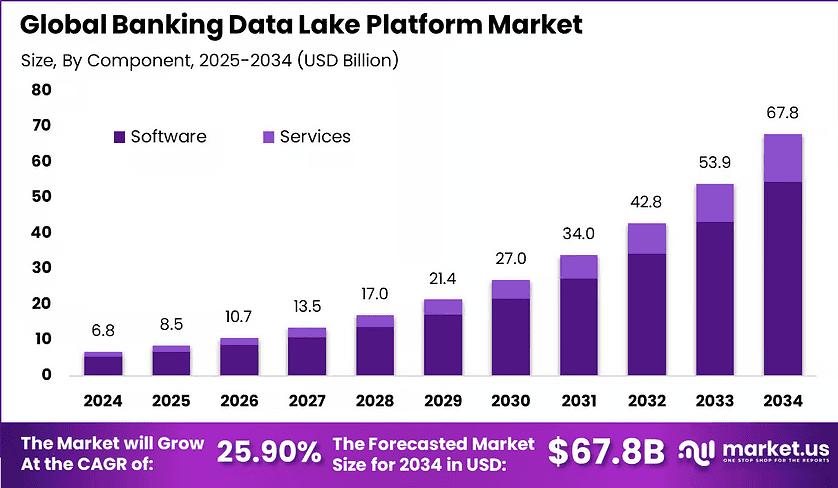
The Global Banking Data Lake Platform Market generated USD 6.8 billion in 2024 and is predicted to register growth from USD 8.5 billion in 2025 to about USD 67.8 billion by 2034, recording a CAGR of 25.90% throughout the forecast span. In 2024, North America held a dominant market position, capturing more than a 33.2% share, holding USD 2.25 Billion revenue.
Banking data lake platforms are centralized data environments that allow financial institutions to store large volumes of structured and unstructured information in one scalable system. These platforms bring together data from core banking, payments, lending, customer channels, fraud systems, and external sources so it can be accessed for analysis and decision making.
Traditional banking systems often keep data in separate silos, which limits visibility and slows response times. Data lake platforms help banks create a more unified foundation for analytics, reporting, and digital transformation.
One of the main driving factors is the increasing need for real time insights in a fast changing banking environment. Financial institutions are handling growing transaction volumes and customer interactions across mobile, branch, web, and partner channels. They need platforms that can process diverse data quickly for fraud detection, risk monitoring, and personalized service.
In addition, regulatory reporting requirements are becoming more complex, which is encouraging banks to modernize data infrastructure. The broader use of artificial intelligence and advanced analytics is also supporting demand, as these tools require access to large and well organized datasets.
Demand for banking data lake platforms is rising as institutions seek flexible and secure systems that support enterprise wide data use. There is a strong preference for platforms that offer strong governance, access controls, scalable storage, and integration with legacy banking systems. Banks are also looking for solutions that can reduce data duplication and improve consistency across departments.
The demand is particularly strong among mid sized and large institutions pursuing digital banking strategies, customer intelligence programs, and operational efficiency improvements. As data becomes central to competitiveness in financial services, the need for reliable and intelligent data lake platforms is expected to grow steadily.
How AI is Reshaping the Future of this market?
AI is reshaping the Banking Data Lake Platform Market by changing data lakes from simple storage systems into intelligent decision support platforms. Banks are handling large volumes of customer data, payment records, loan files, risk data, compliance documents, and digital banking activity. AI helps organize this data, remove duplication, detect errors, and make it easier for teams to use information across departments. This improves the value of data lakes because banks can move from slow reporting to faster insight generation.
A major impact is seen in fraud detection, credit risk, and compliance monitoring. AI can study transaction behavior, identify unusual patterns, flag suspicious activity, and support early action before financial loss increases. In credit risk, AI helps banks assess borrower behavior, repayment signals, and portfolio stress more accurately. In compliance, it supports document review, regulatory checks, audit trails, and suspicious activity monitoring with less manual effort.
AI is also improving customer-focused banking by helping institutions understand product usage, service issues, and changing financial needs. Data lake platforms can combine information from mobile banking, branch systems, cards, loans, payments, and call centers to create a more complete customer view. This supports personalized offers, faster complaint resolution, better retention planning, and improved digital banking experience.
In the future, banks are expected to prefer data lake platforms that are secure, AI-ready, and easy to govern. Strong privacy controls, data lineage, access management, model monitoring, and real-time processing are becoming more important. As banking becomes more digital, AI is expected to make data lake platforms a core layer for risk control, operational efficiency, customer intelligence, and regulatory readiness.
Regional Analysis
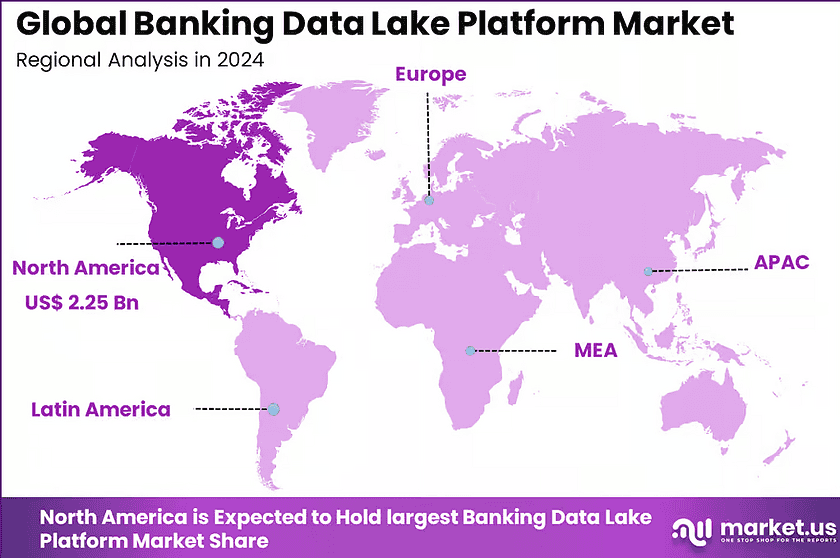
In 2024, North America held a dominant Market position, capturing more than a 33.2% share, holding USD 2.25 Billion revenue. North America is leading the Banking Data Lake Platform Market due to the strong digital maturity of its banking sector, high adoption of cloud-based financial infrastructure, and early investment in enterprise data modernization. Banks across the region are using data lake platforms to manage large volumes of customer data, transaction records, fraud signals, credit risk data, and compliance information in one centralized environment.
The presence of large financial institutions, advanced fintech ecosystems, and strict regulatory reporting needs has made data lake adoption more important across retail banking, commercial banking, investment banking, and digital banking operations.
The region also benefits from strong demand for real-time analytics, AI-based risk monitoring, personalized banking, and fraud detection. Banking institutions in North America are moving away from legacy data warehouses toward flexible data lake platforms that can support structured, semi-structured, and unstructured financial data.
This shift is mainly driven by the need to improve customer experience, reduce data silos, support faster decision-making, and strengthen cybersecurity monitoring. The strong availability of cloud service providers, data engineering talent, and regulatory technology solutions further supports the region’s leadership.
Europe is expected to show steady growth due to rising open banking adoption, data privacy compliance, and digital banking transformation across major economies. Latin America is gaining traction as banks modernize core systems and expand mobile-first financial services.
The Middle East and Africa are also witnessing gradual adoption, mainly supported by banking digitization, cloud migration, and financial inclusion initiatives. However, North America remains the leading region because its banking sector has deeper technology budgets, stronger analytics readiness, mature cloud adoption, and a greater focus on enterprise-wide data intelligence compared with other regions.
Driver
Rising need for unified banking data
Banks are handling large volumes of customer, transaction, risk, credit, compliance, and digital channel data across separate systems. A banking data lake platform helps bring this data into one controlled environment, allowing teams to access cleaner and more connected information for reporting, risk review, fraud checks, and customer analysis.
The main growth driver is the shift toward data-led banking operations. Banks need faster decision-making, better customer visibility, and stronger control over internal data. As digital banking activity rises, institutions are giving more importance to platforms that can manage structured and unstructured data in a flexible way.
Restraint
Data privacy and governance concerns
The market faces restraint due to strict data protection needs in banking. Financial institutions manage sensitive customer and transaction records, so any weakness in access control, data classification, or audit tracking can create serious operational and compliance risks.
Many banks also work with older core systems, which makes data migration and integration difficult. Poor data quality, unclear ownership, and limited internal skills can slow platform adoption. These issues make banks cautious before moving critical data into a large-scale data lake environment.
Opportunity
Use of data lakes for advanced analytics
A strong opportunity exists in using banking data lake platforms for advanced analytics, fraud detection, credit scoring, customer behavior analysis, and regulatory reporting. When banks can connect data from branches, mobile apps, payment systems, and loan portfolios, they gain a clearer view of business performance and customer needs.
This creates room for banks to build more personalized services and improve internal efficiency. Data lake platforms can support better product recommendations, faster risk alerts, and improved financial crime monitoring. As banks focus on smarter data use, demand for flexible data platforms is expected to strengthen.
Challenge
Managing data quality and system complexity
A major challenge is maintaining reliable data quality across multiple banking systems. Data often comes in different formats, with duplicate records, missing fields, or inconsistent definitions. Without strong governance, a data lake can become difficult to manage and less useful for business teams.
Another challenge is balancing flexibility with control. Banking teams need easy access to data, while compliance teams need strict oversight. Managing this balance requires skilled teams, clear policies, and strong platform design. This adds complexity to implementation and ongoing management.
Key Market Segment
By Component
- Software
- Services
By Deployment Mode
- On-Premises
- Cloud
By Application
- Risk Management
- Customer Insights
- Regulatory Compliance
- Fraud Detection
- Others
By Organization Size
- Large Enterprises
- Small and Medium Enterprises
By End-User
- Retail Banking
- Corporate Banking
- Investment Banking
- Others
Competetive Analysis
The competitive landscape of the Banking Data Lake Platform Market is led by global cloud providers, enterprise software companies, and analytics specialists. Companies such as Microsoft Corporation, Oracle Corporation, IBM Corporation, Amazon Web Services (AWS), Google LLC, SAP SE, Snowflake Inc., and Teradata Corporation focus on scalable platforms that help banks store, process, and analyze large volumes of structured and unstructured data.
These players provide strong capabilities in cloud infrastructure, security, governance, and advanced analytics. Their broad enterprise relationships and continuous investment in digital banking technologies help them maintain a leading position in the market.
At the same time, companies such as Cloudera Inc., Hewlett Packard Enterprise (HPE), Informatica LLC, SAS Institute Inc., Dell Technologies Inc., Hitachi Vantara, Talend S.A., Atos SE, Capgemini SE, Tata Consultancy Services (TCS), Infosys Limited, and Accenture plc compete by offering data integration, consulting, managed services, and industry-specific implementation solutions.
These players focus on faster deployment, regulatory compliance, data quality, and modernization of legacy banking systems. Competition in this market is driven by real-time analytics, cloud migration support, artificial intelligence integration, and the ability to deliver secure and efficient data management for financial institutions.
Top Key Players
- Microsoft Corporation
- Oracle Corporation
- IBM Corporation
- Amazon Web Services (AWS)
- Google LLC
- Cloudera Inc.
- Teradata Corporation
- SAP SE
- Snowflake Inc.
- Hewlett Packard Enterprise (HPE)
- Informatica LLC
- SAS Institute Inc.
- Dell Technologies Inc.
- Hitachi Vantara
- Talend S.A.
- Atos SE
- Capgemini SE
- Tata Consultancy Services (TCS)
- Infosys Limited
- Accenture plc
- Others
Recent Development
- March, 2025 – Microsoft expands Azure Data Lake and Fabric for banking with tighter integration to core systems, higher‑level governance, and built‑in AI services so banks can build hybrid/multi‑cloud lakehouse architectures. Recent moves include partnerships with major banks and fintechs to co‑develop industry‑specific data‑platform solutions and acquisitions to strengthen data governance and compliance features.
- March, 2026 – Analysts cite AWS as one of the leading banking data lake providers, with S3‑based data lakes plus Glue, Redshift, Lake Formation, and a large ecosystem of analytics and AI tools. AWS has launched more industry‑specific solutions and regional data centers so banks can meet data‑residency and compliance requirements while using pay‑as‑you‑go lakehouse architectures.
Conclusion
The Banking Data Lake Platform Market is expected to grow steadily as banks continue to manage larger volumes of customer, transaction, risk, and compliance data. These platforms help financial institutions store data in one place, improve reporting, support fraud monitoring, and make faster business decisions. Demand is also rising as banks move toward digital banking, cloud adoption, and better use of AI and analytics. However, data privacy, integration with old banking systems, and high implementation costs remain key concerns. Overall, the market is expected to remain important for banks that want stronger data control, better regulatory readiness, and more accurate customer insights.
Discuss your needs with our analyst
Please share your requirements with more details so our analyst can check if they can solve your problem(s)