Table of Contents
Introduction
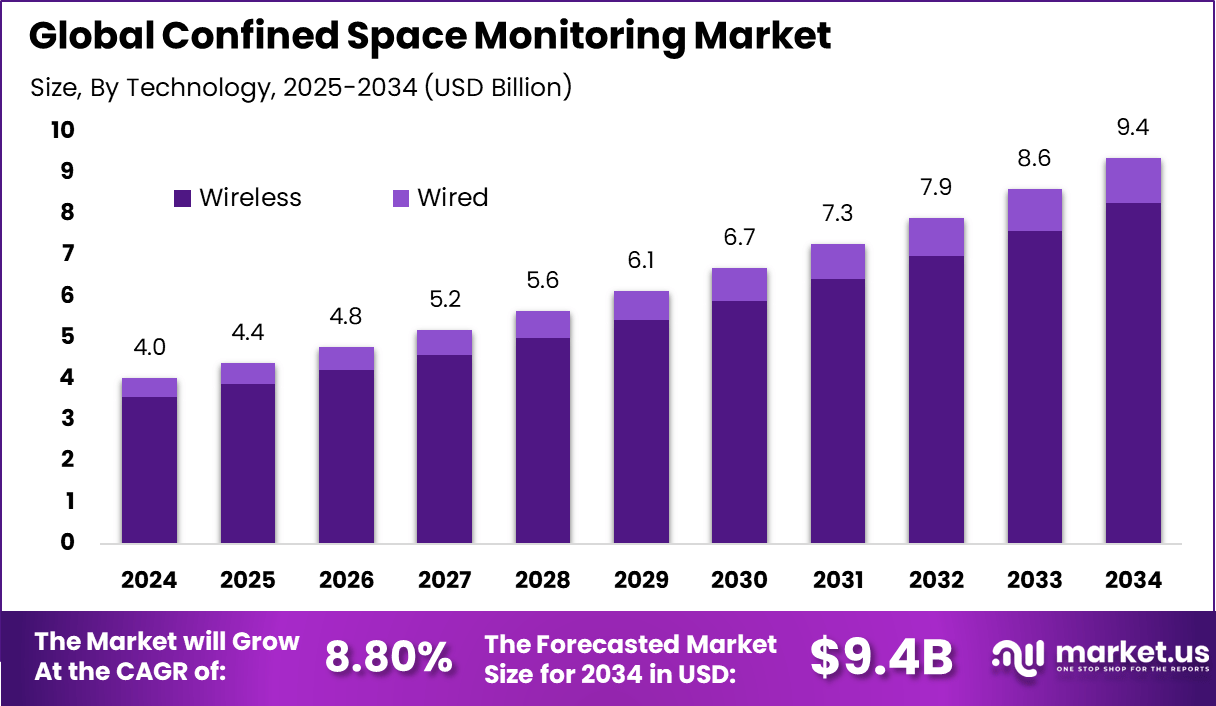
The Global Confined Space Monitoring Market generated USD 4.0 billion in 2024 and is projected to reach approximately USD 9.4 billion by 2034, growing at a CAGR of 8.80% from 2025. North America led the market in 2024, capturing over 34.7% market share, with USD 1.39 billion in revenue.
Confined space monitoring solutions are crucial for ensuring the safety of workers in hazardous environments, detecting toxic gases, oxygen levels, and other dangerous conditions. The growing demand for workplace safety regulations and technological advancements in IoT and sensor technologies are driving market growth.
How Growth is Impacting the Economy
The rapid growth of the confined space monitoring market is driving positive economic impacts, particularly in industrial sectors where worker safety is a primary concern. With increasing regulatory requirements for workplace safety, industries such as construction, oil and gas, manufacturing, and mining are adopting advanced monitoring systems to protect workers in confined spaces. This demand is creating new jobs in technology, safety, and compliance sectors, contributing to economic growth.
As more companies invest in these systems, they are improving productivity by reducing workplace accidents and downtime. Additionally, these solutions are helping companies comply with stricter safety regulations, avoiding costly fines and improving operational efficiency. By preventing accidents and fatalities, these systems reduce insurance costs, further enhancing profitability in affected industries. The growth of this market reflects broader trends in workplace safety, innovation, and regulatory compliance that are benefiting global economies.
➤ Smarter strategy starts here! Get the sample – https://market.us/report/confined-space-monitoring-market/free-sample/
Impact on Global Businesses
The confined space monitoring market is transforming global businesses by addressing rising costs associated with workplace safety and regulatory compliance. As safety standards tighten globally, industries such as oil and gas, manufacturing, and construction are increasingly adopting these systems to prevent accidents and costly fines. The rising need for safety in confined spaces has also led to the growth of new supply chains for monitoring devices, sensors, and IoT technologies.
In sectors like construction and mining, this demand is being met with more advanced, real-time monitoring systems, improving safety standards and reducing liability costs. The oil and gas industry benefits significantly from these solutions, as they mitigate the risks of hazardous gas exposure, saving both lives and resources.
Furthermore, as businesses adapt to these safety needs, they are seeing reduced insurance premiums, fewer operational shutdowns, and better workforce efficiency. Confined space monitoring systems also help businesses avoid downtime caused by accidents, directly benefiting operational continuity.
Strategies for Businesses
To capitalize on the growth in the confined space monitoring market, businesses must focus on adopting cutting-edge technologies such as IoT-based sensors, wireless communication, and real-time data analytics. Integration of AI and machine learning for predictive maintenance is also becoming a key strategy, enabling businesses to anticipate hazardous conditions before they become critical.
Businesses should prioritize partnerships with safety equipment manufacturers to ensure continuous innovation in monitoring technologies and maintain compliance with evolving safety regulations. Additionally, companies should invest in training their workforce on the importance of safety protocols and the proper use of monitoring systems. As the market grows, offering flexible and scalable monitoring solutions tailored to specific industries will be crucial for gaining a competitive edge.
Key Takeaways
- The confined space monitoring market is expected to grow from USD 4.4 billion in 2025 to USD 9.4 billion by 2034, at a CAGR of 8.80%.
- North America holds a dominant market share of 34.7%, valued at USD 1.39 billion in 2024.
- Demand for safety monitoring solutions is driven by stringent workplace regulations and the need to reduce workplace accidents.
- Key sectors benefiting include construction, oil and gas, mining, and manufacturing.
- Technological advancements, including IoT and AI integration, are driving market expansion.
➤ Unlock growth secrets! Buy the full report – https://market.us/purchase-report/?report_id=168853
Analyst Viewpoint
The confined space monitoring market is currently experiencing steady growth, driven by the increasing emphasis on workplace safety regulations. In the future, this market will continue to expand, particularly as IoT technologies and AI-driven predictive analytics play a larger role in ensuring real-time monitoring and faster response times. The industry’s focus on enhancing worker protection and minimizing environmental risks will drive demand for more advanced, cost-effective solutions. The future of confined space monitoring is promising, as industries across the globe invest in innovations that will improve safety standards and operational efficiency. The growth trajectory suggests significant market opportunities in emerging economies as safety regulations become stricter worldwide.
Use Case and Growth Factors
| Use Case | Growth Factor |
|---|---|
| Oil & Gas | Rising need for hazardous gas detection and ventilation safety |
| Construction & Mining | Increased regulations around worker safety in confined spaces |
| Manufacturing | Demand for real-time safety monitoring solutions |
| Emergency Services | Enhanced safety in confined space rescue operations |
| Facility Management | Growing need for comprehensive safety management systems |
Regional Analysis
North America holds the largest market share in the confined space monitoring market, accounting for 34.7% in 2024, driven by stringent workplace safety regulations and widespread industrial activities. The region’s advanced infrastructure and high adoption of IoT technologies are key factors in its dominance.
Europe follows, with a growing focus on worker safety and environmental protection, further boosting market demand. The Asia Pacific region is expected to witness the highest growth, driven by increased industrialization, particularly in China and India, where safety standards are evolving rapidly. Emerging economies are adopting monitoring solutions as regulatory requirements become more stringent.
➤ Want more market wisdom? Browse reports –
- Texture Generation AI Market
- Player Performance AI Market
- AI Commentary Service Market
- AI Patent Search Market
Business Opportunities
The growing demand for confined space monitoring solutions presents significant business opportunities, particularly in industries with high safety risks, such as oil and gas, mining, and construction. As safety regulations tighten globally, there is an increasing need for advanced, cost-effective solutions that can detect hazardous conditions in real time.
Companies specializing in IoT sensors, wireless technologies, and AI-driven predictive analytics can capitalize on this growth by offering innovative solutions tailored to industry-specific needs. Furthermore, there is an opportunity for businesses to expand into emerging markets, particularly in the Asia Pacific region, where industrial activities are expanding rapidly and safety standards are evolving.
Key Segmentation
The confined space monitoring market is segmented into:
- By Product Type: Gas detection systems, oxygen monitoring systems, environmental monitoring systems
- By End-User: Oil and gas, construction, mining, manufacturing, others
- By Technology: IoT-based sensors, wireless communication, AI-powered systems
- By Region: North America, Europe, Asia Pacific, Latin America, Middle East & Africa
These segments are driving the adoption of monitoring solutions, with key industries focusing on safety, operational efficiency, and regulatory compliance.
Key Player Analysis
Key players in the confined space monitoring market are focusing on technological innovation, particularly in the integration of IoT sensors, wireless communication, and AI-driven monitoring solutions. By offering scalable solutions that meet the specific needs of industries such as oil and gas, construction, and manufacturing, these players are solidifying their market positions.
Companies are also enhancing their product offerings with real-time data analytics, predictive maintenance capabilities, and remote monitoring to improve safety and operational efficiency. Strategic partnerships with regulatory bodies and safety organizations are helping these players stay ahead in an increasingly competitive market.
- Honeywell International Inc.
- Drägerwerk AG & Co. KGaA
- MSA Safety Incorporated
- Industrial Scientific Corporation
- Teledyne Technologies Incorporated
- RKI Instruments, Inc.
- Trolex Ltd.
- GfG Europe Ltd.
- Tyco International (Johnson Controls)
- Crowcon Detection Instruments Ltd.
- RAE Systems (by Honeywell)
- Blackline Safety Corp.
- Oldham (by Teledyne Gas and Flame Detection)
- Sensidyne, LP
- Scott Safety (by 3M)
- Others
Recent Developments
- January 2025: A leading manufacturer launched a new AI-powered confined space monitoring system for real-time hazard detection.
- February 2025: A safety technology company introduced a wireless monitoring solution for construction sites to enhance worker protection.
- March 2025: An industrial IoT company expanded its portfolio with a next-generation gas detection system for confined spaces.
- April 2025: A global player in safety equipment released a new multi-sensor environmental monitoring system tailored for confined spaces.
- May 2025: A major oil and gas firm implemented a new real-time air quality monitoring system for offshore platforms.
Conclusion
The confined space monitoring market is growing rapidly, driven by the need for improved safety in industrial environments. As regulatory pressures increase, businesses are increasingly investing in advanced monitoring systems to enhance worker protection, improve operational efficiency, and comply with safety regulations. The market offers significant growth opportunities for companies focusing on innovation, real-time monitoring, and scalable solutions tailored to specific industries.
Discuss your needs with our analyst
Please share your requirements with more details so our analyst can check if they can solve your problem(s)