Table of Contents
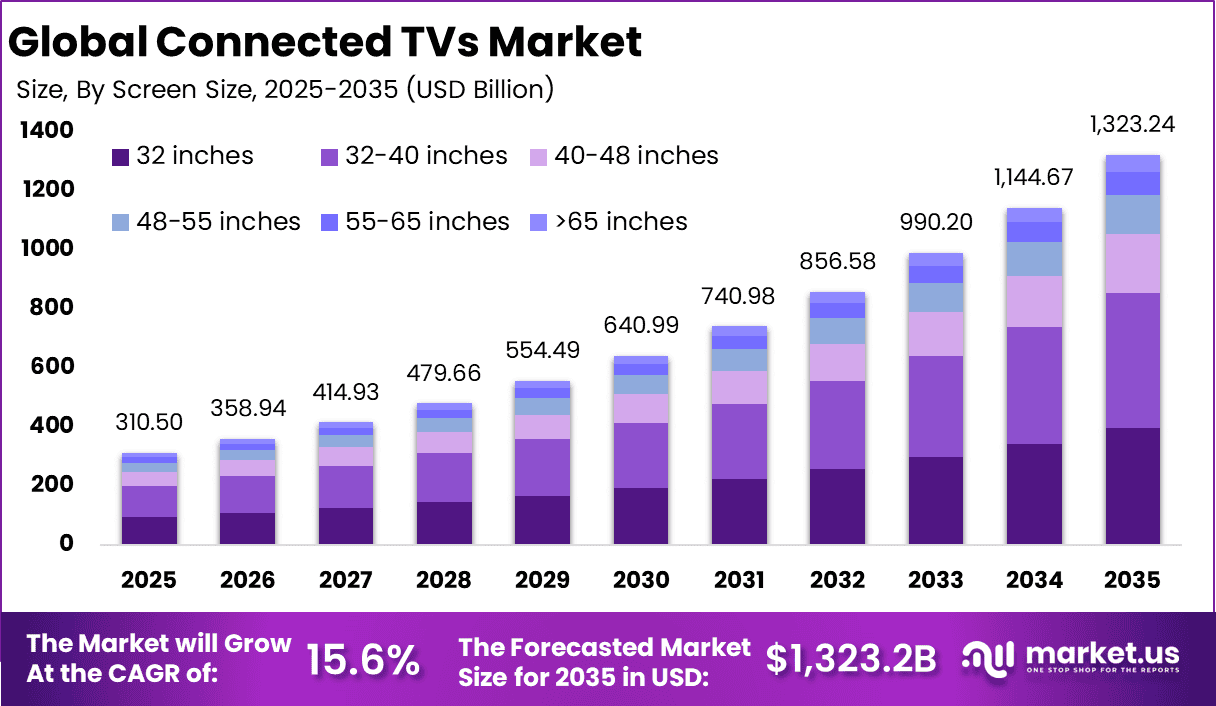
The global connected TVs market is projected to reach approximately USD 1,323.2 billion by 2035, rising from USD 310.5 billion in 2025, reflecting a compound annual growth rate of 15.6% during the forecast period from 2026 to 2035. This growth is being driven by the increasing demand for smart entertainment, rising internet penetration, and the rapid expansion of streaming platforms. In 2025, North America held a dominant market position, capturing more than 36.2% share and generating around USD 112.4 billion in revenue, supported by strong digital infrastructure and high consumer spending on smart devices.
Connected TVs are becoming central to modern home entertainment ecosystems by integrating internet connectivity, applications, and advanced display technologies. Consumers are shifting from traditional broadcasting to on-demand and personalized content consumption. The adoption of smart home technologies is further enhancing the role of connected TVs as interactive digital hubs. As content consumption patterns evolve, the market is expected to witness sustained growth across regions.
Top Market Takeaways
- The market is expected to grow from USD 310.5 billion in 2025 to USD 1,323.2 billion by 2035, reflecting a 15.6% CAGR.
- OLED panels dominated with 60.7% share, driven by superior display quality and energy efficiency.
- Screen sizes between 32 to 40 inches accounted for 34.7% share, supported by demand in compact living spaces.
- Voice control features represented 32.8% adoption, reflecting increasing integration of smart assistants.
- Android TV held 30.0% share among operating systems, supported by its open ecosystem and application compatibility.
- Wi-Fi connectivity accounted for 35.5% share, driven by demand for seamless streaming experiences.
- North America led with 36.2% share, while the U.S. market generated USD 95.54 billion and continues to grow steadily.
How Connected TVs are Reshaping the Future?
Connected TVs are reshaping the future of home entertainment by enabling personalized and on-demand content consumption. Users can access streaming platforms, applications, and digital services directly through their televisions. This reduces reliance on traditional cable services and enhances user convenience. As a result, viewing experiences are becoming more flexible and user-centric.
In addition, connected TVs are integrating with smart home ecosystems to provide enhanced functionality. Features such as voice control and device synchronization allow users to manage multiple connected devices seamlessly. This improves user experience and increases device utility. Over time, connected TVs are evolving into central hubs for digital interaction within households.
Scope and Research Methodology
The scope of the connected TVs market includes devices that integrate internet connectivity, operating systems, and applications to deliver digital content. It covers components such as display technologies, connectivity options, and software platforms. The analysis includes adoption across residential and commercial sectors. Both premium and mid-range product segments are considered.
The research methodology is based on evaluating consumer behavior trends, technological advancements, and digital content consumption patterns. Publicly available data and observed market developments have been analyzed. Validation is supported by usage trends and innovation in display and connectivity technologies. A structured framework ensures consistency and reliability of insights.
Key Forces Driving Market Expansion
One of the primary forces driving market growth is the increasing demand for streaming services and digital content. Consumers are shifting toward on-demand entertainment platforms that offer flexibility and variety. Connected TVs enable seamless access to these services. This is encouraging widespread adoption.
Another key force is the rapid growth of broadband and high-speed internet connectivity. Improved network infrastructure allows users to stream high-quality content without interruptions. This enhances the overall viewing experience. It is significantly contributing to market expansion.
Emerging Trends Analysis
A major trend in the market is the adoption of advanced display technologies such as OLED, which accounted for 60.7% of the market share. These technologies provide better picture quality, contrast, and energy efficiency. This is influencing consumer purchasing decisions. The trend is gaining traction globally.
Another emerging trend is the integration of voice control features, which represented 32.8% adoption. Voice-enabled TVs allow users to interact with devices using natural language commands. This improves accessibility and convenience. The trend is expanding with the growth of smart assistants.
Driver Analysis
A key driver is the strong adoption of Wi-Fi connectivity, which accounted for 35.5% share. Seamless internet connectivity is essential for accessing streaming services and applications. This is driving demand for connected TVs.
Another driver is the popularity of Android TV, which captured 30.0% share. Its open ecosystem and wide application compatibility attract both manufacturers and consumers. This is supporting market growth.
Restraint Analysis
One of the major restraints is the high cost of advanced connected TV models, particularly those with premium display technologies. This can limit adoption among price-sensitive consumers. Cost remains a barrier in certain markets.
Another restraint is concerns related to data privacy and security. Connected TVs collect user data for personalization and analytics. Ensuring secure data handling is critical. These concerns may impact consumer trust.
Opportunity Analysis
A significant opportunity lies in the expansion of connected TVs in emerging markets. Increasing internet penetration and rising disposable income are driving demand for smart entertainment devices. This presents strong growth potential.
Another opportunity is the integration of connected TVs with smart home ecosystems. As consumers adopt smart devices, the demand for integrated solutions is increasing. This creates new opportunities for innovation and product development.
Challenge Analysis
A key challenge is managing software updates and compatibility across different platforms and devices. Ensuring smooth performance and user experience requires continuous updates. This can increase operational complexity.
Another challenge is the fragmentation of content platforms and services. Users may need multiple subscriptions to access desired content. This can affect user experience and adoption. Addressing this issue is important for market growth.
Competitive Analysis
The competitive landscape is characterized by strong innovation in display technologies, operating systems, and smart features. Companies are focusing on enhancing product performance and user experience. Differentiation is achieved through advanced features and ecosystem integration. This is intensifying competition in the market.
In addition, organizations are forming partnerships with content providers and technology platforms to expand their offerings. The focus is on delivering seamless and personalized entertainment experiences. Competitive strategies also include improving affordability and expanding distribution networks. This is shaping a dynamic market environment.
Top Key Players in the Market
- Samsung Electronics
- LG Electronics
- Sony Corporation
- Panasonic Corporation
- Philips
- TCL Technology
- Xiaomi Corporation
- Hisense Group
- Sharp Electronics
- Roku
- Skyworth
- Haier Group
- Others
Key Market Segments
By Panel Type
- LCD
- OLED
- QLED
By Screen Size
- 32 inches
- 32-40 inches
- 40-48 inches
- 48-55 inches
- 55-65 inches
- >65 inches
By Smart Features
- Voice control
- Gesture control
- Content streaming
- Gaming
- Smart home integration
- Others
By Operating System
- Android TV
- Tizen OS
- webOS
- Fire TV OS
- Roku OS
- Others
By Connectivity Feature
- Wi-Fi
- Bluetooth
- Ethernet
- HDMI
- USB
- Others
Conclusion
The connected TVs market is experiencing steady growth, driven by the increasing demand for smart entertainment, digital content, and advanced technologies. Consumers are adopting connected TVs to access personalized and on-demand content. The integration of smart features and connectivity is transforming traditional television experiences.
Despite challenges related to cost, data privacy, and platform fragmentation, the overall outlook remains positive. Continued advancements in display technologies and increasing adoption of smart home ecosystems are expected to support long-term growth. As consumer preferences evolve, connected TVs will play a central role in shaping the future of digital entertainment. The market is positioned for sustained expansion with significant impact on global media consumption.
Discuss your needs with our analyst
Please share your requirements with more details so our analyst can check if they can solve your problem(s)