Table of Contents
Introduction
The global desert border surveillance market was valued at USD 6.37 billion in 2024 and is projected to reach USD 14.67 billion by 2034, expanding at a robust 8.7% CAGR. Increasing cross-border risks, illegal smuggling, and national security priorities are driving investment in advanced surveillance technologies. North America dominated the market with a 39.4% share, generating USD 2.50 billion in 2024, supported by heavy defense spending and large-scale border modernization programs.
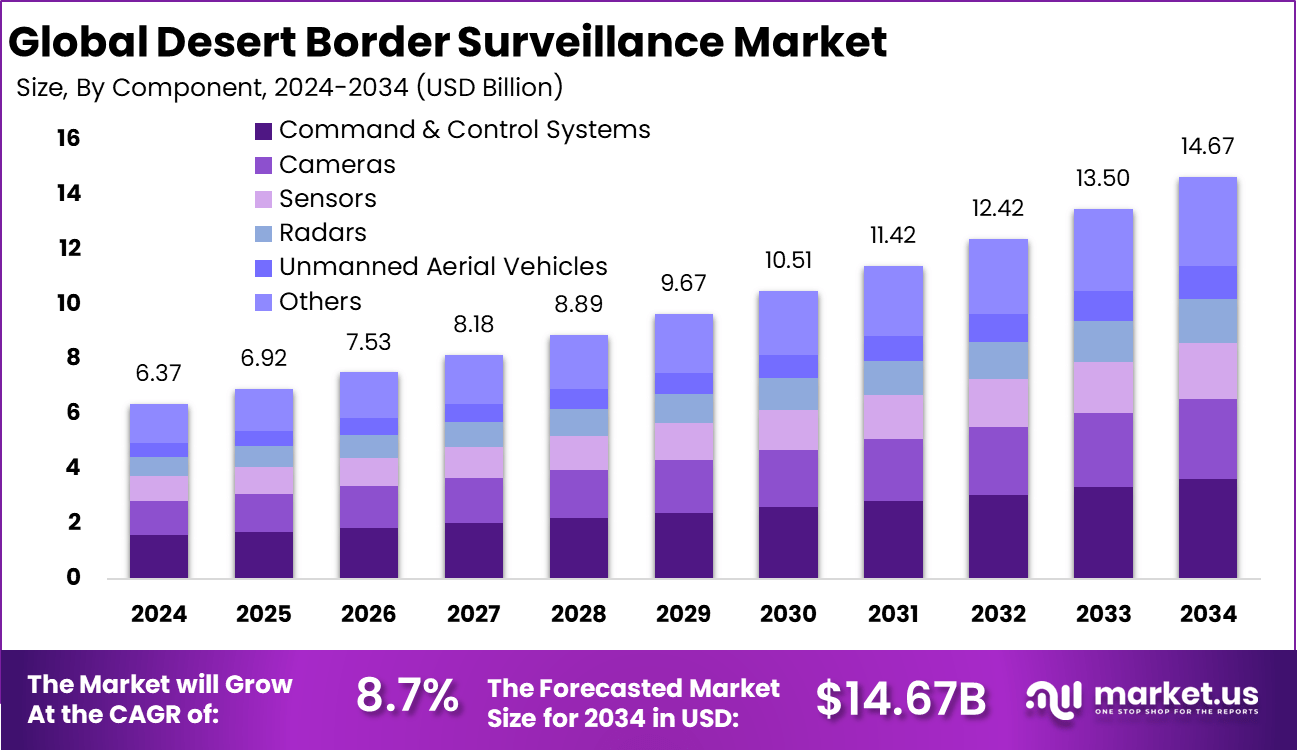
How Growth Is Impacting the Economy
The rapid expansion of desert border surveillance infrastructure is boosting economic activity across defense technology, communication networks, and advanced security systems. Continuous investments stimulate job creation in aerospace engineering, AI analytics, software development, and sensor manufacturing. Governments are prioritizing resilient borders to reduce economic losses associated with illegal trafficking, unmonitored migration, and cross-border crime.
This shift strengthens national stability and reduces long-term enforcement costs. Additionally, the growth of radar, drones, electro-optical systems, and command-and-control platforms is stimulating innovation ecosystems, attracting private-sector investments, and enhancing global trade security. As demand rises, both developed and emerging countries are increasing procurement budgets, creating a broader economic ripple effect that supports defense exports and industrial capacity utilization.
➤ Smarter strategy starts here! Get the sample – https://market.us/report/desert-border-surveillance-market/free-sample/
Impact on Global Businesses
Rising costs in sensors, thermal cameras, and high-end communication systems are increasing the financial burden on solution providers and governments. Supply chains are shifting toward localized production to ensure reliability and reduce geopolitical risks. Sector-specific impacts include improved situational awareness for defense agencies, enhanced perimeter protection for energy infrastructure, and greater reliance on unmanned surveillance systems in mining and remote industrial operations. Private contractors also gain new opportunities through integrated security platforms.
Strategies for Businesses
• Invest in AI-driven threat detection systems
• Strengthen supply chains with domestic manufacturing partnerships
• Prioritize ruggedized equipment for extreme desert conditions
• Adopt interoperable platforms for multi-agency coordination
• Expand R&D in long-range sensing and autonomous systems
Key Takeaways
• Market to reach USD 14.67 billion by 2034
• Strong 8.7% CAGR driven by rising border security needs
• North America leads with 39.4% share
• AI, drones, and radar systems shaping future surveillance
• Governments are increasing border modernization budgets
➤ Unlock growth secrets! Buy the full report – https://market.us/purchase-report/?report_id=169709
Analyst Viewpoint
The current market is witnessing strong momentum as global security demands intensify. Investments in unmanned systems, thermal imaging, radar, and AI-based analytics are accelerating adoption across both government and private sectors. Looking ahead, autonomous surveillance networks and integrated command centers will transform border monitoring efficiency. With rising geopolitical tensions and cross-border risks, long-term market growth remains highly positive, supported by innovation and sustained defense funding.
Use Case & Growth Factors
| Category | Details |
|---|---|
| Key Use Cases | Perimeter monitoring, illegal trafficking detection, drone-based patrols, remote infrastructure protection, long-range thermal surveillance |
| Growth Factors | Geopolitical tensions, government defense spending, AI adoption, unmanned systems expansion, advanced radar deployment |
Regional Analysis
North America dominates due to substantial defense budgets, large desert borders, and advanced technological integration across military surveillance systems. Europe follows with rising investment in protecting external borders and critical desert regions. Asia-Pacific is expanding rapidly, driven by territorial disputes, homeland security modernization, and increased drone adoption. The Middle East and Africa show significant potential as vast desert terrains require robust, long-range surveillance. Latin America is gradually adopting advanced border systems to strengthen national security initiatives.
➤ Want more market wisdom? Browse reports –
- Bandwidth Calculator Tools Market
- Hold Your Own Key Platform Market
- Cross-Device Sync Platform Market
- Flux for Semiconductor Market
Business Opportunities
Key opportunities lie in AI-enhanced surveillance analytics, autonomous drones, long-endurance radar systems, and multi-sensor fusion platforms. Companies can explore partnerships with defense agencies to deliver integrated command-and-control solutions. Growing demand for rugged communication networks, solar-powered surveillance towers, and real-time threat intelligence platforms also offers profitable avenues. Emerging markets with large, unsecured desert borders represent strong long-term potential for scalable solutions.
Key Segmentation
The market is segmented by system type, technology, end-user, platform, and application. System types include radar systems, thermal cameras, electro-optical sensors, drones, and integrated security towers. Advanced technologies such as AI, machine learning, and satellite-based monitoring are gaining traction. Key end-users include defense, homeland security, border protection forces, and critical infrastructure industries. Applications span illegal trafficking detection, perimeter security, smuggling prevention, and real-time monitoring in remote desert environments.
Key Player Analysis
Leading market participants focus on enhancing long-range detection accuracy, improving rugged hardware performance, and integrating AI for automated threat classification. Companies are expanding their portfolios with unmanned aerial platforms, advanced thermal imaging systems, and modular command centers. Strategic partnerships with defense agencies strengthen market positioning, while investments in secure communication networks and multi-sensor integration enable better situational awareness. Continuous R&D supports innovation in autonomous systems and desert-ready surveillance tools.
- Elbit Systems Ltd.
- Raytheon Technologies Corporation
- Lockheed Martin Corporation
- Leonardo S.p.A.
- Thales Group
- FLIR Systems, Inc. (Teledyne FLIR)
- Northrop Grumman Corporation
- Saab AB
- BAE Systems Plc
- Harris Corporation (L3Harris Technologies)
- Indra Sistemas S.A.
- Israel Aerospace Industries (IAI)
- General Dynamics Corporation
- Rheinmetall AG
- Kongsberg Gruppen ASA
- Airbus Defence and Space
- Others
Recent Developments
• Launch of long-endurance solar-powered surveillance towers
• Deployment of AI-driven perimeter threat detection platforms
• Expansion of drone-based border patrol fleets in desert regions
• Introduction of next-generation long-range radar systems
• Investments in integrated command-and-control surveillance networks
Conclusion
The desert border surveillance market continues to expand as nations strengthen security infrastructure. With advancements in AI, drones, and rugged sensors, the market offers strong long-term growth potential supported by rising geopolitical and security demands.
Discuss your needs with our analyst
Please share your requirements with more details so our analyst can check if they can solve your problem(s)