Table of Contents
Market Overview
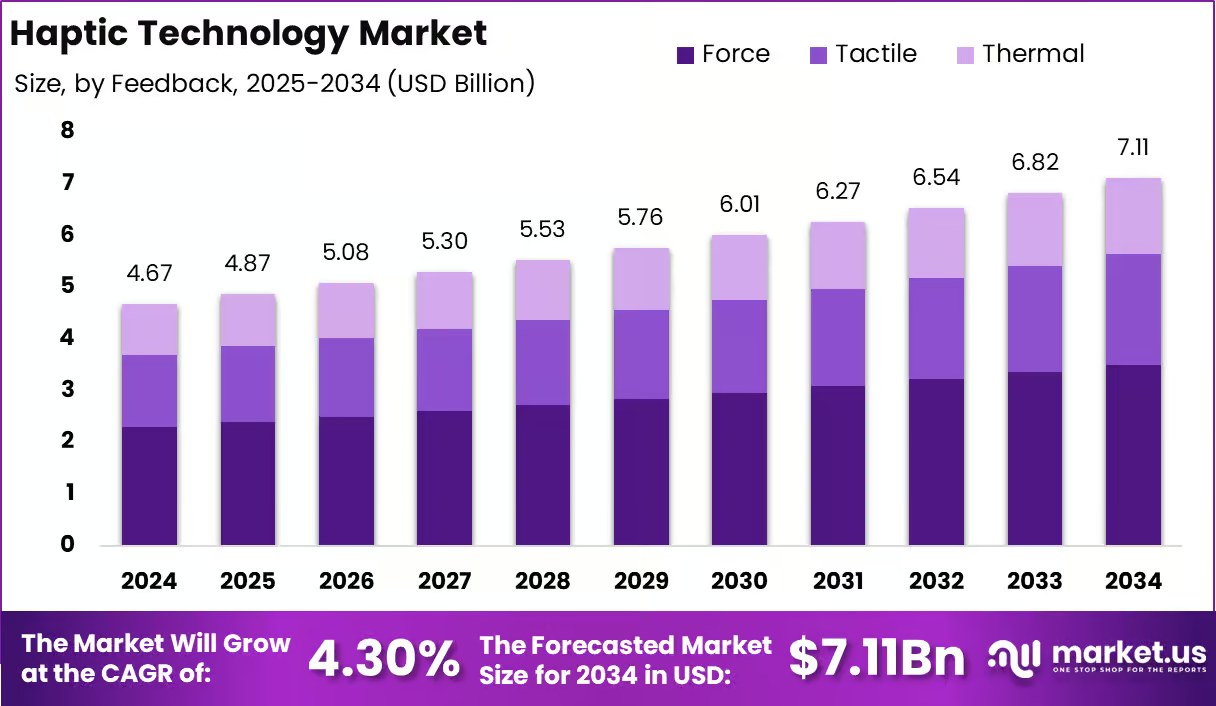
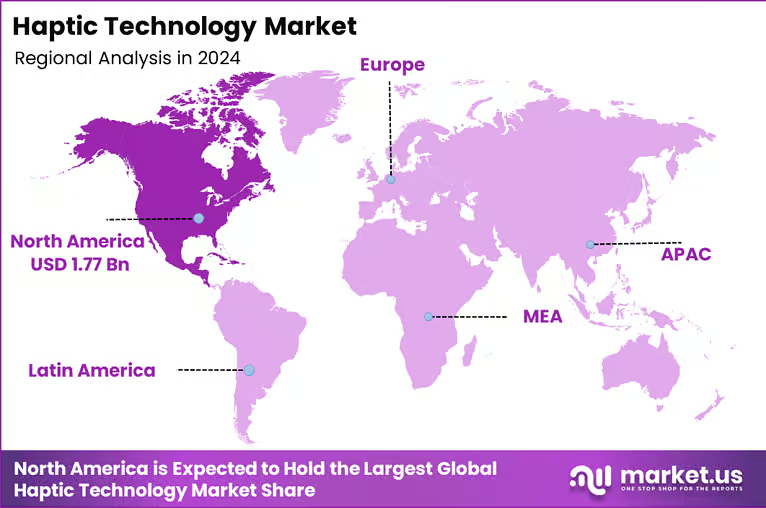
The haptic technology market is projected to expand at a CAGR of 4.3% from 2024 to 2034, supported by increasing integration of tactile feedback systems across consumer electronics, automotive, and healthcare applications. North America accounted for 38% of the global market in 2024, driven by strong adoption in the US across smartphones, wearables, and advanced automotive controls.
Hardware dominated with 67.3% share due to its critical role in actuators, sensors, and drivers. Force feedback led with 49.2%, while graspable interfaces accounted for 43.1%. Consumer electronics emerged as the leading application segment with 27.8%, reflecting rising demand for enhanced user interaction.
Key Takeaways
- The market is projected to grow at a CAGR of 4.3% from 2024 to 2034.
- North America held 38% of the global market in 2024.
- The US remains the leading contributor within North America.
- Hardware is dominated by components with 67.3% share.
- Force feedback led the feedback type segment with 49.2%.
- Graspable interfaces accounted for 43.1% by usage type.
- Consumer electronics led applications with 27.8% share.
- Growth is driven by demand for immersive and responsive user experiences.
Role of AI
Artificial intelligence is strengthening the capabilities of haptic technology by enabling smarter and more adaptive tactile responses. AI algorithms help interpret user behavior, pressure sensitivity, and motion patterns to deliver more precise and personalized feedback. In consumer electronics, AI enhances touch response in smartphones and wearables by adjusting vibration intensity and patterns.
Automotive systems, AI-driven haptics improve driver interaction with touch controls, reducing distraction and improving safety. In healthcare and simulation, AI supports realistic feedback in robotic surgeries and training systems. As AI integration deepens, haptic systems are expected to become more intuitive, context-aware, and responsive across applications.
Analyst’s Viewpoint
The haptic technology market is progressing steadily as industries focus on improving human-machine interaction. Growth is being shaped by the need for more immersive digital experiences and more intuitive control systems across devices.
Hardware continues to dominate due to its foundational role in enabling tactile precision, while force feedback remains critical in high-accuracy environments such as simulation and robotics. Consumer electronics leads adoption, but automotive and healthcare applications are expected to expand steadily. The market outlook remains stable as innovation continues to enhance realism, responsiveness, and user engagement across multiple end-use industries.
Regional Highlights
North America accounted for 38% of the global haptic technology market in 2024, supported by strong demand across consumer electronics, automotive systems, and healthcare devices. The US leads regional growth due to high adoption of advanced smartphones, wearables, and connected vehicle technologies.
The presence of established technology ecosystems and continuous product innovation supports regional dominance. Increasing integration of haptic feedback in automotive infotainment systems and medical devices is also contributing to growth. North America is expected to maintain its leadership position as industries continue to invest in enhanced user interface technologies and immersive digital experiences.
Key Market Segmentation
- By Component: Hardware leads due to its essential role in enabling tactile feedback through actuators, sensors, and control systems.
- By Feedback Type: Force feedback dominates as it provides the realistic resistance and precision required in simulation and advanced interfaces.
- By Usage Type: Graspable interfaces lead due to growing adoption in VR, robotics, and medical training applications.
- By Application: Consumer electronics dominate as devices increasingly integrate haptic feedback to improve user engagement and interaction.
Emerging Trends
- Increasing adoption of haptics in AR and VR environments.
- Integration of haptic feedback in automotive touch interfaces.
- Growth of wearable devices with advanced tactile features.
- Development of multi-dimensional and localized feedback systems.
- Rising focus on energy-efficient and compact haptic components.
Top Use Cases
- Smartphones and tablets for enhanced touch interaction.
- Virtual reality gaming for immersive experiences.
- Automotive dashboards for safer control systems.
- Medical simulation and robotic surgery training.
- Wearable devices for notifications and health monitoring.
Major Challenges
- High cost of advanced haptic components.
- Complexity in integrating precise feedback systems.
- Limited standardization across devices and platforms.
- Power consumption concerns in portable devices.
- Technical limitations in achieving realistic tactile sensations.
Attractive Opportunities
- Expansion of haptics in healthcare and surgical robotics.
- Growing demand in gaming and immersive entertainment.
- Rising use in automotive safety and driver assistance systems.
- Development of next-generation wearable technologies.
- Increasing adoption in industrial training and simulation systems.
Business Benefits
Haptic technology delivers strong business value by improving user engagement, product differentiation, and overall experience quality. In consumer electronics, it enhances device interaction, making interfaces more intuitive and satisfying. Automotive systems improve safety by enabling drivers to interact with controls without distraction.
In healthcare and training, it provides realistic simulation environments that improve learning outcomes and precision. Businesses benefit from higher customer satisfaction, better usability, and stronger product appeal. As haptic systems become more advanced and cost-efficient, companies are expected to leverage them to create more interactive and user-centric solutions across industries.
Recent Developments
Recent developments focus on improving actuator efficiency, reducing component size, and enhancing multi-point feedback capabilities. Companies are also integrating haptics with AI and advanced sensors to create more responsive and adaptive systems across consumer electronics, automotive, and healthcare applications.
Key Players Analysis
The market is moderately competitive, with companies focusing on innovation in hardware components, feedback precision, and system integration. Players are strengthening their portfolios by developing compact, energy-efficient, and high-performance haptic solutions tailored for consumer electronics, automotive, and healthcare sectors.
Top Key Players in the Market
- Immersion Corporation
- Imagis Co., Ltd.
- Nidec Corporation
- Onsemi
- Johnson Electric Holdings Limited
- Microchip Technology Incorporated
- AAC Technologies
- Aito BV
- Force Dimension
- Geomagic, Inc.
- Others
Customer Insights
Customers in the haptic technology market prioritize performance, responsiveness, and reliability when selecting solutions. Consumer electronics buyers seek enhanced touch experience, battery efficiency, and seamless integration. Automotive customers focus on safety, ease of use, and durability in haptic-enabled controls. Healthcare users prioritize precision and realism in simulation and robotic systems.
Purchasing decisions are influenced by product performance, compatibility, and long-term value. Across segments, there is a clear preference for technologies that deliver consistent, high-quality tactile feedback while maintaining efficiency and ease of integration.
Future Outlook
The haptic technology market is expected to witness steady growth as industries continue to focus on improving interaction between humans and digital systems. Consumer electronics will remain a major driver, while automotive and healthcare applications are projected to gain stronger traction.
Advancements in actuator design, AI integration, and feedback precision are expected to enhance system capabilities. The demand for immersive technologies such as AR and VR is likely to further support market expansion. As technology evolves, haptic systems are expected to become more refined, accessible, and widely adopted across multiple sectors.
Conclusion
The haptic technology market is developing at a steady pace, supported by growing demand for enhanced user interaction and immersive experiences. With a projected CAGR of 4.3% from 2024 to 2034, the market reflects consistent adoption across consumer electronics, automotive, and healthcare sectors.
Hardware continues to dominate due to its critical role in system functionality, while force feedback and graspable interfaces highlight the importance of realism and control. North America leads the market, driven by strong technological adoption. As innovation continues, the market is expected to offer stable growth and expanded application opportunities across industries.
Discuss your needs with our analyst
Please share your requirements with more details so our analyst can check if they can solve your problem(s)