Table of Contents
Market Overview
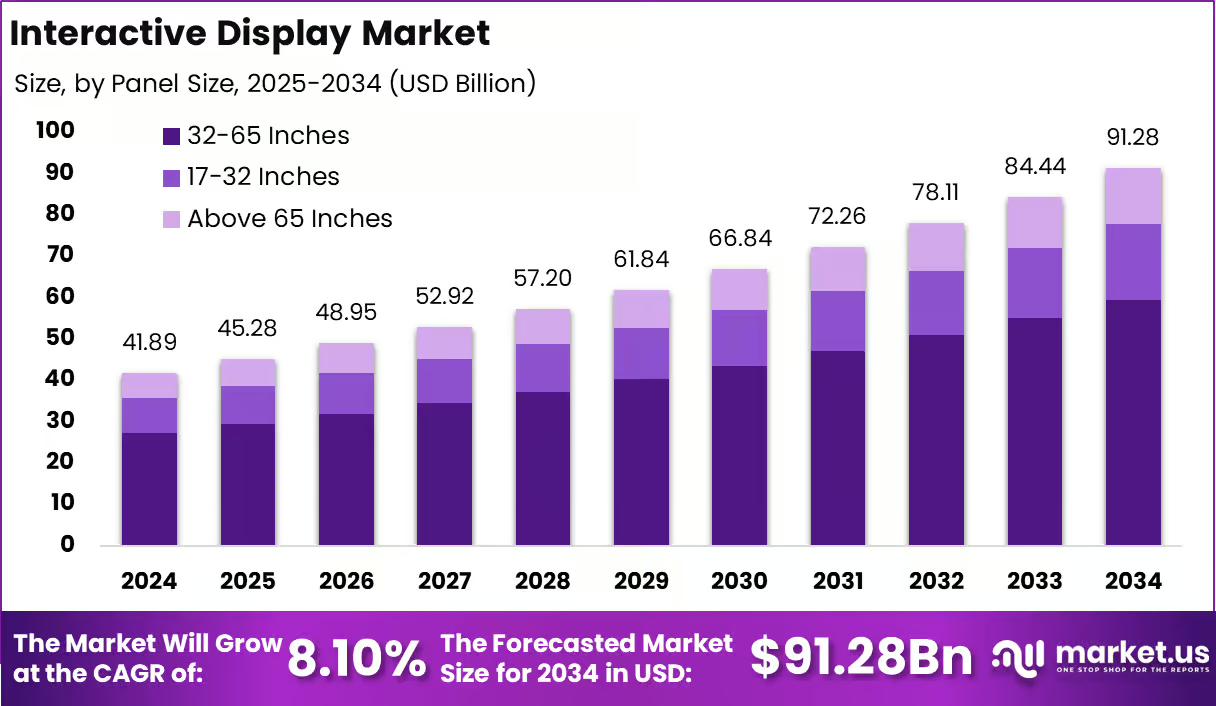
The global interactive display market was valued at USD 41.89 billion in 2024 and is projected to reach USD 91.28 billion by 2034, expanding at a CAGR of 8.1% during the forecast period. Market growth is being shaped by rising adoption of digital learning tools, stronger use of collaborative technologies in enterprises, and wider deployment of display-based engagement systems across commercial spaces.
Interactive whiteboards remain in strong demand due to their value in classrooms and training centers. Flat panels and LED-based displays remain central to demand as buyers increasingly prefer energy-efficient, high-clarity, and easy-to-install solutions across education, corporate, and institutional settings.
Key Takeaways
- The global interactive display market stood at USD 41.89 billion in 2024.
- The market is anticipated to reach USD 91.28 billion by 2034.
- The market is projected to expand at a CAGR of 8.1% over the forecast period.
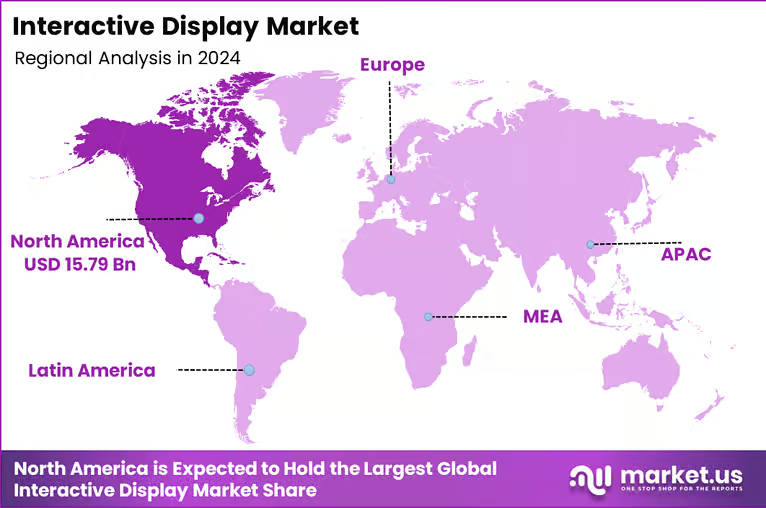
- North America held 37.7% of the global market in 2024.
- North America was valued at USD 15.79 billion in 2024.
- The US market accounted for USD 35.8 billion in 2024.
- The US market is projected to reach USD 66.57 billion by 2034.
- The US market is expected to grow at a CAGR of 6.4%.
- By product, interactive whiteboards led with 35.6% share.
- By panel size, 32–65 inches dominated with 65.2% share.
- By panel type, flat panels held 98.2% share.
- By technology, LED-based displays led with 70.3% share.
- By vertical, education accounted for 30.5% share.
Role of AI
Artificial intelligence is becoming a meaningful value enhancer in the interactive display market as buyers increasingly expect smarter and more responsive user experiences. AI supports voice recognition, gesture control, automated content recommendations, language translation, meeting transcription, and real-time classroom assistance. In business settings, AI-powered displays improve collaboration by simplifying presentations, note capture, and hybrid meeting engagement.
In education, AI helps personalize learning content and improve student interaction through adaptive teaching tools. AI also supports predictive maintenance and usage analytics, allowing institutions and enterprises to optimize screen performance, reduce downtime, and improve return on investment from interactive display deployments.
Analyst’s Viewpoint
The interactive display market shows strong long-term potential, as it sits at the intersection of education modernization, enterprise digitization, and smart visual communication. Demand is no longer limited to premium institutions or large corporations. Mid-sized enterprises, training centers, retail spaces, and public institutions are also adopting these systems to improve engagement and productivity.
The dominance of flat panels and LED-based technologies reflects a clear buyer preference for low-maintenance and high-performance solutions. Education remains the leading vertical, but commercial and corporate demand is expected to deepen further. The market outlook remains favorable as display technology becomes more intelligent, collaborative, and application-focused across sectors.
Regional Highlights
North America led the global interactive display market with 37.7% share in 2024 and reached USD 15.79 billion, supported by strong digital adoption across education and corporate environments. The region benefits from established technology infrastructure, early adoption of smart classroom tools, and widespread use of collaboration platforms in enterprises.
The US remains a major revenue contributor, valued at USD 35.8 billion in 2024 and projected to reach USD 66.57 billion by 2034 at a CAGR of 6.4%. Regional momentum is also supported by ongoing investment in digital learning systems, workplace modernization, and connected presentation technologies. North America is expected to remain a high-value market throughout the forecast period.
Key Market Segmentation
- By Product: Interactive whiteboards led the market due to their strong use in classrooms, training rooms, and collaborative workspaces.
- By Panel Size: 32–65 inch displays dominated because they offer the right balance of visibility, affordability, and installation flexibility.
- By Panel Type: Flat panels held the leading share as users prefer slim, energy-efficient, and high-quality display formats.
- By Technology: LED-based displays remained dominant owing to their brightness, long life, and lower energy consumption.
- By Vertical: Education-led demand as schools and institutions continued integrating digital and interactive teaching tools.
Emerging Trends
- Strong shift from traditional projectors to flat interactive display panels.
- Rising integration of cloud-enabled collaboration features in display systems.
- Higher demand for touch-enabled displays in hybrid learning environments.
- Growing use of interactive displays in smart meeting rooms and training centers.
- Product development focused on thinner designs, better clarity, and low power usage.
Top Use Cases
- Digital classrooms for collaborative and visual learning.
- Corporate meeting rooms for presentations and team interaction.
- Employee training centers for skill development and engagement.
- Retail environments for product information and customer interaction.
- Public institutions for announcements, navigation, and service delivery.
Major Challenges
- High upfront installation cost for advanced display systems.
- Budget limitations in schools and small businesses.
- Need for regular software updates and system compatibility.
- User training requirements for effective deployment.
- Intense competition is creating pressure on pricing and margins.
Attractive Opportunities
- Expanding smart education projects across public and private institutions.
- Rising replacement demand for legacy classroom and office systems.
- Growth potential in mid-sized enterprises adopting collaboration tools.
- Increasing demand for multilingual and AI-enabled display solutions.
- Wider adoption in healthcare, retail, and government communication settings.
Business Benefits
Interactive displays offer measurable business value by improving communication, engagement, and decision-making across user environments. In corporate settings, they support clearer presentations, faster brainstorming, and more effective hybrid meetings. In education, they improve participation, visual learning, and content retention.
Their ability to combine display, touch interaction, and digital collaboration in one system reduces reliance on multiple devices and simplifies workflow. Businesses also benefit from improved customer interaction in commercial spaces where interactive screens support product discovery and brand communication. As display technologies become easier to manage and integrate, organizations are expected to see stronger productivity, better user experiences, and more efficient information delivery.
Recent Developments
Manufacturers are focusing on slimmer flat panels, stronger LED performance, better touch responsiveness, and software integration for education and enterprise use. Product innovation is increasingly centered on collaboration tools, cloud connectivity, and smart content management features that improve usability across classrooms, boardrooms, and public-facing environments.
Key Players Analysis
The market remains competitive with players focusing on product quality, software integration, display clarity, and sector-specific solutions. Companies are strengthening their presence through innovation in flat panels, LED displays, and collaboration features tailored for education, enterprise, and commercial applications. Competitive differentiation is increasingly based on usability, lifecycle value, and smart functionality.
Top Key Players in the Market
- Samsung Electronics Co., Ltd.
- LG Display Co., Ltd.
- BOE Technology Group Co., Ltd.
- Panasonic Corporation
- Leyard Optoelectronic Co., Ltd.
- Sharp NEC Display Solutions, Ltd.
- ViewSonic Corporation
- Planar Systems, Inc.
- SMART Technologies ULC
- Promethean World Ltd.
- Newline Interactive, Inc.
- Elo Touch Solutions, Inc.
- BenQ Corporation
- Delta Electronics, Inc. (Vivitek)
- Christie Digital Systems USA, Inc.
- AU Optronics Corp.
- Advantech Co., Ltd.
- Boxlight Corporation
- Horizon Display, Inc.
- Baanto International Ltd.
- Intuiface (IntuiLab SAS)
- CLEVERTOUCH (Boxlight)
- Kiosk Information Systems
- GestureTek Systems, Inc.
- Others
Customer Insights
Buyers in the interactive display market are highly value-conscious and application-driven. Education customers prioritize usability, durability, screen visibility, and compatibility with digital teaching platforms. Corporate buyers focus on collaboration features, display quality, easy integration with conferencing tools, and long-term maintenance value.
Panel size preferences indicate that customers favor practical and versatile solutions, especially in the 32–65 inch range, where installation and viewing convenience are strongest. Purchasing decisions are increasingly influenced by energy efficiency, touch performance, and software support. Customer segmentation reflects differing needs across schools, offices, retail sites, and institutions, but all segments show strong preference for dependable, easy-to-manage, and future-ready display systems.
Future Outlook
The future of the interactive display market appears promising as digital communication and collaborative learning continue to expand across industries. Education is expected to remain a core demand center, while enterprise applications are anticipated to gain additional momentum through hybrid work and meeting room upgrades.
Technology advancement is likely to improve screen performance, connectivity, and smart functionality, making these systems more accessible to a broader buyer base. LED and flat panel solutions are projected to remain dominant due to their strong performance characteristics. Market participants that focus on user-friendly design, software compatibility, and sector-specific innovation are expected to strengthen their competitive position over the coming years.
Conclusion
The interactive display market is progressing steadily on the back of digital transformation in education, enterprise communication, and institutional engagement. With the market projected to rise from USD 41.89 billion in 2024 to USD 91.28 billion by 2034, the outlook remains favorable.
Strong segment leadership by interactive whiteboards, flat panels, LED technology, and education applications shows that buyers are prioritizing practical, efficient, and high-impact visual tools. North America continues to lead, supported by mature digital infrastructure and early technology adoption. As organizations increasingly value interactivity, collaboration, and smarter communication, the market is expected to maintain a healthy growth trajectory across the forecast period.
Discuss your needs with our analyst
Please share your requirements with more details so our analyst can check if they can solve your problem(s)