Table of Contents
KNX Sensors Market Size
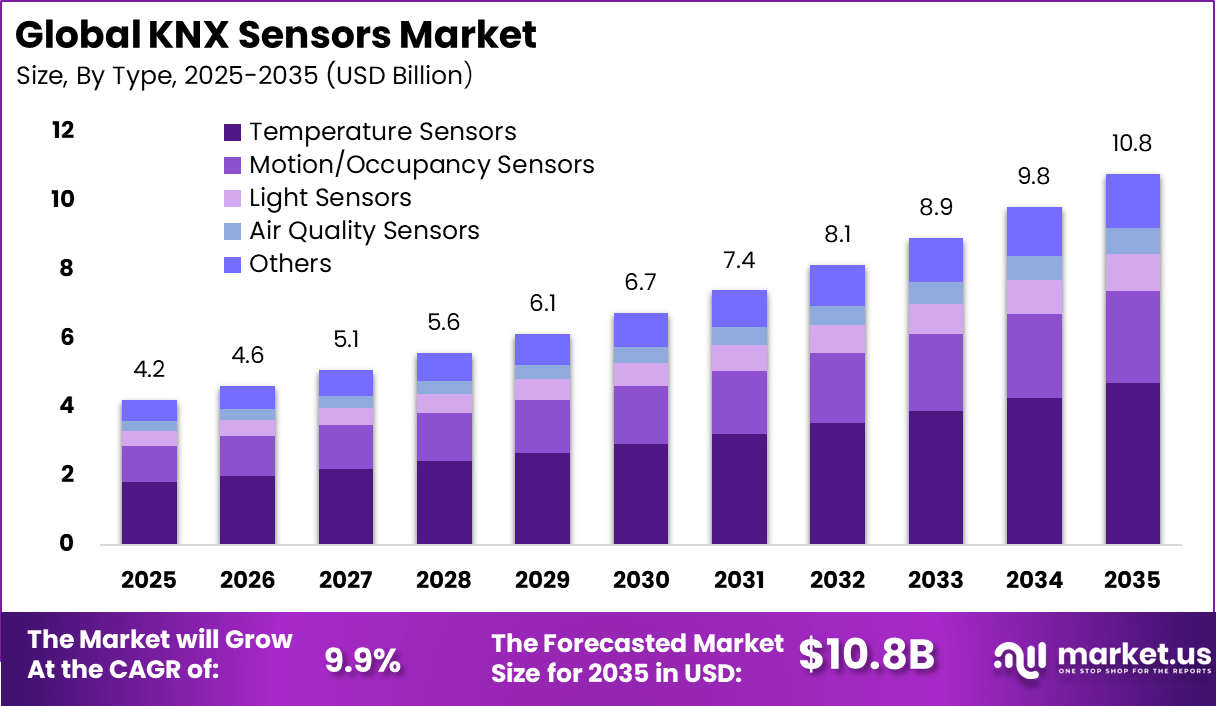
The global KNX Sensors market was valued at USD 4.2 billion in 2025 and is expected to grow steadily over the forecast period. The market is projected to reach approximately USD 10.8 billion by 2035, expanding at a CAGR of 9.9% from 2026 to 2035. This growth is driven by increasing adoption of smart building technologies and rising demand for energy efficient automation systems. Greater focus on connected infrastructure and building intelligence is further supporting market expansion.
The KNX sensors market refers to the ecosystem of sensor devices and associated technologies designed for building automation systems that use the KNX open standard for communication. KNX sensors detect environmental and occupancy parameters such as temperature, humidity, motion, light levels, and air quality, and transmit this information to controllers and actuators within smart building networks. These sensors support automated control of lighting, heating, ventilation, air conditioning (HVAC), shading, and security systems. Adoption spans commercial buildings, residential complexes, healthcare facilities, hotels, and educational institutions seeking energy efficiency, comfort, and operational optimisation.
Key Takeaways
- Temperature sensors led by type with a 43.5% share, as accurate indoor climate monitoring remained essential for smart buildings and energy management systems.
- Commercial applications accounted for 38.2%, driven by widespread deployment of KNX sensors across offices, retail outlets, hotels, and large commercial properties.
- Building automation represented the largest end user segment at 40.7%, reflecting deep integration of KNX sensors with HVAC, lighting, and energy control infrastructures.
- Asia Pacific held a 33.6% regional share, supported by rapid urban development, expanding smart city initiatives, and adoption of intelligent building standards.
- The U.S. market reached USD 1.25 billion, expanding at a 7.4% growth rate, driven by commercial building upgrades and increased focus on automation and energy efficiency.
Energy Efficiency and Performance Impact
- Lighting control delivered energy savings of up to 60%, achieved through occupancy sensing and constant light regulation in automated environments.
- Ventilation systems achieved reductions of up to 60%, as KNX sensors adjusted airflow based on real time occupancy levels and air quality data.
- HVAC and room level temperature control recorded savings of up to 50%, supported by precise sensor driven heating and cooling optimization.
- Overall building energy consumption declined by an average of 34% across smart building projects using KNX based automation.
- Investment payback periods shortened significantly, with KNX system deployments recovering costs in around 2 years by 2025–2026, compared with 5 to 10 years during earlier adoption phases.
Regional Analysis
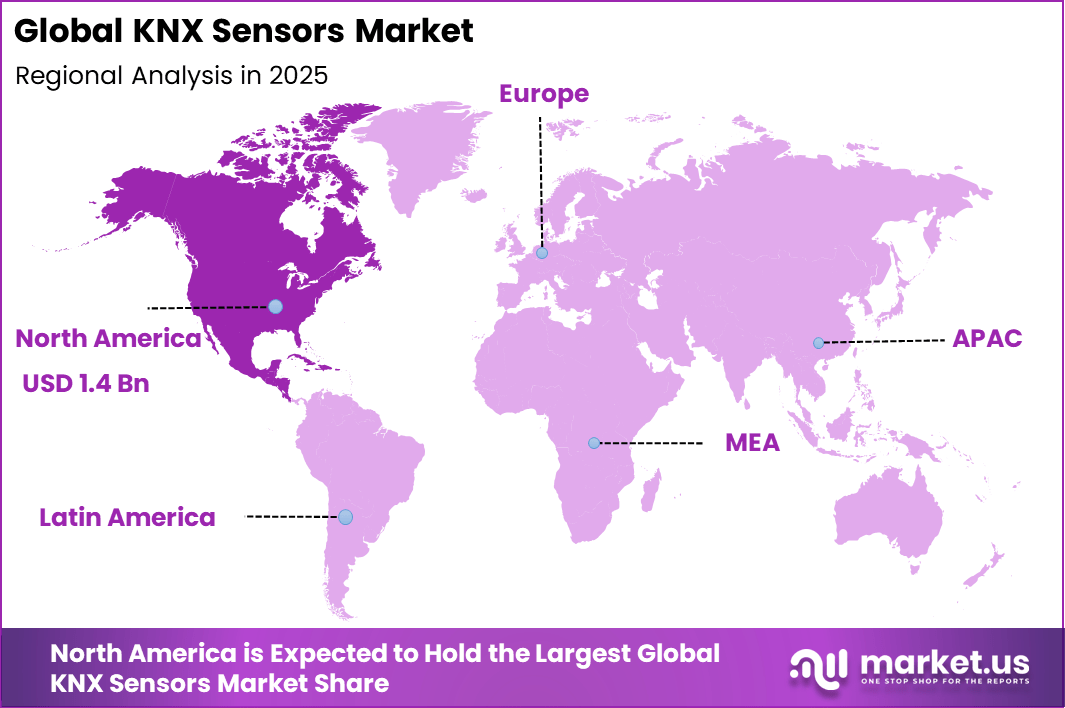
North America held a dominant position in the global market, accounting for more than 33.6% of total revenue. The region generated around USD 1.4 billion, supported by strong investment in commercial and residential smart buildings. Early adoption of automation standards and advanced building management systems strengthened regional leadership. As a result, North America continues to influence growth and technology adoption in the KNX sensors market.
Top Driving Factors
One primary driver of the KNX sensors market is the increasing focus on energy efficiency and sustainable building practices. Buildings account for a significant share of energy consumption globally, and precise environmental sensing allows automated systems to adjust lighting, temperature, and ventilation based on real occupancy and conditions. KNX sensors provide accurate data that supports demand-based control, reducing waste and operational costs. Regulatory incentives and sustainability targets further reinforce adoption.
Another key driver is the need for enhanced occupant comfort and indoor environmental quality. Modern occupants expect personalised comfort conditions such as stable temperatures, appropriate lighting, and clean air. KNX sensors enable fine-tuned control that responds to real-time conditions and user preferences. These enhancements improve user satisfaction, productivity, and wellbeing, making sensor-enabled automation strategically valuable.
Demand Analysis
Demand for KNX sensors is influenced by rising deployment of intelligent building management systems (BMS) across commercial and institutional segments. Property owners and facility managers seek scalable, interoperable, and reliable sensor networks that integrate with broader KNX ecosystems. The ability to standardise sensor data across diverse building systems strengthens demand for KNX-compliant devices.
Demand is also shaped by upgrade and retrofit projects in existing buildings. Many structures built before digital automation became mainstream require sensor integration to modernise and remain competitive. KNX sensors offer a pathway to incremental automation without complete system overhaul. This retrofit friendly market expands adoption beyond greenfield construction.
Increasing Adoption Technologies
Wireless communication technologies are accelerating adoption of KNX sensors by reducing installation complexity and cost. Wireless KNX devices support retrofit scenarios where wiring disruptions are impractical or expensive. These technologies increase flexibility and shorten deployment timelines, making advanced sensing feasible across more building types.
Integration of artificial intelligence (AI) and analytics tools is also influencing the market by enabling autonomous optimisation and predictive responses. Sensor data feeds machine learning models that can forecast occupancy patterns, energy demand, and maintenance needs. Intelligent analytics enhance control strategies and improve long-term efficiency. These innovations deepen value capture from sensor infrastructure.
One key reason organisations adopt KNX sensors is improved operational efficiency and reduced energy costs. Real-time environmental feedback allows systems to operate only when needed and at appropriate intensities. Automated adjustments reduce peak demand and lower utility expenses. Efficiency gains contribute to better financial performance and sustainability metrics.
Another reason is enhanced safety and security. Occupancy sensors support lighting control and intrusion detection, while air quality sensors can trigger alerts for hazardous conditions. These safe-guards improve occupant well-being and operational reliability. Integration with KNX security systems enhances situational awareness and rapid response capabilities.
Investment Opportunities
Investment opportunities in the KNX sensors market exist in high-precision and multi-parameter devices that expand sensing capabilities. Advanced sensors that combine motion, light, temperature, humidity, and air quality into single devices reduce hardware costs and simplify integration. Investors may focus on modular products that scale across building types.
Another opportunity lies in platforms that unify sensor data with analytics and digital twin technologies. Tools that offer visualisation, trend analysis, and predictive recommendations increase the value of sensor networks. Investments in analytics integration support deeper insights and unlock premium service offerings. These capabilities strengthen differentiation.
Investor Type Impact Matrix
| Investor Type | Adoption Level | Contribution to Market Growth (%) | Key Motivation | Investment Behavior |
|---|---|---|---|---|
| Small and medium enterprises | Very High | ~39% | Protection from litigation risk | Selective policy purchase |
| Large enterprises | High | ~27% | Balance sheet protection | Portfolio based coverage |
| Insurers | High | ~18% | Specialty insurance expansion | Product innovation |
| Reinsurers | Moderate | ~11% | Risk diversification | Capacity allocation |
| Legal and IP advisory firms | Low to Moderate | ~5% | Risk mitigation support | Partnership driven |
Technology Enablement Analysis
| Technology Layer | Enablement Role | Impact on Market Growth (%) | Adoption Status |
|---|---|---|---|
| IP analytics platforms | Patent strength and risk assessment | ~2.0% | Growing |
| Legal cost modeling tools | Litigation expense forecasting | ~1.6% | Growing |
| Digital underwriting systems | Faster policy issuance | ~1.3% | Developing |
| AI driven prior art analysis | Improved infringement risk detection | ~0.9% | Developing |
| Blockchain documentation | Secure IP ownership records | ~0.5% | Early |
Business Benefits
Adoption of KNX sensors enhances building performance through continuous monitoring and automated control. Organisations benefit from lower operational costs, improved environmental comfort, and reduced manual adjustments. Real-time responsiveness supports adaptive building behaviour that aligns with occupancy and usage patterns.
Sensors also support compliance and reporting for sustainability certifications such as LEED and BREEAM. Detailed environmental data helps demonstrate performance against established green building standards. Compliance readiness improves property valuation and market positioning. Sensor data contributes to transparent sustainability reporting.
Regulatory Environment
The regulatory environment for the KNX sensors market includes energy efficiency standards and building codes that encourage or require automated control and monitoring. Regulations in many regions mandate energy audits, minimum performance standards, and documentation of usage patterns. KNX sensor systems help organisations meet these legal obligations.
Data privacy and cybersecurity regulations also influence sensor deployment, particularly when occupant behaviour or personal data is involved. Secure integration and data governance practices are essential to protect sensitive information and comply with regional privacy laws. Maintaining regulatory alignment builds trust and reduces risk in connected building environments.
Key Market Segments
By Type
- Temperature Sensors
- Motion/Occupancy Sensors
- Light Sensors
- Air Quality Sensors
- Others
By Application
- Residential
- Commercial
- Industrial
- Others
By End-User
- Building Automation
- HVAC Systems
- Lighting Control
- Security and Access Control
- Others
Top Key Players in the Market
- Siemens AG
- ABB Ltd.
- Schneider Electric SE
- Hager Group
- Gira Giersiepen GmbH & Co. KG
- Theben AG
- Jung GmbH & Co. KG
- Busch-Jaeger Elektro GmbH
- Ekinex S.p.A.
- Zennio Avance y Tecnología S.L.
- HDL Automation Co., Ltd.
- Ivory Egg (UK) Limited
- Elsner Elektronik GmbH
- MDT technologies GmbH
- Weinzierl Engineering GmbH
- Interra KNX Solutions
- Lingg & Janke OHG
- Tense Top Design Switches
- Basalte
- B.E.G. Brück Electronic GmbH
- Others
Report Scope
| Report Features | Description |
|---|---|
| Market Value (2025) | USD 4.2 Bn |
| Forecast Revenue (2035) | USD 10.8 Bn |
| CAGR(2026-2035) | 9.9% |
| Base Year for Estimation | 2025 |
| Historic Period | 2020-2024 |
| Forecast Period | 2026-2035 |
| Report Coverage | Revenue forecast, AI impact on Market trends, Share Insights, Company ranking, competitive landscape, Recent Developments, Market Dynamics and Emerging Trends |
| Segments Covered | By Type (Temperature Sensors, Motion/Occupancy Sensors, Light Sensors, Air Quality Sensors, Others), By Application (Residential, Commercial, Industrial, Others), By End-User (Building Automation, HVAC Systems, Lighting Control, Security and Access Control, Others) |
Discuss your needs with our analyst
Please share your requirements with more details so our analyst can check if they can solve your problem(s)