Table of Contents
Parallel Computing Market
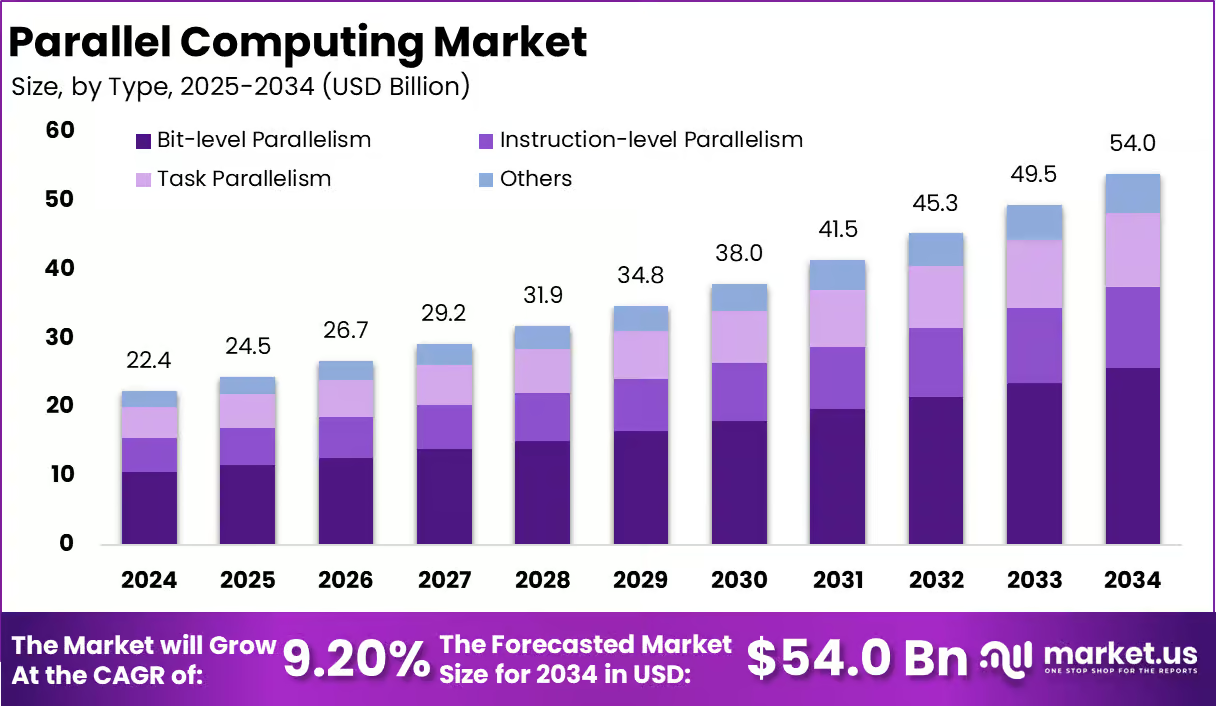
The global parallel computing market was valued at USD 22.4 billion in 2024 and is projected to reach USD 54.0 billion by 2034. Reflecting a robust compound annual growth rate (CAGR) of 9.2% during the forecast period. The market’s impressive growth is underpinned by increasing demand for high-performance computing solutions across various industries. Including scientific research, finance, healthcare, and IT services.
As businesses and research institutions face growing data complexity, parallel computing has emerged as a critical technology for accelerating processing capabilities. Optimizing computational efficiency and enabling real-time data analytics.
North America Leads the Global Parallel Computing Market
North America dominated the global parallel computing market in 2024, accounting for 42.7% of the total market share, valued at USD 9.56 billion. The region’s dominance is driven by advanced technological infrastructure. High adoption rates of high-performance computing systems and strong investments in research and development.
The presence of major technology companies, research centers, and leading universities in the US and Canada has contributed significantly to the region’s market leadership. In addition, government initiatives aimed at enhancing computational research capabilities and fostering innovation in artificial intelligence and big data analytics further reinforce North America’s position as a global leader in parallel computing solutions.
The US, in particular, represents a substantial portion of the North American market, valued at USD 8.61 billion in 2024. The country’s strong IT infrastructure, robust R&D ecosystem, and early adoption of cutting-edge computing technologies are key factors driving its market growth.
The US parallel computing market is projected to expand at a CAGR of 8.1%, reaching USD 18.76 billion by 2034. This growth reflects the increasing integration of parallel computing technologies in sectors such as aerospace, defense, healthcare, and financial services. Where the need for faster and more efficient data processing has become imperative.
Get the full version of the Parallel Computing Market Report data here @
https://market.us/purchase-report/?report_id=162358
Market Drivers and Technological Advancements
The global parallel computing market is experiencing accelerated growth due to multiple factors. Rapid expansion of data-intensive applications. Growing adoption of artificial intelligence and machine learning, and increasing computational requirements in scientific research, are primary drivers. Organizations are increasingly relying on parallel computing systems to reduce processing times, improve simulation accuracy, and enhance predictive analytics capabilities.
Technological advancements in multi-core processors, graphical processing units (GPUs), and distributed computing frameworks have further strengthened the market. Modern parallel computing systems enable efficient processing of complex tasks by dividing workloads across multiple processors or computing nodes.
This approach not only reduces execution time but also optimizes energy consumption and computational resources. Additionally, the development of parallel algorithms and software tools has made these systems more accessible to industries and research institutions, driving widespread adoption.
Industry Applications and Use Cases
Parallel computing is transforming multiple industries by enabling high-speed data processing, real-time analytics, and large-scale simulations. In healthcare, for instance, parallel computing accelerates genome sequencing, drug discovery, and medical imaging analysis. Allowing researchers and clinicians to generate insights faster and more accurately. In finance, it supports high-frequency trading, risk analysis, and fraud detection, where milliseconds can impact decision-making and profitability.
Scientific research and academic institutions heavily rely on parallel computing for complex simulations in physics, chemistry, climate modeling, and astrophysics. Parallel computing systems allow researchers to process massive datasets and perform intricate calculations that would be impractical or impossible with conventional computing architectures. The growing demand for high-performance computing solutions in these applications underscores the technology’s significance and its potential to drive future growth.
Key Market Segments
Type
- Bit-level Parallelism
- Instruction-level Parallelism
- Task Parallelism
- Others
Architectures
- Shared Memory
- Distributed Memory
- Hybrid memory
- Specialized architectures
End User
- Smartphones
- Blockchains
- Laptop Computers
- Internet of Things
- Others
Regional Insights: North America and Beyond
North America continues to be the largest regional market for parallel computing, supported by a combination of technological infrastructure, investment capacity, and innovation ecosystems. The US, as a key market within North America, is characterized by substantial funding for scientific research, strong public-private partnerships, and an ecosystem conducive to the development of high-performance computing technologies.
Europe is also emerging as a critical market, driven by initiatives such as the European High-Performance Computing Joint Undertaking (EuroHPC JU) that aim to advance computing capabilities and support research and industrial applications. Countries such as Germany, France, and the UK are investing in supercomputing facilities, parallel computing clusters, and AI-driven applications. Which collectively contribute to regional market growth.
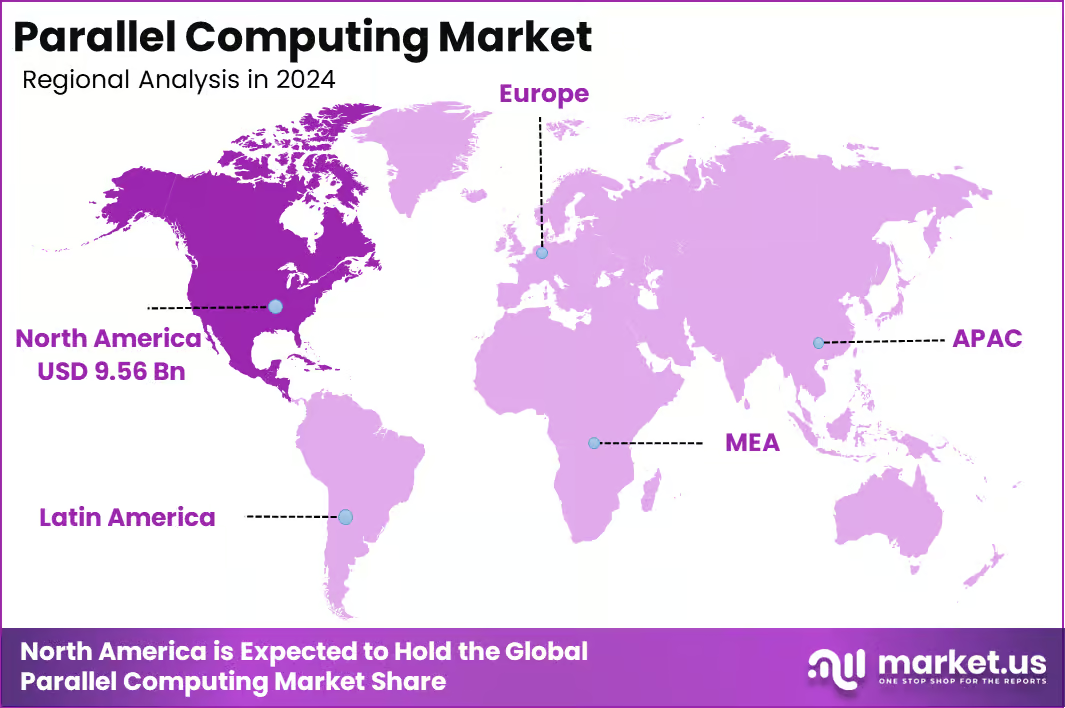
Asia-Pacific represents another high-growth region, driven by rapid industrialization, digital transformation initiatives, and government-led investment in technology infrastructure. Countries like China, Japan, and India are expanding their high-performance computing capacities to support scientific research, smart manufacturing, and financial analytics. The region is expected to witness significant adoption of parallel computing technologies, contributing meaningfully to the global market expansion.
Key Trends Shaping the Market
Several trends are shaping the parallel computing market, influencing both technology development and adoption strategies. Cloud-based parallel computing services are becoming increasingly prevalent, allowing organizations to leverage high-performance computing capabilities without substantial upfront investment in hardware. Hybrid cloud solutions that integrate on-premises infrastructure with cloud resources provide flexibility, scalability, and cost efficiency, accelerating market growth.
Another notable trend is the convergence of parallel computing with artificial intelligence and machine learning. Parallel computing accelerates AI model training and inference, enabling faster deployment of AI applications across industries. This integration is expected to enhance computational capabilities and expand the potential use cases of parallel computing systems in the coming years.
Market Outlook and Forecast
The global parallel computing market is poised for substantial growth between 2024 and 2034. Driven by increasing demand for computational efficiency, advancements in multi-core processing, and the proliferation of data-intensive applications.
North America is expected to maintain its leadership position, with the US playing a pivotal role in market expansion due to its robust technological ecosystem and high adoption rates of innovative computing solutions.
As the market evolves, emerging technologies such as quantum computing, neuromorphic computing, and edge computing are likely to complement parallel computing frameworks. Further enhancing processing capabilities and enabling novel applications. The adoption of these technologies, combined with continuous investments in high-performance computing infrastructure. Positions the parallel computing market for sustained growth and innovation.
Conclusion
Parallel computing continues to play a transformative role across industries, enabling faster data processing, improving decision-making, and supporting research and development activities. With ongoing technological advancements, strategic investments, and expanding applications. The parallel computing market is set to redefine the landscape of high-performance computing globally.
Discuss your needs with our analyst
Please share your requirements with more details so our analyst can check if they can solve your problem(s)