Table of Contents
Market Overview
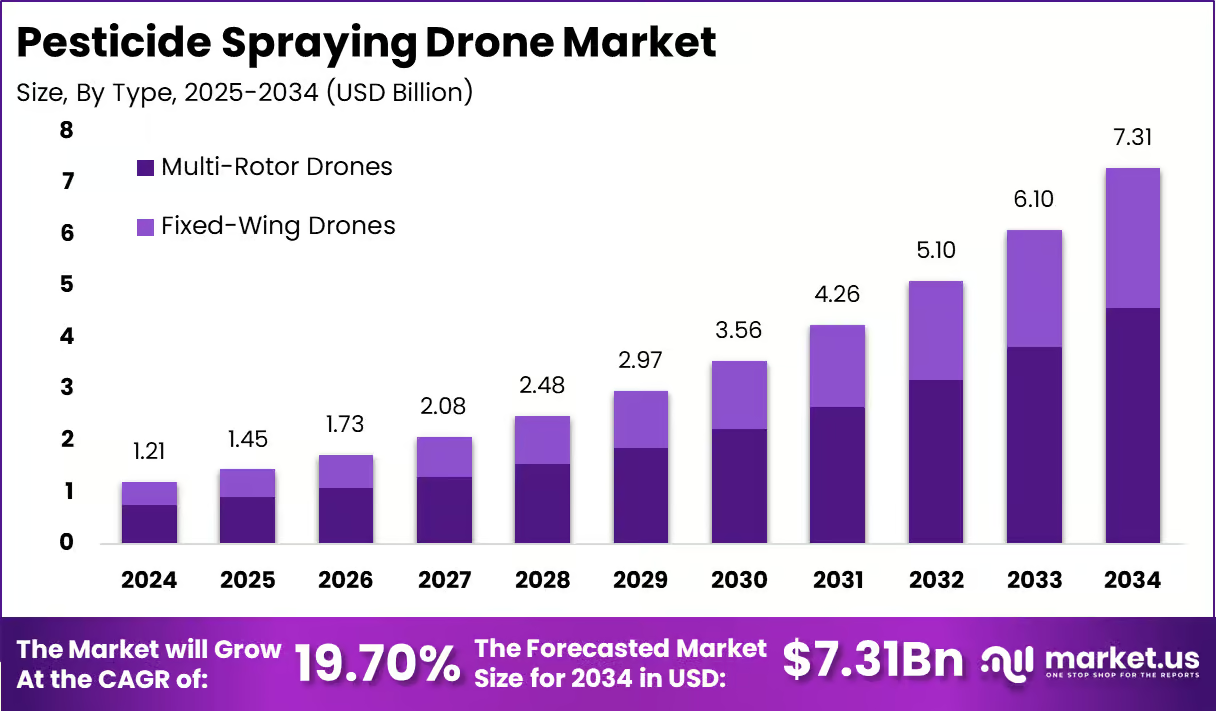
The Pesticide Spraying Drones Market is expanding steadily, rising from USD 1.21 billion in 2024 to USD 7.31 billion by 2034, at a CAGR of 19.7%. Growth is driven by increasing adoption of precision agriculture and automation technologies across farming operations.
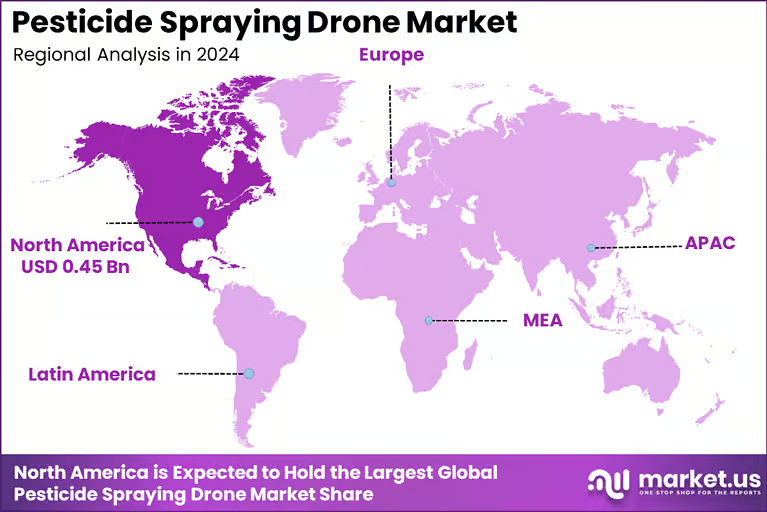
North America holds a 38% share, valued at USD 0.45 billion, with the US contributing USD 0.41 billion in 2024 and projected to reach USD 2.0 billion by 2034. Multi-rotor drones dominate due to better maneuverability, while crop farming leads application demand. Large farms remain the primary users, reflecting strong adoption of drone-based spraying solutions in large-scale agricultural environments.
Key Takeaways
- Market size in 2024: USD 1.21 billion
- Projected market size by 2034: USD 7.31 billion
- CAGR: 19.7%
- North America share: 38%
- North America value in 2024: USD 0.45 billion
- US market size in 2024: USD 0.41 billion
- US projected value by 2034: USD 2.0 billion
- US CAGR: 17.2%
- Leading type: Multi-rotor drones at 62.6%
- Leading application: Crop farming at 49.8%
- Leading farm size: Large farms at 68.4%
Role of AI
AI is enhancing pesticide-spraying drones by improving precision, efficiency, and decision-making in agricultural operations. It helps analyze crop health using aerial data, enabling drones to apply pesticides only where needed. AI-driven image recognition can detect pests, diseases, and stress patterns in crops, reducing chemical usage and improving yield quality.
It also supports automated flight planning, obstacle detection, and route optimization, ensuring safe and efficient operations. Real-time data processing allows farmers to make informed decisions quickly. As farms become more data-driven, AI is playing a key role in making drone-based spraying systems more accurate, cost-effective, and environmentally sustainable.
Analyst’s Viewpoint
The Pesticide Spraying Drones Market is transitioning from early adoption to broader commercial deployment. The dominance of multi-rotor drones shows that flexibility and precision are critical in agricultural environments. Crop farming leads due to the need for efficient pest control across large fields, while large farms dominate because they benefit most from automation and scale.
North America’s leadership reflects advanced farming practices and higher technology adoption. In our view, the market is expected to maintain strong growth as farmers seek to reduce labor dependency, improve productivity, and adopt more sustainable agricultural practices supported by drone technology.
Regional Highlights
North America leads the market with a 38% share, valued at USD 0.45 billion in 2024, supported by strong adoption of advanced agricultural technologies and precision farming practices. The US dominates the region with USD 0.41 billion and is projected to reach USD 2.0 billion by 2034 at a CAGR of 17.2%.
The region benefits from large-scale farming operations, higher investment in automation, and supportive regulatory frameworks for drone usage. Farmers are increasingly adopting drones to improve efficiency and reduce input costs, making North America a key region for innovation and deployment of pesticide-spraying drone technologies.
Key Market Segmentation
- By Type: Multi-rotor drones lead with 62.6% due to high maneuverability and suitability for uneven terrains.
- By Application: Crop farming dominates with 49.8%, driven by demand for targeted pesticide spraying.
- By Farm Size: Large farms lead with 68.4% as they benefit most from automation and scale efficiencies.
Emerging Trends
- Rising adoption of precision agriculture technologies
- Increasing use of drones for targeted pesticide application
- Integration of AI for crop monitoring and decision-making
- Growing focus on reducing chemical usage in farming
- Expansion of drone usage in large-scale agricultural operations
Top Use Cases
- Targeted pesticide spraying in crop fields
- Monitoring crop health and pest infestation
- Precision application of fertilizers and chemicals
- Large farm automation and resource optimization
- Data-driven agricultural decision-making
Major Challenges
- High initial investment cost for drone systems
- Limited technical knowledge among small farmers
- Regulatory restrictions on drone operations
- Battery limitations affecting flight time
- Maintenance and operational complexity
Attractive Opportunities
- Expansion into emerging agricultural markets
- Development of cost-effective drone solutions
- Growth in sustainable and eco-friendly farming practices
- Integration with farm management software systems
- Increasing government support for smart agriculture
Business Benefits
Pesticide spraying drones provide significant benefits by improving efficiency, reducing labor costs, and optimizing chemical usage. They allow farmers to cover large areas quickly and apply pesticides with high precision, reducing waste and environmental impact. Automated operations minimize human exposure to harmful chemicals, improving safety.
These drones also support data collection and analysis, enabling better crop management and yield optimization. For large farms, they offer scalability and operational efficiency, while for the broader agricultural sector, they support the transition toward smarter and more sustainable farming practices driven by technology and automation.
Recent Developments
Recent developments focus on improving drone payload capacity, flight efficiency, and AI-driven crop analysis capabilities. There is also increasing emphasis on integrating drones with digital farm management systems to enhance precision and operational efficiency in agricultural activities.
Key Players Analysis
The market includes drone manufacturers and agricultural technology providers focusing on innovation, performance, and ease of use. Competitive advantage depends on drone efficiency, precision capabilities, battery performance, and integration with smart farming solutions.
Top Key Players in the Market
- XAG
- Yamaha Motor
- Parrot
- AeroVironment
- Honeycomb
- AgEagle
- TTA
- Kray
- Delair
- DJI Agriculture
- Hylio
- Ursula Agriculture
- ATI
- Israel Aerospace Industries
- Others
Customer Insights
Customer behavior in this market is influenced by farm size, cost considerations, and awareness of precision agriculture benefits. Large farm operators are the primary adopters due to higher return on investment and operational efficiency gains. Farmers prefer solutions that offer ease of use, reliability, and measurable productivity improvements.
Many buyers are also influenced by government incentives and sustainability goals. Segmentation is based on farm scale, crop type, and technology readiness, with different users prioritizing factors such as cost savings, efficiency, environmental impact, and ease of integration into existing farming practices.
Future Outlook
The future of the Pesticide Spraying Drones Market is expected to remain strong as agriculture continues to adopt automation and digital technologies. Demand is likely to increase as farmers focus on improving productivity, reducing costs, and adopting sustainable practices. AI integration and advancements in drone technology are expected to enhance precision and efficiency further.
Large farms will continue to lead adoption, while smaller farms may gradually adopt cost-effective solutions. As regulations become clearer and technology becomes more accessible, drone-based pesticide spraying is expected to become a standard practice in modern agriculture.
Conclusion
The Pesticide Spraying Drones Market is positioned for sustained growth, supported by the increasing need for efficient and precise agricultural solutions. With the market projected to grow from USD 1.21 billion in 2024 to USD 7.31 billion by 2034, the outlook remains positive. North America leads adoption, with the US playing a key role in market expansion.
Segment trends highlight the importance of multi-rotor drones, crop farming applications, and large farm adoption. Overall, drone technology is expected to transform agricultural practices by improving efficiency, reducing environmental impact, and supporting the shift toward smarter and more sustainable farming systems.
Discuss your needs with our analyst
Please share your requirements with more details so our analyst can check if they can solve your problem(s)