Table of Contents
Introduction
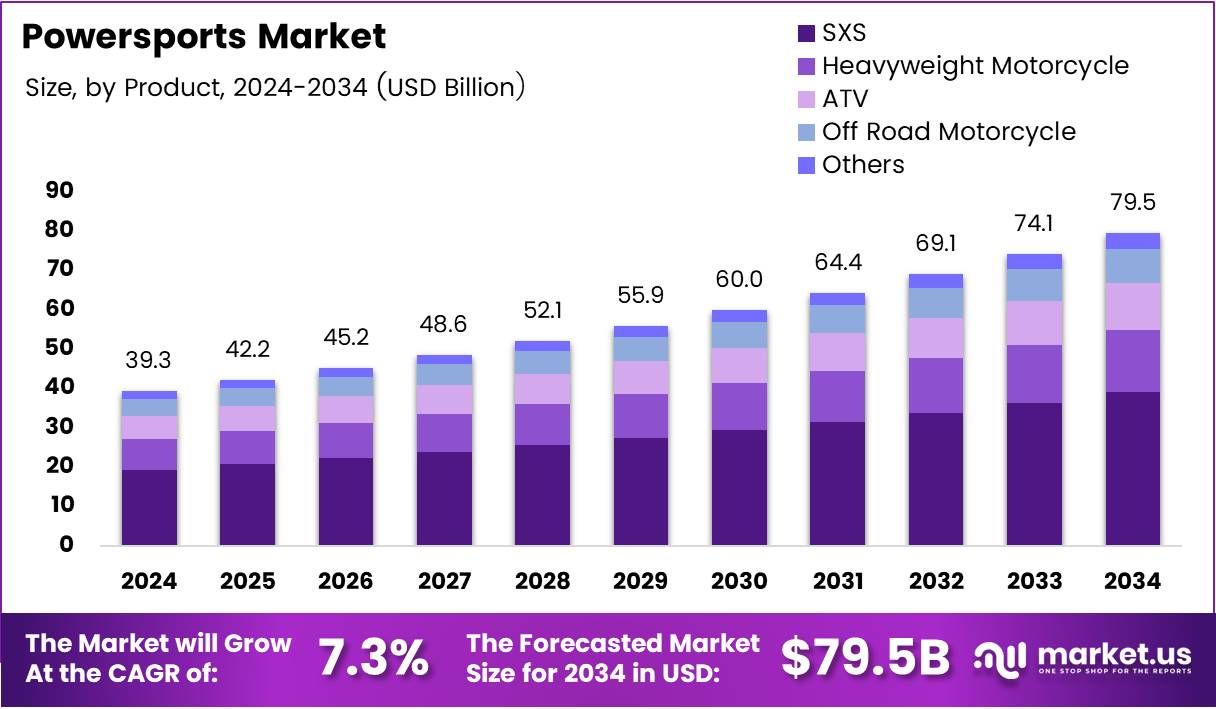
Market.us has released a comprehensive analysis of the Global Powersports Market, projecting robust expansion from USD 39.3 Billion in 2024 to USD 79.5 Billion by 2034. The market is forecast to grow at a CAGR of 7.3% over the 2025–2034 period, reflecting increasing consumer interest in outdoor recreational activities and adventure tourism across global markets.
Consequently, rising disposable incomes and growing urbanization are fueling demand for leisure-oriented powersport vehicles worldwide. Consumers are prioritizing experiential spending, with trail riding, camping adventures, and family outings driving consistent demand across all-terrain vehicles, side-by-sides, motorcycles, and specialty recreational machines.
Furthermore, adventure tourism is gaining significant momentum as consumers seek adrenaline-driven outdoor experiences. According to the Outdoor Industry Association, U.S. outdoor recreation reached 175.8 million participants in 2023, representing a 51.9% participation rate. This expanding consumer base directly translates into sustained powersport vehicle sales and rental demand.
Additionally, electric and hybrid powersport vehicles are emerging as transformative forces in the industry. Environmental consciousness, government clean-energy incentives, and battery technology improvements are accelerating the electrification of traditional gasoline-powered vehicles, opening new market segments and attracting environmentally conscious buyers.
Finally, technological integration is reshaping the powersport ownership experience. Smart diagnostics, GPS navigation, electronic stability control, and smartphone connectivity are becoming standard expectations among modern riders, compelling manufacturers to differentiate through innovation while maintaining competitive pricing across product categories.
Key Takeaways
- The Global Powersports Market is projected to grow from USD 39.3 Billion in 2024 to USD 79.5 Billion by 2034 at a CAGR of 7.3%.
- North America leads the market with a 48.9% share, valued at USD 19.2 Billion.
- SXS dominates the By Product segment with a 34.8% market share.
- Gasoline fuel type holds a 79.3% market share, remaining the preferred choice.
- Recreational application accounts for 39.6% of total market demand.
Market Segmentation Overview
By product, SXS leads with a 34.8% share due to superior passenger capacity, cargo hauling capabilities, and enclosed cabin designs suited for both family recreation and commercial operations. Heavyweight motorcycles serve premium touring segments, while ATVs maintain steady demand across recreational and utility applications. Off-road motorcycles cater to competitive motorsports enthusiasts seeking lightweight, agile performance.
By fuel type, Gasoline dominates with a commanding 79.3% share, supported by proven reliability and extensive refueling infrastructure across recreational areas. By application, Recreational leads with 39.6% of total demand, driven by growing outdoor participation and social media influence amplifying riding culture among younger demographics. Utility, Commercial, Sports, and Defense applications each serve distinct and growing end-user bases.
Drivers
Rising adoption of electric and hybrid powersport vehicles is a significant growth driver. Battery technology improvements have extended range capabilities while reducing charging times, and government incentives are lowering acquisition costs for environmentally conscious buyers. Major manufacturers are launching competitive electric models across multiple product categories to meet evolving regulatory requirements and consumer expectations.
Adventure tourism and outdoor recreational participation are driving parallel demand growth. National parks, off-road trails, and backcountry destinations attract millions of visitors annually, while social media and motorsports content creators amplify recreational riding’s appeal among millennial and Gen-Z audiences. This cultural momentum directly strengthens powersport vehicle sales and aftermarket accessory revenue across all segments.
Use Cases
Recreational riding represents the most active use case, encompassing weekend trail riding, camping adventures, and family outings across diverse terrains. According to the Motorcycle Industry Council, there are 9.5 million registered motorcycles in the United States alone, demonstrating deep market penetration and sustained consumer engagement in recreational powersport activities.
Utility and agricultural applications represent an equally important use case. Farmers and landowners rely on ATVs and side-by-side vehicles for daily operational tasks across vast properties, reducing labor costs and enhancing productivity in challenging terrain conditions. Durability, load-carrying capacity, and ease of operation remain critical selection criteria for this practical, non-discretionary buyer segment.
Major Challenges
Escalating maintenance costs and repair complexity present meaningful barriers to market growth. Modern powersport vehicles incorporate sophisticated electronic systems requiring trained technicians and proprietary diagnostic equipment not readily available in rural areas. Parts availability challenges and lengthy repair turnaround times frustrate existing owners and discourage prospective buyers from committing to purchase decisions.
Stringent environmental and noise emission regulations impose growing compliance burdens on manufacturers while restricting vehicle performance characteristics. Sound restrictions at popular recreational areas limit riding opportunities and diminish user experiences. Evolving regulatory landscapes create uncertainty for industry participants regarding future product development investments, particularly for manufacturers serving multiple international markets simultaneously.
Business Opportunities
Connected telematics and smart diagnostics integration presents a compelling commercial opportunity. Real-time vehicle health monitoring, predictive maintenance, over-the-air software updates, and personalized customer engagement platforms deepen brand loyalty while generating recurring revenue streams beyond initial vehicle sales. Manufacturers that lead in connectivity will differentiate meaningfully in an increasingly competitive landscape.
Emerging Asian and Latin American markets represent enormous untapped growth potential. Expanding middle-class populations, rising outdoor recreation participation rates, and infrastructure development are unlocking new consumer bases in China, India, Brazil, and Mexico. International manufacturers establishing local production facilities and distribution networks early are positioned to capture first-mover advantages in these high-growth regions.
Regional Analysis
North America dominates the global market with a commanding 48.9% share valued at USD 19.2 Billion, driven by deeply ingrained recreational culture, extensive trail networks, and high consumer purchasing power. The United States and Canada offer vast wilderness areas and well-maintained off-road parks supporting year-round powersport activities, backed by strong dealer networks providing comprehensive sales and service coverage.
Asia Pacific represents the fastest-growing regional market, fueled by expanding middle-class populations and increasing outdoor participation rates in China, India, and Australia. Europe demonstrates steady growth supported by adventure tourism traditions and rapid electric vehicle adoption, particularly in Scandinavian countries leading sustainability initiatives. Latin America and Middle East & Africa present additional long-term opportunity horizons as infrastructure and economic development progress.
Recent Developments
- In October 2024, Taiga Motors announced that the Superior Court of Quebec approved the acquisition of substantially all of its business by the backer of a leading electric marine group, integrating Taiga into a broader electric mobility ecosystem focused on marine and powersport electrification.
- In February 2024, BRP confirmed the addition of two new electric snowmobile models — the Ski-Doo Expedition Electric and the Lynx Adventure Electric — to its 2025 lineup, advancing its commitment to electrify its powersport product portfolio.
- In October 2025, Polaris Inc. announced it will sell a majority stake in Indian Motorcycle to Carolwood LP, establishing Indian as a standalone company in a major strategic restructuring of its corporate portfolio.
- In August 2025, BRP expanded its electric off-road lineup by launching the all-new 2026 Can-Am Outlander Electric ATV, offering a fully electric option in the utility and adventure quad market.
Conclusion
The Global Powersports Market is entering a sustained expansion phase anchored by rising recreational participation, accelerating electrification, and technological innovation across vehicle platforms. With the market forecast to grow from USD 39.3 Billion in 2024 to USD 79.5 Billion by 2034 at a CAGR of 7.3%, stakeholders across the automotive, recreation, and clean-energy sectors face significant opportunities to capture value in this evolving landscape.
As consumer preferences shift toward connected, electric, and experience-driven mobility, manufacturers that invest decisively in sustainable powertrain development, smart vehicle integration, and emerging market expansion will define the competitive landscape of the global powersports industry for the decade ahead.
Discuss your needs with our analyst
Please share your requirements with more details so our analyst can check if they can solve your problem(s)