Table of Contents
Overview
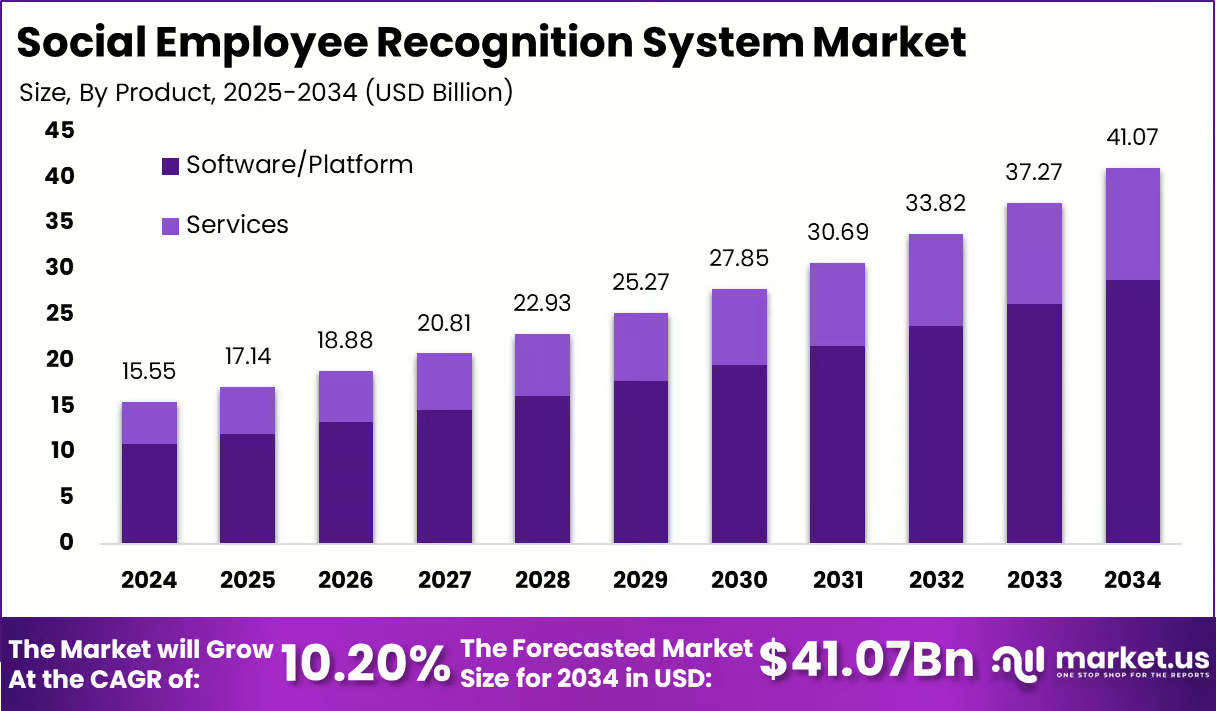
The Social Employee Recognition System Market reached USD 15.55 billion in 2024 and is projected to reach USD 41.07 billion by 2034, growing at a CAGR of 10.20%. North America accounted for 32.8% share, valued at USD 5.10 billion. The US alone reached USD 4.61 billion and is expected to hit USD 10.33 billion by 2034 at 8.4% CAGR. Growth is driven by rising focus on employee engagement and digital workplace tools.
Organizations are increasingly adopting recognition platforms to improve productivity, retention, and workplace culture. The integration of AI and cloud-based solutions is reshaping how companies manage employee motivation and performance tracking.
Key Takeaways
- Market size reached USD 15.55 billion in 2024 and is projected to reach USD 41.07 billion by 2034 at 10.20% CAGR.
- North America held 32.8% share valued at USD 5.10 billion
- The US market reached USD 4.61 billion in 2024 and is expected to reach USD 10.33 billion by 2034 at 8.4% CAGR
- Software or platform led with 70.3% share
- Cloud-based deployment dominated with 82.6% share
- AI and machine learning contributed 35.2%
- Rewards programs held 30.8% share
- Employee engagement led applications with 31.9%
- Large enterprises captured 72.7% share
- IT and telecom held 20.5% share
- Integration capabilities dominated with 32.4% share
Experts Review
Experts highlight strong government support for workplace digitization and employee welfare programs, encouraging the adoption of recognition systems. Technological innovation, especially AI integration at 35.2%, enhances real-time feedback and automation.
Investment opportunities remain high due to rising demand for cloud solutions at 82.6%, though risks include data privacy concerns and integration challenges. Increasing employee awareness about recognition benefits supports adoption. Regulatory frameworks around data protection are shaping system design. Overall, technology-driven transformation and supportive policies are expected to sustain market growth across regions.
Report Segmentation
The market is segmented by product, deployment, technology, component, application, enterprise size, end-user, and functionality. Software or platform leads with 70.3%, while cloud-based deployment dominates at 82.6%. AI and machine learning account for 35.2% in technology.
Rewards programs contribute 30.8% under components. Employee engagement leads applications with 31.9%. Large enterprises dominate with 72.7% share. IT and telecom lead end-users at 20.5%. Integration capabilities hold 32.4%, reflecting the growing need for seamless HR system connectivity.
Drivers, Restraints, Challenges, and Opportunities
The market is driven by a growing focus on employee engagement and retention, supported by 31.9% application share. Cloud adoption at 82.6% boosts scalability and remote access. However, data privacy concerns and integration complexities act as restraints.
Challenges include aligning recognition programs with diverse workforce expectations. Opportunities lie in AI adoption at 35.2%, enabling personalized recognition and expanding demand from SMEs. Increasing digital HR transformation and hybrid work trends are expected to further create growth avenues.
Key Player Analysis
Key players in the Social Employee Recognition System Market focus on enhancing platform capabilities through AI integration, cloud scalability, and advanced analytics. Companies are prioritizing user-friendly interfaces and mobile accessibility to improve adoption. With software or platform holding 70.3% share, vendors are investing in comprehensive solutions that combine recognition, rewards, and performance tracking.
Top Key Players in the Market
- Achievers
- Bonusly
- Kudos
- Reward Gateway
- Globoforce
- Terryberry
- Motivosity
- Bucketlist
- Awardco
- Workstars
- Fond
- O. C. Tanner
- Blueboard
- Guusto
- Vantage Circle
- Rewardian
- High Ground
- Limeade
- Kazoo
- TINYpulse
- Others
Integration capabilities, which hold 32.4%, are a major competitive factor, as organizations seek seamless connectivity with existing HR systems. Players are also expanding into IT and telecom, which holds 20.5% share, while targeting new industries. Strategic partnerships, product innovation, and geographic expansion are strengthening competitive positioning.
Regional Analysis
North America held 32.8% of the global market in 2024, valued at USD 5.10 billion, making it the leading region. The US contributed USD 4.61 billion and is expected to reach USD 10.33 billion by 2034 at an 8.4% CAGR. This dominance is supported by early adoption of digital HR technologies, strong corporate culture initiatives, and high awareness of employee engagement tools. Large enterprises in the region, which account for 72.7% share globally, continue to invest heavily in cloud-based platforms, driving further growth.
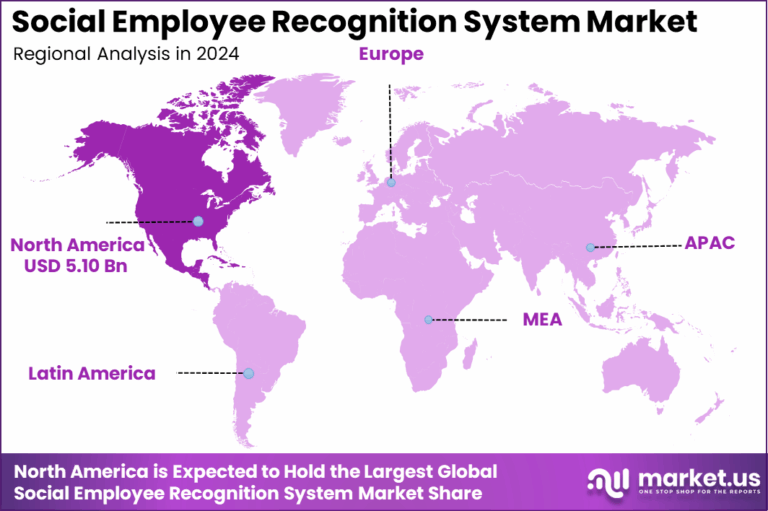
Europe is witnessing steady adoption due to increasing focus on workforce satisfaction and regulatory emphasis on employee well-being. Asia Pacific is emerging as a high-growth region driven by rapid digital transformation, expanding IT and telecom sector, and growing enterprise base. Meanwhile, Latin America and Middle East, and Africa are gradually adopting recognition systems, supported by rising awareness and cloud deployment expansion.
Recent Developments
Recent developments highlight strong momentum in cloud-based recognition platforms, accounting for 82.6% share. Companies are integrating AI and machine learning, contributing 35.2%, to enable real-time recognition and predictive insights. There is a growing shift toward mobile-first platforms, improving accessibility for distributed teams.
Vendors are enhancing rewards programs, which represent 30.8%, with flexible and personalized incentives. Large enterprises, holding 72.7%, continue to drive adoption, while SMEs are gradually increasing participation. Focus on integration capabilities, which hold 32.4%, is improving interoperability across HR systems and enhancing employee experience.
Conclusion
The Social Employee Recognition System Market is expected to grow steadily, reaching USD 41.07 billion by 2034 at a CAGR of 10.20%. North America and the US remain key contributors to market expansion. Cloud, AI, and software platforms continue to drive adoption.
Increasing focus on employee engagement, digital HR transformation, and integration capabilities supports long-term growth. While challenges such as data privacy exist, continuous innovation and rising awareness are expected to sustain market momentum globally.
Discuss your needs with our analyst
Please share your requirements with more details so our analyst can check if they can solve your problem(s)