Table of Contents
Introduction
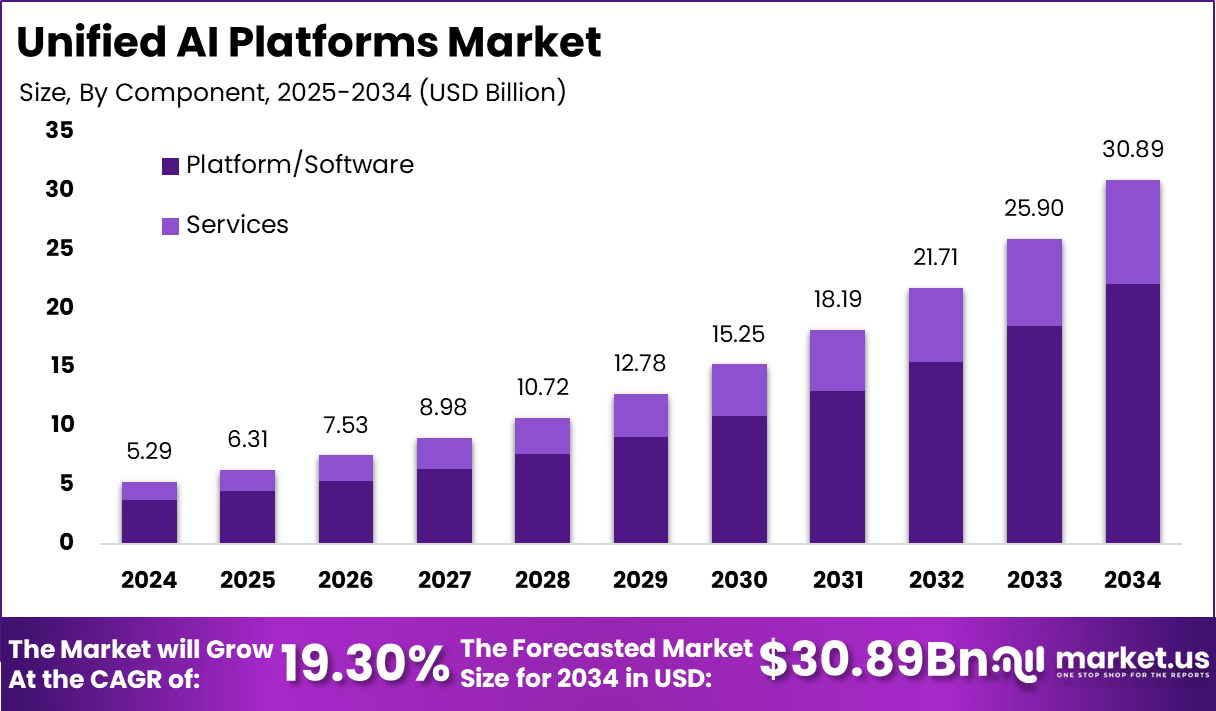
The Unified AI Platforms Market, valued at USD 5.29 billion in 2024, continues to expand rapidly as enterprises unify data, analytics, automation, and model lifecycle management into a single ecosystem. Global adoption accelerates as businesses shift from fragmented AI tools to scalable, end-to-end platforms that enhance accuracy, reduce operational friction, and improve deployment speed. With strong enterprise digitalization and rising generative AI integration, the market is anticipated to reach USD 30.89 billion, supported by robust investments from the technology, finance, manufacturing, and healthcare sectors.
How Growth Is Impacting the Economy
Rapid expansion of unified AI platforms strengthens economic productivity by enabling organizations to automate repetitive workflows, reduce manual labor requirements, and enhance operational accuracy. This shift is improving labor efficiency and helping countries address rising skill shortages through automated decision-making and AI-driven insights. The technology also promotes innovation-led economic growth, as enterprises adopt AI to create new digital services, streamline public-sector operations, and support national digital transformation policies.
Government incentives for AI adoption further accelerate productivity gains, strengthen national competitiveness, and push traditional industries toward modernization. At a macro level, demand for cloud computing, data centers, cybersecurity, and edge infrastructure rises, creating indirect economic multipliers across hardware, software, and telecom sectors. As AI becomes embedded into daily business activities, economies benefit from faster output cycles, improved resource allocation, and higher value creation across industries.
➤ Smarter strategy starts here! Get the sample – https://market.us/report/unified-ai-platforms-market/free-sample/
Impact on Global Businesses
Global businesses experience rising operational costs as AI model training, cloud infrastructure usage, and data storage expenses increase. Supply chains also shift as companies adopt AI-driven planning, smart logistics, and predictive procurement to reduce uncertainty. Manufacturing, retail, banking, healthcare, and logistics see deeper AI integration as they optimize forecasting, fraud detection, and patient care. Meanwhile, firms with fragmented tools face complexity in scaling, pushing organizations to transition to unified platforms to reduce integration costs and accelerate decision-making.
Strategies for Businesses
- Prioritize end-to-end AI platform adoption to reduce integration complexity.
- Invest in data quality, governance, and scalable cloud infrastructure.
- Build internal AI talent pipelines through training and partnerships.
- Deploy vertical-specific use cases to maximize ROI.
- Implement responsible and transparent AI governance frameworks.
- Strengthen cybersecurity to protect models and data pipelines.
Key Takeaways
- Unified AI platforms accelerate enterprise automation and intelligence.
- North America leads adoption with 47.3% market share.
- Rising cloud and ML infrastructure costs reshape financial planning.
- Sector-specific deployments drive faster ROI in manufacturing, BFSI, and healthcare.
- Future growth driven by generative AI, automation, and intelligent workflows.
➤ Unlock growth secrets! Buy the full report – https://market.us/purchase-report/?report_id=167385
Analyst Viewpoint
Current market momentum remains highly positive as enterprises consolidate AI tools to reduce complexity and accelerate deployment. The shift from standalone ML systems to unified AI stacks enables faster scaling across industries. Future growth is expected to stay strong as generative AI, multi-cloud integration, and automated MLOps become global standards. Long-term potential remains robust due to increasing demand for trustworthy, scalable, and domain-specific AI solutions across both developed and emerging regions.
Use Case & Growth Factors
| Category | Details |
|---|---|
| Key Use Cases | Cloud adoption surge, rising enterprise digitalization, demand for automation, advances in LLMs, and government AI initiatives |
| Growth Factors | Cloud adoption surge, rising enterprise digitalization, demand for automation, advances in LLMs, government AI initiatives |
Regional Analysis
North America leads the market with 47.3% share, contributing USD 2.50 billion in 2024, driven by strong enterprise digitalization and high AI investments. The US alone reached USD 2.28 billion, supported by cloud hyperscalers and advanced AI regulatory frameworks. Europe experiences steady adoption through industry modernization and data-governance compliance efforts. Asia Pacific grows fastest as China, India, Japan, and South Korea expand AI infrastructure and strengthen digital-economy programs. Middle East, Africa, and Latin America adopt unified AI platforms to enhance public-sector efficiency and industry automation.
➤ Want more market wisdom? Browse reports –
- AI Compliance Saas Market
- Voice First Internet UX Market
- Vacation Rental Software Market
- Machinery Breakdown Insurance Market
Business Opportunities
Growing demand for AI automation creates opportunities in enterprise SaaS platforms, domain-specific AI solutions, MLOps tools, AI governance software, and cloud-based orchestration systems. Companies can expand into SME-focused AI suites, low-code model builders, and privacy-preserving AI solutions. Integration services, training programs, and industry customization offer significant revenue potential. Emerging markets open long-term opportunities as governments invest heavily in national AI missions, smart manufacturing, and digital infrastructure modernization.
Key Segmentation
The market spans components such as platforms, services, data management, model development, orchestration tools, and deployment infrastructure. Applications include automation, analytics, forecasting, generative AI, customer intelligence, and operational optimization. Deployment models include cloud, on-premise, and hybrid architectures. End-users range across BFSI, healthcare, retail, manufacturing, logistics, telecom, and government sectors, each adopting unified platforms to streamline workflows, reduce costs, and accelerate innovation.
Key Player Analysis
Leading market participants focus on platform consolidation, multi-cloud integration, automated MLOps, and generative AI capabilities to strengthen their competitive position. They invest heavily in R&D to improve scalability, reliability, and ease of deployment. Partnerships with cloud providers, enterprise software vendors, and industry-specific solution providers support rapid expansion. Companies emphasize strong governance, security, and compliance features to address enterprise concerns and differentiate through domain expertise and ecosystem strength.
- Microsoft Corporation
- AWS
- International Business Machines Corporation
- Databricks
- DataRobot
- H2O.ai
- C3.ai
- SAS
- Palantir
- NVIDIA
- Cloudera
- OpenAI
- Anaconda
- Graphcore
- Abacus.ai
- Domino Data Lab
- Run:AI
- CognitiveScale
- Others
Recent Developments
- Launch of advanced LLM-integrated enterprise AI suites in 2024.
- Expansion of multi-cloud AI deployment frameworks across global regions.
- Introduction of automated MLOps pipelines for large enterprises.
- New AI governance modules focused on transparency and compliance.
- Partnerships formed to integrate unified AI layers into industry workflows.
Conclusion
Unified AI platforms are reshaping enterprise digital transformation by consolidating tools, reducing complexity, and enabling scalable innovation. With strong global adoption and long-term growth projections, the market will continue to drive automation, intelligence, and competitive advantage across industries.
Discuss your needs with our analyst
Please share your requirements with more details so our analyst can check if they can solve your problem(s)