Table of Contents
Introduction
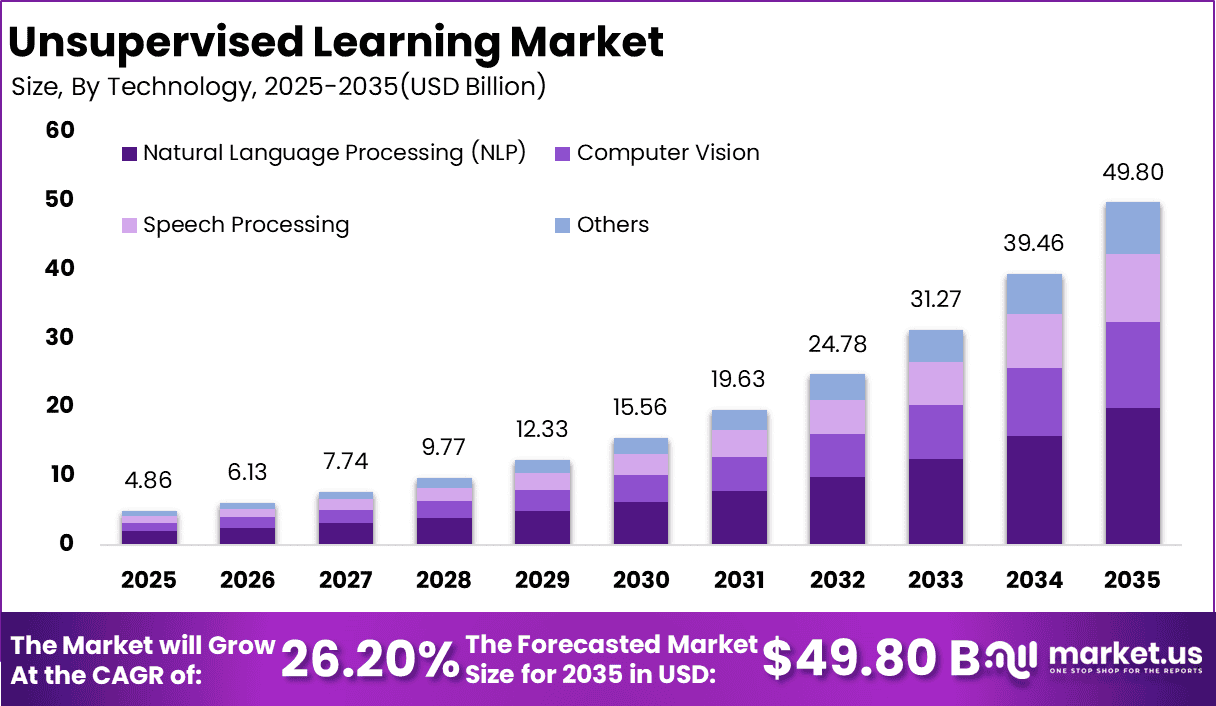
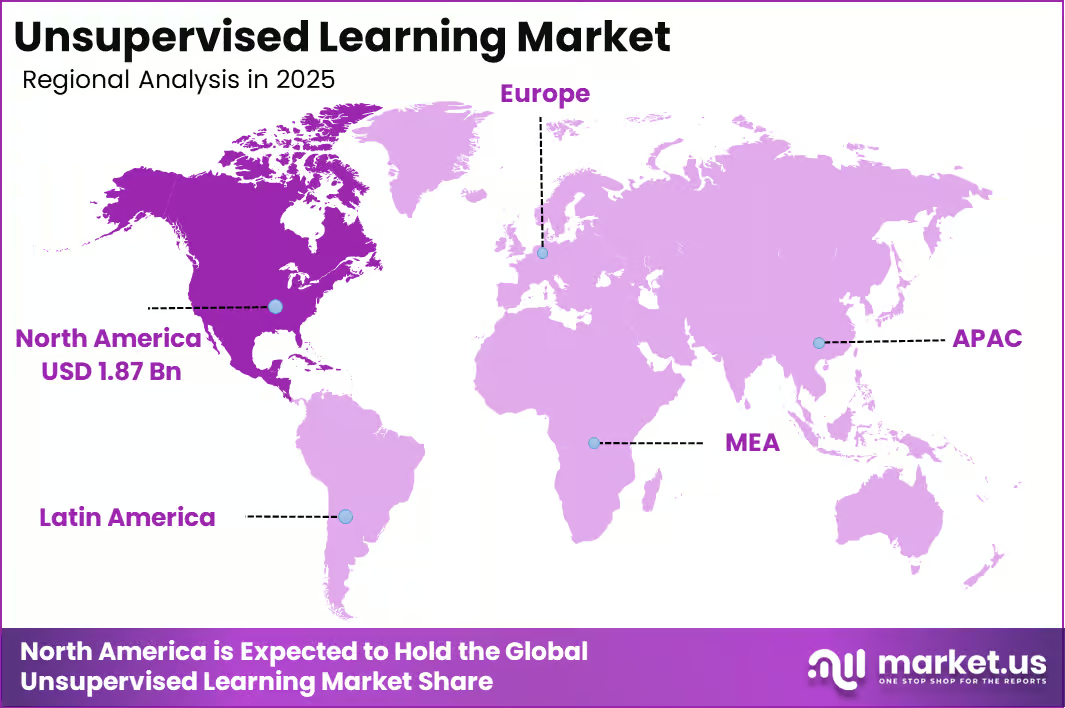
The Unsupervised Learning Market is projected to expand from USD 4.86 billion in 2025 to USD 49.80 billion by 2035, registering a CAGR of 26.20%. North America leads with a 38.5% share, valued at USD 1.87 billion in 2025, while the United States alone is anticipated to reach USD 15.09 billion by 2035. NLP dominates with 40.0% share, followed by on-premise deployments at 60.0%. Large enterprises hold 66.7% share, and BFSI contributes 33.6%, highlighting strong adoption across data-intensive industries.
How Growth is Impacting the Economy
Rapid expansion of unsupervised learning is reshaping global economic structures by improving productivity and data utilization across industries. Organizations are increasingly leveraging clustering, anomaly detection, and pattern recognition to extract insights without labeled datasets, reducing dependency on manual data processing. This shift is lowering operational costs and accelerating decision-making cycles in sectors such as finance, healthcare, and retail.
The market’s growth is also driving investments in AI infrastructure, including high-performance computing, cloud storage, and advanced analytics platforms. Governments and enterprises are allocating higher budgets toward digital transformation initiatives, leading to job creation in AI development, data science, and system integration. Additionally, increased automation is enhancing efficiency in supply chains, fraud detection, and predictive analytics, contributing to higher economic output. Emerging economies are witnessing accelerated adoption due to growing digital ecosystems, which are expected to strengthen global competitiveness and innovation capacity.
Impact on Global Businesses
Businesses are experiencing rising costs associated with AI infrastructure, including GPUs, storage systems, and integration services. The need for advanced computing capabilities is increasing capital expenditure, particularly for on-premise deployments. Supply chains are shifting toward localized data processing and edge computing to reduce latency and enhance data security.
Sector-specific impacts are significant, with BFSI leveraging unsupervised learning for fraud detection and risk modeling, while healthcare uses it for disease pattern identification and diagnostics. Retail and e-commerce sectors are utilizing it for customer segmentation and recommendation systems, improving personalization. Manufacturing industries are adopting it for predictive maintenance and quality control, enhancing operational efficiency and reducing downtime.
Strategies for Businesses
Businesses are focusing on hybrid deployment strategies combining on-premise and cloud solutions to balance cost and scalability. Investment in AI talent and partnerships with technology providers is becoming essential for implementation. Companies are prioritizing data governance frameworks to ensure compliance and security. Additionally, integrating unsupervised learning with existing analytics platforms is helping organizations maximize ROI and accelerate adoption.
Key Takeaways
- Market projected to grow at 26.20% CAGR, indicating strong demand for AI-driven insights.
- NLP dominates technology adoption with 40.0% share.
- On-premise deployment leads with 60.0% due to data security needs.
- Large enterprises account for 66.7% of adoption.
- BFSI remains the largest end-user with 33.6% share.
- North America leads with 38.5% regional share.
- Increasing automation is enhancing productivity across industries.
Analyst Viewpoint
The current market demonstrates strong momentum driven by data explosion and the need for advanced analytics without labeled datasets. Enterprises are actively integrating unsupervised learning into core operations to improve efficiency and decision-making. The technology is expected to evolve with improved algorithms and integration with generative AI systems.
Future outlook remains highly positive as industries continue to prioritize automation and data-driven strategies. Expansion in emerging markets, combined with advancements in computing power and AI frameworks, is anticipated to accelerate adoption. Increasing use cases across sectors such as healthcare, finance, and manufacturing are projected to sustain long-term growth and innovation.
Use Case and Growth Factors
| Use Case | Growth Factor |
|---|---|
| Fraud Detection in BFSI | Increasing cyber threats and the need for anomaly detection |
| Customer Segmentation | Increasing demand for personalized marketing strategies |
| Healthcare Diagnostics | Growing use of AI in disease pattern recognition |
| Predictive Maintenance | Industrial automation and cost reduction needs |
| Cybersecurity | Increasing cyber threats and need for anomaly detection |
Regional Analysis
North America holds a dominant 38.5% share, driven by strong AI infrastructure, high investment in research, and early adoption of advanced analytics technologies. The United States leads the region, supported by large-scale enterprise adoption and innovation in AI solutions. Europe is witnessing steady growth due to regulatory support and increasing digital transformation initiatives. Asia-Pacific is emerging as a high-growth region, fueled by expanding IT infrastructure, rising data volumes, and government initiatives promoting AI adoption. Developing economies are increasingly investing in AI technologies, which is expected to enhance regional competitiveness and drive market expansion.
Business Opportunities
The market presents significant opportunities in AI-driven automation, particularly in sectors requiring large-scale data analysis. Growth in cloud computing and edge AI is creating new avenues for scalable deployment models. Increasing demand for real-time analytics in finance, healthcare, and retail is opening new revenue streams for solution providers. Emerging markets offer untapped potential due to rapid digitalization and growing adoption of AI technologies. Additionally, integration of unsupervised learning with IoT and big data platforms is expected to create innovative solutions, enhancing operational efficiency and enabling businesses to gain competitive advantages.
Key Segmentation
The market is segmented by technology, deployment, organization size, and end-user industries. NLP leads the technology segment due to its ability to process large volumes of unstructured data efficiently. Deployment is dominated by on-premise solutions, driven by security and compliance requirements. Large enterprises represent the majority of adoption due to higher investment capacity and complex data needs. End-user segmentation highlights BFSI as the leading industry, followed by healthcare, retail, and manufacturing, where data-driven decision-making is becoming critical for operational efficiency and customer engagement.
Key Market Segments
By Technology
- Natural Language Processing (NLP)
- Computer Vision
- Speech Processing
- Others
By Deployment Mode
- On-premise
- Cloud
By Enterprise Size
- Large Enterprises
- Small and Medium-sized Enterprises
By End-User Industry
- BFSI
- IT and Telecom
- Retail and E-commerce
- Healthcare
- Government
- Automotive and Transportation
- Others
Key Player Analysis
Key players are focusing on continuous innovation in machine learning algorithms and expanding their AI capabilities to maintain a competitive advantage. Strategic investments in research and development are driving the development of advanced analytics platforms. Companies are also forming partnerships and collaborations to enhance their product offerings and expand market reach. Emphasis on scalable solutions, data security, and integration capabilities is shaping competitive strategies. Additionally, players are investing in cloud-based and hybrid deployment models to cater to diverse enterprise needs and improve accessibility.
Top Key Players in the Market
- Microsoft Corporation
- IBM Corporation
- Amazon.com, Inc.
- Google LLC
- SAP SE
- Oracle Corporation
- H2O.ai
- RapidMiner
- TIBCO Software Inc.
- Databricks
- Cloud Software Group, Inc.
- Fair Isaac Corporation
- Salesforce, Inc.
- SAS Institute Inc.
- Hewlett-Packard Enterprise Company
- Others
Recent Developments
- Increased integration of unsupervised learning with generative AI models
- Expansion of AI infrastructure investments by enterprises
- Rising adoption of hybrid deployment models
- Growth in AI-driven cybersecurity solutions
- Advancements in NLP-based analytics platforms
Conclusion
The unsupervised learning market is experiencing rapid growth driven by increasing data complexity and demand for automation. Strong adoption across industries and continuous technological advancements are expected to sustain long-term expansion, making it a critical component of future AI-driven ecosystems.
Discuss your needs with our analyst
Please share your requirements with more details so our analyst can check if they can solve your problem(s)