Table of Contents
Introduction
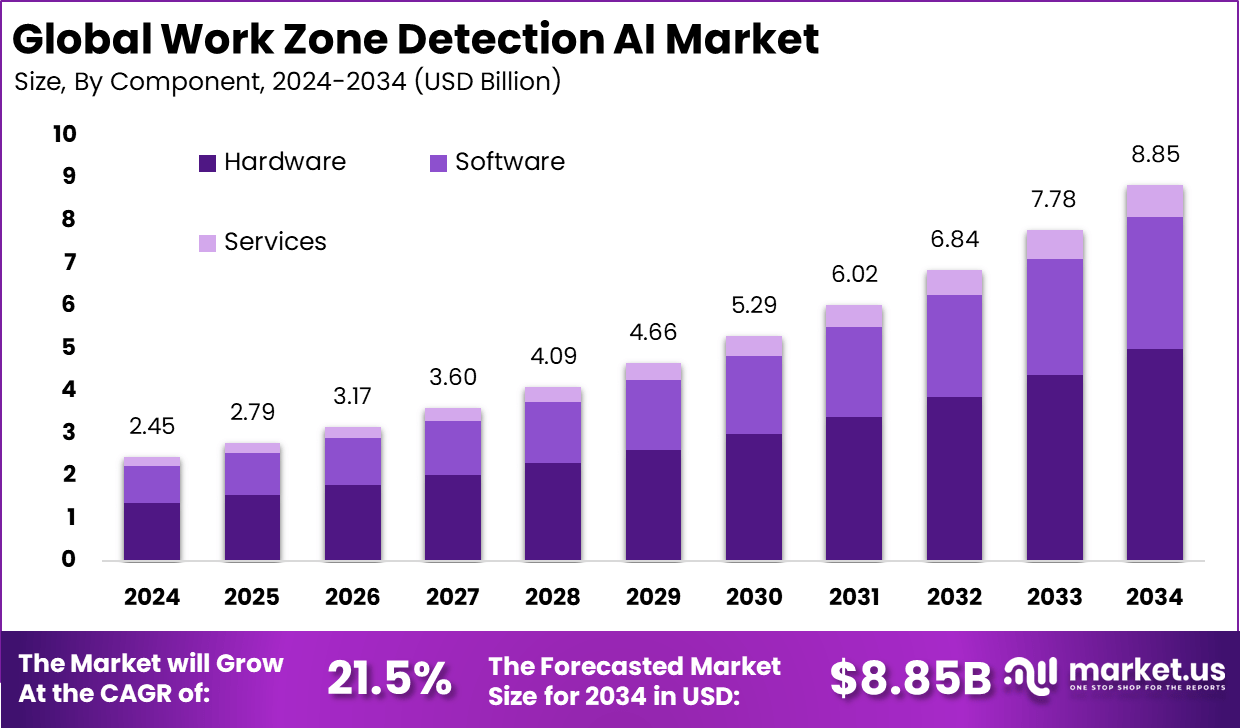
The Global Work Zone Detection AI Market reached USD 2.45 billion in 2024 and is projected to grow to USD 8.85 billion by 2034, registering a CAGR of 21.5%. North America led the market with 35.2% share and USD 0.86 billion in revenue. Growth is driven by rising roadway construction activities, increasing accident-prevention initiatives, and expanding adoption of AI-enabled monitoring, automated hazard detection, and smart traffic systems.
How Growth Is Impacting the Economy
The rapid expansion of Work Zone Detection AI strengthens economic productivity by reducing accident-related losses, improving infrastructure project efficiency, and enhancing worker safety. Governments worldwide invest heavily in roadway modernization, creating demand for AI solutions that minimize delays and lower operational risks. This accelerates the digital transformation of transportation systems, leading to higher workforce productivity and reduced insurance liabilities.
The market’s growth further supports job creation in AI engineering, roadway analytics, smart sensor deployment, and mobility-tech integration. As construction and transportation sectors adopt automated hazard alerts, real-time traffic analytics, and predictive safety models, national economies benefit from reduced congestion costs and improved logistics. Investments in AI-backed infrastructure safety stimulate upstream industries such as hardware sensors, cloud computing, machine vision, and geospatial technologies, amplifying economic impact.
➤ Smarter strategy starts here! Get the sample – https://market.us/report/work-zone-detection-ai-market/free-sample/
Impact on Global Businesses
Businesses face rising costs associated with deploying AI cameras, edge-compute systems, and cloud-based analytics. Supply chains shift toward sensor manufacturers, IoT integrators, and AI-vision solution providers. Sector impacts vary: construction firms gain improved site visibility; transportation companies reduce collision risks; logistics operations experience smoother route planning; and insurance providers benefit from lower accident claims due to predictive safety alerts.
Strategies for Businesses
• Integrate AI-enabled hazard detection and monitoring
• Deploy real-time traffic and work-zone analytics
• Collaborate with civil authorities for unified data exchange
• Invest in cloud-based safety dashboards
• Adopt predictive maintenance for work-zone equipment
• Implement scalable, sensor-driven safety infrastructure
Key Takeaways
• Market to reach USD 8.85 billion by 2034
• Strong CAGR of 21.5% boosts transportation digitalization
• North America dominates with 35.2% share
• AI reduces accident risk and enhances safety efficiency
• Infrastructure modernization fuels long-term demand
➤ Unlock growth secrets! Buy the full report – https://market.us/purchase-report/?report_id=168278
Analyst Viewpoint
The market shows strong momentum due to expanding roadway construction, regulatory emphasis on worker safety, and growing AI maturity. In the present landscape, businesses adopt computer vision and real-time alerts to reduce onsite risks. Future growth remains highly positive as autonomous mobility, digital highways, and smart city infrastructure accelerate demand for intelligent work-zone detection. AI’s role will expand across construction automation, predictive analytics, and connected traffic ecosystems.
Use Case & Growth Factors
| Use Case | Description | Growth Factors |
|---|---|---|
| Work Zone Monitoring | Detects workers, vehicles & barriers | Rising construction volumes & safety mandates |
| Hazard Detection | Alerts for collisions, speeding & intrusions | Need to minimize accidents & insurance losses |
| Traffic Flow Optimization | AI-guided rerouting & congestion control | Urbanization & smart mobility programs |
| Predictive Safety Analytics | Identifies high-risk zones | Government road-safety investments |
Regional Analysis
North America leads due to advanced highway infrastructure, strong regulatory focus on construction safety, and early adoption of AI-based roadway technologies. Europe follows with increased funding for smart mobility and automated traffic management. Asia Pacific grows rapidly, driven by large-scale infrastructure development in China, India, Japan, and Southeast Asia. Latin America sees gradual adoption supported by urban expansion projects, while the Middle East & Africa invest in smart-road pilots to reduce construction-related accidents and modernize transport systems.
➤ Want more market wisdom? Browse reports –
Business Opportunities
Growth opportunities include AI-based camera systems, IoT sensors for hazard detection, autonomous traffic-management platforms, and connected worker-safety solutions. Vendors can expand into predictive analytics, cloud dashboards for work-zone monitoring, and real-time vehicle–work-zone communication systems. Emerging markets offer strong potential for scalable, cost-efficient AI safety tools as governments prioritize roadway modernization. Companies can also tap into infrastructure digital twins, 3D mapping, and AI-powered compliance monitoring to support safer construction operations globally.
Key Segmentation
The market includes segmentation by component (hardware, software, services), by technology (computer vision, IoT sensors, AI analytics, edge computing), by application (hazard detection, traffic management, worker safety monitoring, intrusion detection), and by end-user (construction companies, transportation authorities, logistics firms, municipal agencies). Hazard detection dominates due to rising accident rates and regulatory enforcement. Traffic management grows steadily with the increased adoption of smart mobility solutions. Software-led AI analytics expand rapidly due to real-time decision-making needs.
Key Player Analysis
Market participants focus on developing advanced machine-vision algorithms, high-accuracy detection models, and integrated AI safety platforms. Their strategies include expanding sensor networks, strengthening cloud capabilities, and partnering with construction and transportation agencies. Innovation centers on edge-compute devices, real-time object detection, and multimodal data fusion for improved risk prediction. Companies prioritize scalable deployments, interoperability with traffic systems, and compliance with regional safety standards. Investments also focus on enhancing analytics dashboards and strengthening automated alert systems.
- Bosch
- Siemens Mobility
- Honeywell International, Inc.
- Topcon Corporation
- Trimble Inc.
- FLIR Systems
- Caterpillar Inc.
- Hexagon AB
- Conduent Incorporated
- Iteris Inc.
- Miovision Technologies
- RoadBotics
- RoboSense
- Waycare Technologies
- Derq
- LeddarTech
- Sensys Networks
- Kapsch TrafficCom
- SWARCO AG
- Allied Vision Technologies
- Others
Recent Developments
• Launch of next-gen AI-enabled work-zone cameras
• Expansion of traffic management AI platforms
• Deployment of connected worker-safety wearables
• Integration of edge devices for instant hazard alerts
• Smart road pilot programs with AI-driven monitoring
Conclusion
The Work Zone Detection AI Market is evolving rapidly as global infrastructure projects grow and safety demands intensify. With strong long-term potential, AI-driven detection systems will continue transforming construction, transportation, and roadway management worldwide.
Discuss your needs with our analyst
Please share your requirements with more details so our analyst can check if they can solve your problem(s)