Table of Contents
5G Market Size
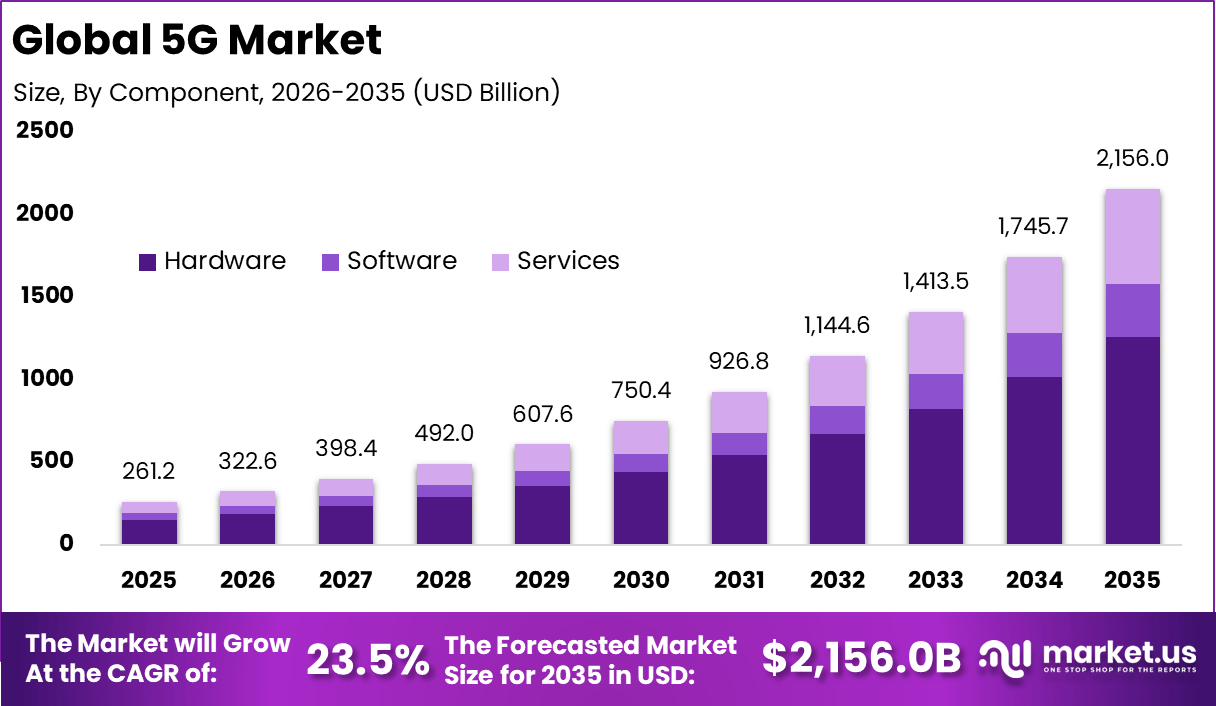
According to Market.us, The global 5G market was valued at USD 261.2 billion in 2025 and is projected to reach approximately USD 2,156 billion by 2035, expanding at a CAGR of 23.5% during the forecast period from 2026 to 2035. In 2025, North America held a dominant position with more than 33.6% market share, generating around USD 87.6 billion in revenue, supported by early spectrum allocation, strong operator investment, and advanced digital infrastructure.

The 5G Market encompasses the ecosystem of fifth-generation wireless technology, including infrastructure, services, devices, and applications that deliver ultra-high speeds, low latency, and massive connectivity. It supports enhanced mobile broadband, ultra-reliable low-latency communications, and massive machine-type communications for diverse uses like IoT and real-time data processing. This market drives transformation across consumer and enterprise sectors by replacing 4G limitations with scalable network capabilities.
One major driving factor is the rapid growth in mobile data consumption. Video streaming, cloud services, and mobile applications require higher network performance. Existing networks face capacity limitations. 5G addresses these challenges through improved efficiency. Another driving factor is the expansion of connected devices. Smart devices, sensors, and machines rely on stable and fast connectivity. Industries require networks that support large device volumes. 5G enables this scale of connectivity.
Top Market Takeaways
- Hardware leads the 5G market with a 58.4% share, as radios, antennas, and core network equipment remain essential for large-scale rollouts.
- Non-Standalone 5G accounts for 62.7%, reflecting faster deployment by leveraging existing 4G networks.
- Enhanced Mobile Broadband dominates applications with 71.5%, supported by demand for high-speed data, streaming, and low-latency services.
- Consumers represent 67.3% of end-user adoption, driven by widespread use of 5G smartphones and data-heavy applications.
- Manufacturing holds 28.9% among end-user industries, showing growing use of 5G for automation, robotics, and smart factories.
- North America captures 33.6% share, supported by early spectrum access, strong operator investment, and advanced digital infrastructure.
- The U.S. market reached USD 79.2 billion in 2024 and is expanding at a 21.02% CAGR, driven by nationwide network expansion, enterprise use cases, and rising data consumption.
Quick Market Facts
- Global 5G adoption continues to accelerate, with subscriptions expected to reach 2.9 billion by late 2025, close to one third of all mobile subscriptions worldwide.
- Connections reached nearly 2 billion by Q1 2024, supported by the addition of 185 million new users.
- North America leads adoption, with 32% of cellular connections on 5G, followed by Northeast Asia with 1.4 billion connections and strong uptake across GCC countries.
India 5G Snapshot
- India reached 365 million 5G subscribers within three years of launch, equal to 35% penetration.
- By 2025, over 486,000 5G base transceiver stations had been deployed, supporting wide coverage and strong performance.
- India ranked among the top ten countries globally for 5G speeds in 2023, with median speeds above 300 Mbps.
- 5G is expected to contribute around ₹36.4 trillion or USD 455 billion to India’s economy by 2040.
Performance and Enterprise Trends
- Higher median speeds are driving increased data usage, with monthly consumption ranging from 18 GB to 55 GB in India.
- Population coverage outside China is expected to reach 60% by the end of 2025.
- In enterprise environments, around 75% of data is expected to be processed at the edge by 2025, enabled by low-latency and high-capacity 5G networks supporting advanced industrial and digital use cases.
Emerging Trends
Shift Toward Private 5G and Network Slicing
An important trend in the 5G market is the emergence of private 5G networks for enterprises. These networks allow organizations to build dedicated connectivity that serves specific operational needs, such as manufacturing automation, logistics tracking, or campus communication. Private 5G gives controlled coverage and tailored performance in localized settings.
Another trend is network slicing, a method that allows operators to create multiple virtual networks within a single physical 5G infrastructure. Each slice can be configured to meet the requirements of specific services, such as low-latency applications or massive IoT communications. Network slicing supports flexible use of network resources and enables operators to offer differentiated services for enterprise and consumer needs.
Growth Factors
Increasing Data Consumption and Digital Services Adoption
A key growth factor for the 5G market is the rise in data consumption due to video streaming, cloud services, and online collaboration tools. Consumers and businesses use more bandwidth for high-quality video, real-time communication, and large-file transfers. 5G networks provide the capacity and speed needed to support these expanding requirements.
Another growth factor is the adoption of digital services by enterprises. Many businesses use digital tools to support remote work, automation, and customer engagement. 5G connectivity helps ensure reliable performance for applications such as virtual meetings, AR/VR experiences, and cloud-based software. As enterprises integrate digital operations, demand for higher connectivity performance increases.
Driver Analysis
Demand for Lower Latency and Enhanced Network Performance
A key driver of the 5G market is the demand for lower network latency and improved performance. Many applications such as online gaming, remote healthcare monitoring, and autonomous systems require rapid responses that traditional networks cannot consistently deliver. 5G systems reduce delay in data transmission, supporting responsive user experiences and real-time operations.
Another driver is the need for greater network capacity. The number of connected devices, sensors, and mobile users continues to increase. 5G networks support high device density and maintain performance when many devices operate simultaneously. This capacity benefit encourages operators and users to transition from older network technologies.
Restraint Analysis
High Deployment Costs and Infrastructure Requirements
A significant restraint for the 5G market is the cost of deploying new infrastructure. Building 5G networks often requires upgrades to base stations, antennas, and backhaul systems. These changes involve capital investment by service providers and may take time to achieve full coverage. In some regions, limited funding or delayed infrastructure planning slows rollout.
Another restraint arises from the need for widespread spectrum availability. 5G networks depend on access to suitable radio spectrum bands that are allocated by regulatory authorities. The process of assigning and coordinating spectrum access can delay network expansion. Without sufficient spectrum, operators may face limitations in delivering full 5G performance.
Opportunity Analysis
Expansion of IoT and Industry Digitalization
There is strong opportunity in the expansion of IoT solutions supported by 5G. Industries such as manufacturing, logistics, and utilities deploy connected sensors for tracking, monitoring, and automation. 5G networks can support large numbers of IoT devices within the same area while maintaining performance. As IoT usage grows, demand for 5G connectivity expands.
Another opportunity lies in digital transformation initiatives across public and private sectors. Services such as smart transportation, connected healthcare, and tele-education require high-performance networks. 5G can support these applications by providing stable connectivity and enabling advanced digital capabilities. Providers that support broad use cases can capture expanding market interest.
Challenge Analysis
Security and Standardization Concerns
A major challenge in the 5G market is ensuring robust network security. As networks become more complex and connected, vulnerabilities may emerge that affect data integrity and privacy. Operators and stakeholders must implement strong security protocols, continuous monitoring, and risk management practices. These requirements increase operational workload and require coordination among industry partners.
Another challenge involves global standardization and interoperability. 5G systems must adhere to international standards to ensure devices and networks can interconnect across regions. Coordination among manufacturers, service providers, and regulators is necessary to maintain compatibility and prevent fragmentation. Achieving consistent implementation across markets remains a key hurdle.
Key Market Segments
By Component
- Hardware
- Software
- Services
By Network Architecture
- Standalone (SA) 5G
- Non-Standalone (NSA) 5G
By Application
- Enhanced Mobile Broadband (eMBB)
- Massive Machine-Type Communications (mMTC)
- Ultra-Reliable Low-Latency Communications (URLLC)
- Fixed Wireless Access (FWA)
By End-User
- Consumers
- Enterprises
- Industrial Verticals
By End-User Industry
- Manufacturing (Industry 4.0)
- Automotive & Transportation
- Healthcare
- Media & Entertainment
- Energy & Utilities
- Others
Top Key Players in the Market
- Ericsson
- Nokia Corporation
- Huawei Technologies Co., Ltd.
- Samsung Electronics Co., Ltd.
- ZTE Corporation
- Cisco Systems, Inc.
- Qualcomm Incorporated
- Intel Corporation
- NEC Corporation
- Fujitsu, Ltd.
- Ciena Corporation
- Mavenir Systems, Inc.
- Affirmed Networks
- CommScope Holding Company, Inc.
- Amdocs, Ltd.
- Others
Report Scope
| Report Features | Description |
|---|---|
| Market Value (2025) | USD 261.2 Bn |
| Forecast Revenue (2035) | USD 2,156 Bn |
| CAGR(2026-2035) | 23.5% |
| Base Year for Estimation | 2025 |
| Historic Period | 2020-2024 |
| Forecast Period | 2026-2035 |
| Report Coverage | Revenue forecast, AI impact on Market trends, Share Insights, Company ranking, competitive landscape, Recent Developments, Market Dynamics and Emerging Trends |
Discuss your needs with our analyst
Please share your requirements with more details so our analyst can check if they can solve your problem(s)