Introduction
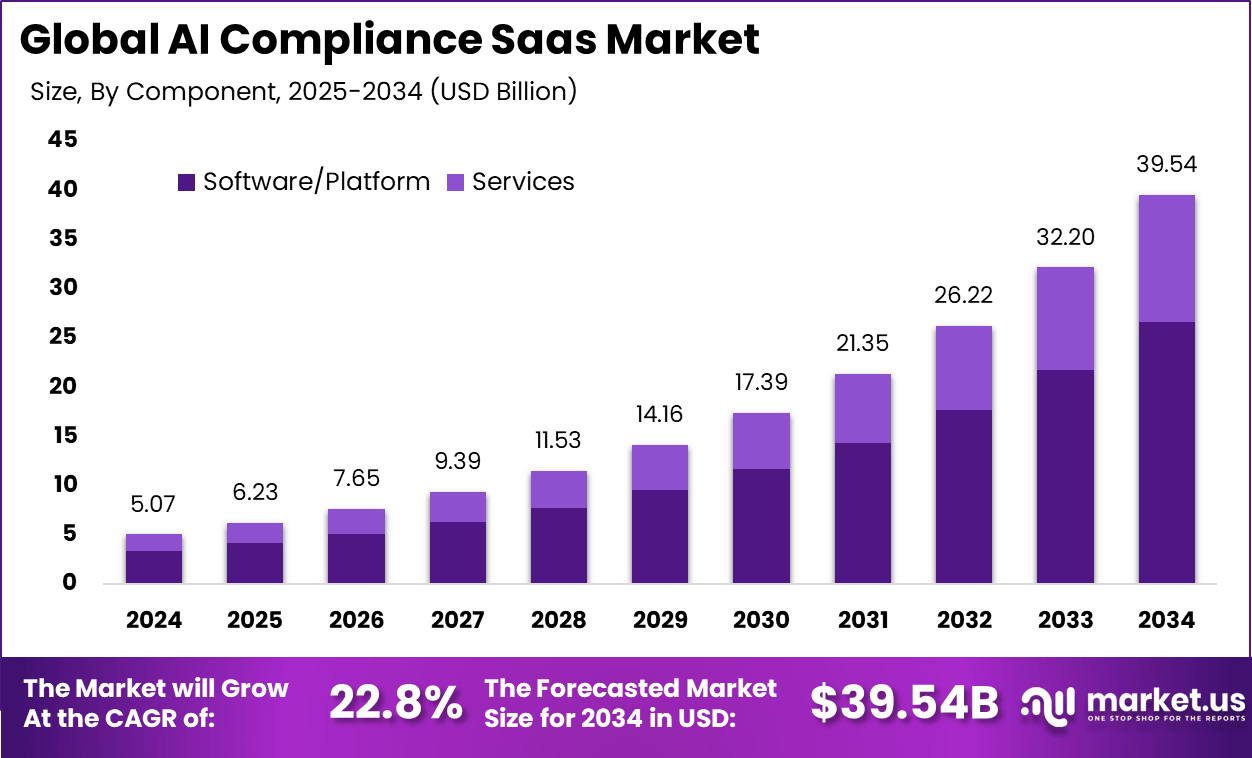
The Global AI Compliance SaaS Market reached USD 5.07 billion in 2024 and is projected to expand to USD 39.54 billion by 2034, registering a strong CAGR of 22.8%. Growth accelerates as enterprises adopt automated compliance platforms to manage regulatory complexity, AI governance, data privacy, risk assessment, and audit automation.
North America dominated with a 45.4% share, generating USD 2.30 billion in 2024, supported by stringent regulations and rapid enterprise adoption. Increasing reliance on AI systems across industries fuels strong demand for platforms that ensure transparency, accountability, and compliance readiness.
How Growth Is Impacting the Economy
The rising adoption of AI compliance platforms enhances economic productivity by reducing regulatory burdens and minimizing the high costs associated with non-compliance. Businesses across finance, healthcare, retail, manufacturing, and IT rely on automated compliance tools to improve audit accuracy and reduce manual workloads. Governments and enterprises benefit from heightened data security, improved governance, and lower legal risks, enabling smoother operations and faster innovation cycles.
Economic efficiency strengthens as AI compliance SaaS enables standardized frameworks for responsible AI adoption, promoting trust and stability across digital ecosystems. The expansion of compliance-focused SaaS solutions also drives substantial investment in cloud infrastructure, cybersecurity, and digital transformation activities. This contributes to job creation, higher technology spending, and improved operational resilience, ultimately boosting economic competitiveness across global markets.
➤ Smarter strategy starts here! Get the sample – https://market.us/report/ai-compliance-saas-market/free-sample/
Impact on Global Businesses
Global businesses are experiencing rising costs due to stricter data protection laws and increased demand for secure AI systems, leading to investments in compliance automation, documentation, and real-time monitoring tools. Supply chain operations shift as enterprises seek AI-enabled governance to ensure transparent data handling, third-party risk assessment, and cross-border compliance management. Highly regulated sectors such as BFSI, healthcare, and telecom witness deeper dependence on AI compliance SaaS to reduce exposure to audits, enhance reporting accuracy, and eliminate manual compliance inefficiencies.
Strategies for Businesses
- Adopt centralized AI compliance platforms to automate risk assessment.
- Strengthen governance frameworks aligned with global regulations.
- Integrate real-time monitoring for data usage and model transparency.
- Invest in staff training for AI ethics, privacy, and compliance.
- Implement cross-border compliance tools to reduce regulatory conflicts.
- Prioritize cybersecurity and secure AI model deployment.
Key Takeaways
- AI compliance SaaS demand rising due to regulatory tightening.
- North America leads with 45.4% market share.
- Automating governance reduces audit, risk, and legal costs.
- Sectors with heavy data sensitivity adopt platforms fastest.
- Future growth driven by AI transparency and responsible-AI mandates.
➤ Unlock growth secrets! Buy the full report – https://market.us/purchase-report/?report_id=168551
Analyst Viewpoint
Current market momentum remains strong as organizations face mounting regulatory expectations and shift toward automated governance. Businesses increasingly view AI compliance SaaS as essential for operational continuity, risk mitigation, and trust-building. The future outlook remains highly positive due to expanding AI ecosystems and global legislation mandating transparency, explainability, and responsible AI use. Regions with emerging AI laws will further accelerate demand for scalable compliance automation.
Use Case & Growth Factors
| Category | Details |
|---|---|
| Key Use Cases | Automated audits, regulatory reporting, AI model monitoring, risk scoring, data governance, privacy management |
| Growth Factors | Tightening global AI regulations, enterprise digitalization, rising privacy concerns, adoption of responsible AI, growth of cloud ecosystems |
Regional Analysis
North America dominates the market with a 45.4% share driven by stringent AI and data protection laws, robust technological infrastructure, and high enterprise adoption. Europe follows closely as GDPR, AI Act mandates, and cross-border data rules fuel rapid adoption. Asia Pacific shows fastest growth with expanding AI policy frameworks in China, India, Japan, and South Korea. Latin America, Middle East, and Africa witness gradually rising adoption as digital transformation, fintech expansion, and government AI governance initiatives increase compliance needs.
➤ Want more market wisdom? Browse reports –
- Data Acquisition Equipment Market
- RoCE for AI Workloads Market
- Data Contracts for AI Market
- Returns Root Cause AI Market
Business Opportunities
Businesses can capitalize on opportunities in automated governance tools, cross-border compliance engines, real-time AI auditing, privacy-by-design solutions, and model explainability software. The growth of generative AI expands prospects for bias detection, content governance, IP protection, and responsible AI policy integration. SMEs represent a large untapped segment requiring affordable, easy-to-deploy compliance SaaS. Consulting, training, and managed governance services also offer recurring revenue potential.
Key Segmentation
The market includes components such as compliance platforms, governance tools, reporting software, data-privacy modules, audit automation systems, and model-monitoring engines. Applications span regulatory reporting, data management, algorithmic transparency, risk scoring, and policy enforcement. Deployment models include cloud-based and hybrid environments. Key end-users include BFSI, healthcare, retail, telecom, manufacturing, government, and IT enterprises, each relying on AI compliance SaaS to safeguard operations and meet regulatory obligations.
Key Player Analysis
Leading vendors focus on strengthening platform integration, enhancing real-time monitoring, and expanding global compliance coverage. They invest in AI-driven governance frameworks that support explainability, ethical assessment, and automated data protection. Product strategies emphasize scalable cloud architecture, customizable workflows, and multi-region compliance mapping. Companies also expand via partnerships, industry-specific modules, and continuous upgrades to align with evolving regulations. A strong focus on security, transparency, and interoperability defines competitive differentiation.
- IBM Corporation
- Microsoft Corporation
- SAP SE
- Oracle Corporation
- com, Inc.
- ServiceNow, Inc.
- MetricStream
- LogicGate
- Workiva Inc.
- OneTrust
- RiskLens
- NAVEX Global
- SAI Global
- Deloitte
- PwC
- Accenture
- Cognizant
- FICO
- Fortinet
- Others
Recent Developments
- Introduction of AI audit automation tools with explainability features.
- Expansion of cloud-native compliance platforms across new regions.
- Launch of bias-detection modules for enterprise AI models.
- Integration of real-time privacy monitoring with advanced analytics.
- Collaboration with regulators to develop sector-specific governance guidelines.
Conclusion
The AI Compliance SaaS market is rapidly evolving, driven by regulatory tightening and the need for secure, responsible AI deployment. With strong growth prospects and rising enterprise adoption, the sector is positioned to remain essential for global digital transformation.
Discuss your needs with our analyst
Please share your requirements with more details so our analyst can check if they can solve your problem(s)