Overview
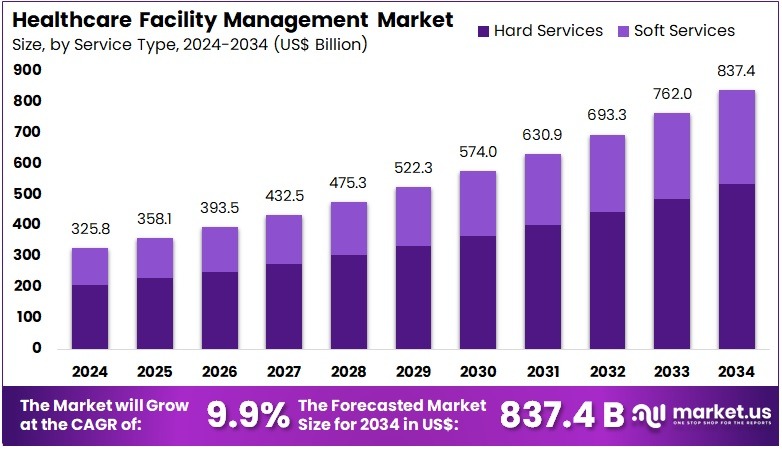
New York, NY – April 23, 2026 – The Global Healthcare Facility Management Market Size is expected to be worth around US$ 837.4 billion by 2034 from US$ 325.8 billion in 2024, growing at a CAGR of 9.9% during the forecast period 2025 to 2034.
Healthcare Facility Management (HFM) refers to the coordinated management of infrastructure, services, and support functions within healthcare environments such as hospitals, clinics, and diagnostic centers. It ensures that medical facilities operate efficiently, safely, and in compliance with regulatory standards, thereby supporting high-quality patient care.
The scope of HFM includes both “hard services” and “soft services.” Hard services involve the maintenance of critical systems such as electrical infrastructure, HVAC (heating, ventilation, and air conditioning), plumbing, fire safety, and medical equipment. Soft services encompass housekeeping, waste management, security, catering, and patient support services. Together, these functions contribute to a hygienic, secure, and patient-friendly environment.
The demand for healthcare facility management services has been driven by the rapid expansion of healthcare infrastructure, increasing patient volumes, and the growing emphasis on infection control and safety standards. Additionally, the integration of advanced technologies, including automation and digital monitoring systems, has enhanced operational efficiency and predictive maintenance capabilities.
Outsourcing of facility management services has gained traction, enabling healthcare providers to focus on core medical functions while ensuring cost optimization and service quality. The market is expected to witness steady growth, supported by rising healthcare investments, urbanization, and the need for sustainable and energy-efficient facility operations.
Key Takeaways
- In 2024, the healthcare facility management market was valued at US$ 325.8 billion and is projected to reach US$ 837.4 billion by 2034, expanding at a CAGR of 9.9% during the forecast period.
- By service type, the market is categorized into hard services and soft services. Hard services dominated the segment in 2024, accounting for a market share of 63.7%.
- Based on end users, the market is segmented into hospitals & clinics, long-term healthcare facilities, and others. Hospitals & clinics emerged as the leading segment, capturing 71.4% of the total market share.
- Regionally, North America held the largest share in 2024, contributing 42.4% to the global market.
Regional Analysis
North America accounted for the largest share of the healthcare facility management market in 2024, contributing 42.4% of total revenue. This dominance has been driven by the increasing complexity of healthcare infrastructure and a strong focus on operational efficiency.
Regulatory frameworks led by the US Centers for Medicare & Medicaid Services have emphasized quality and safety standards, necessitating advanced facility management practices. Additionally, rising healthcare expenditure in the United States has supported continuous investments in infrastructure maintenance and modernization. Data published by the American Cancer Society indicates over 1.8 million new cancer cases in 2024, reinforcing sustained demand for efficient healthcare environments.
Asia Pacific is projected to register the fastest growth during the forecast period. This expansion is attributed to increasing healthcare investments, expanding hospital networks, and rising public health expenditure. The growing elderly population, higher incidence of chronic diseases, and expanding medical tourism industry are further accelerating demand for advanced facility management services.
Emerging Trends
- Digitalization and smart facility systems: Hospitals are increasingly adopting IoT and AI tools. Studies from World Health Organization indicate digital health adoption has exceeded 60% in advanced facilities, improving monitoring, maintenance, and operational efficiency.
- Growth in healthcare infrastructure investment: According to World Bank, global health expenditure accounts for nearly 10% of GDP, driving demand for modern facility management systems in hospitals and clinics.
- Focus on sustainability and energy efficiency: Healthcare buildings consume about 2–3 times more energy than commercial buildings, as reported by International Energy Agency, leading to adoption of energy-efficient systems and green building standards.
- Enhanced infection control protocols: Post-pandemic, strict hygiene standards have been implemented. The Centers for Disease Control and Prevention highlights that effective facility management can reduce hospital-acquired infections by up to 30%.
Key Use Cases
- Asset and infrastructure maintenance: Facility management ensures continuous functioning of HVAC, power, and medical equipment, reducing downtime and extending asset life in high-dependency healthcare environments.
- Energy management and cost control: Smart systems monitor and optimize energy usage, enabling hospitals to reduce consumption by 10–20%, improving cost efficiency and supporting sustainability goals.
- Infection prevention and sanitation management: Standardized cleaning, air filtration, and biomedical waste handling systems help maintain hygiene compliance and reduce infection risks in clinical settings.
- Space optimization and patient experience improvement: Efficient space planning, lighting, and air quality management enhance patient comfort, while also improving workflow efficiency for healthcare staff.
Frequently Asked Questions on Healthcare Facility Management
- What are the key components of healthcare facility management?
The core components include maintenance of medical equipment, waste management, security services, cleaning, energy management, and space optimization. These functions collectively support clinical operations, improve patient experience, and ensure adherence to healthcare standards and safety regulations. - Why is healthcare facility management important?
Healthcare facility management plays a critical role in maintaining hygiene standards, reducing operational risks, and ensuring uninterrupted healthcare delivery. It directly influences patient satisfaction, infection control, and cost efficiency, thereby supporting the overall performance of healthcare institutions. - What factors are driving the healthcare facility management market growth?
Market growth is driven by increasing healthcare infrastructure investments, rising patient volumes, stringent regulatory requirements, and growing outsourcing trends. Additionally, the demand for cost optimization and enhanced operational efficiency is significantly contributing to market expansion. - What are the different types of healthcare facility management services?
Services are broadly categorized into hard services and soft services. Hard services include mechanical and electrical maintenance, while soft services cover cleaning, catering, and security. Both categories are essential for ensuring smooth and safe healthcare operations. - What role does technology play in healthcare facility management?
Technology integration enhances efficiency through automation, predictive maintenance, and real-time monitoring. Advanced tools such as IoT-enabled systems and facility management software improve asset tracking, reduce downtime, and enable data-driven decision-making within healthcare environments. - How is outsourcing impacting the healthcare facility management market?
Outsourcing allows healthcare providers to focus on core clinical activities while reducing operational costs. Specialized service providers offer expertise, scalability, and compliance support, which is leading to increased adoption of outsourced facility management solutions globally. - Which regions are leading the healthcare facility management market?
North America and Europe dominate due to advanced healthcare infrastructure and high outsourcing adoption. Meanwhile, Asia-Pacific is experiencing rapid growth, driven by expanding healthcare investments, urbanization, and increasing demand for quality healthcare services.
Conclusion
The healthcare facility management market is experiencing steady expansion, driven by rising healthcare infrastructure, increasing patient volumes, and stringent regulatory standards. Market growth from US$ 325.8 billion in 2024 to US$ 837.4 billion by 2034, at a 9.9% CAGR, reflects strong demand for efficient and compliant facility operations.
Dominance of hard services and hospitals highlights the need for reliable infrastructure management. Regional leadership of North America and rapid growth in Asia Pacific indicate balanced global development. Increasing adoption of digital technologies, outsourcing, and sustainability practices is expected to enhance operational efficiency and support long-term market growth.
Discuss your needs with our analyst
Please share your requirements with more details so our analyst can check if they can solve your problem(s)