Introduction
The Global Virtual Security Appliance Market reached USD 4.9 billion in 2024 and is set to grow from USD 5.7 billion in 2025 to USD 20.9 billion by 2034, advancing at a strong CAGR of 15.6%. Growth is fueled by rising cloud adoption, escalating cyber threats, and increasing enterprise reliance on virtualization. In 2024, North America dominated with 38.0%, generating USD 1.86 billion as organizations prioritized scalable, software-driven cybersecurity. Worldwide digital transformation programs continue strengthening the demand for flexible virtual security infrastructure.
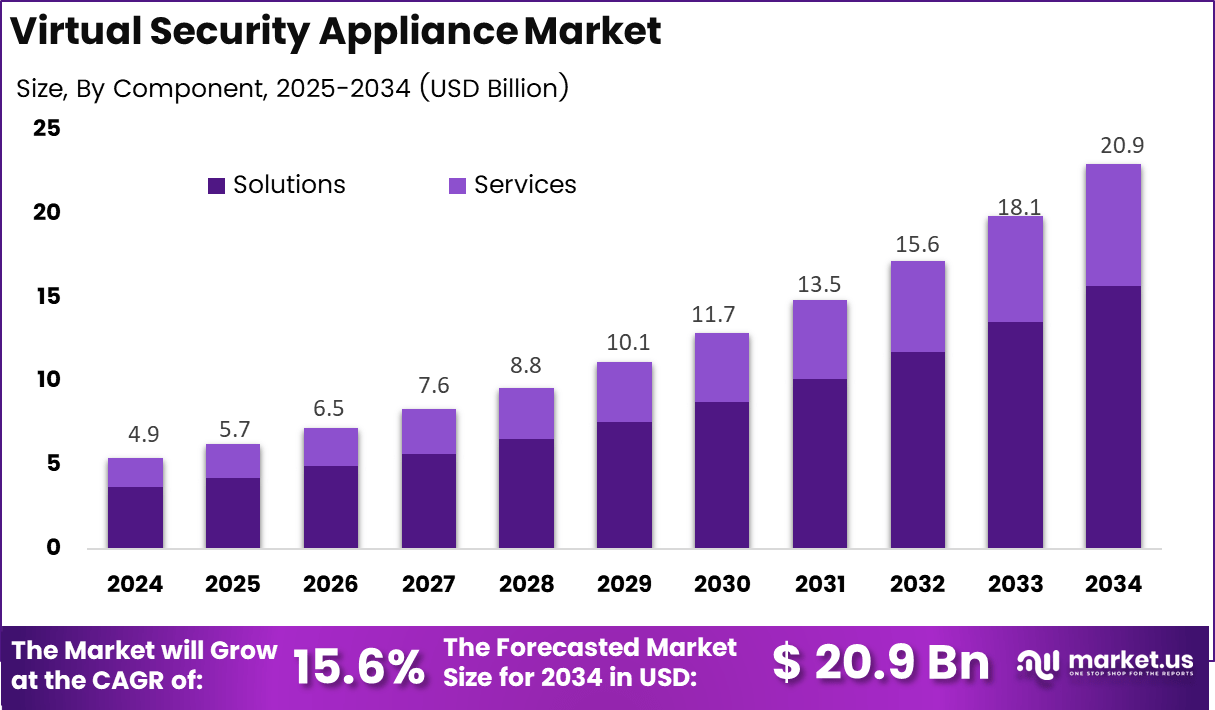
How Growth is Impacting the Economy
Rapid market expansion enhances economic resilience by supporting secure digital ecosystems, enabling enterprises to shift from hardware-heavy models to cost-efficient virtual solutions. This shift lowers long-term infrastructure expenses, increases cybersecurity readiness, and drives new job creation in cloud security operations.
As digital services, e-commerce, and online financial platforms grow, virtual security appliances help protect national and commercial digital assets, reducing the economic losses associated with cyber incidents. The strong 15.6% growth fuels technological innovation, attracts global investment, and strengthens country-level digital competitiveness by promoting secure modernization across public and private sectors.
➤ Smarter strategy starts here! Get the sample – https://market.us/report/virtual-security-appliance-market/free-sample/
Impact on Global Businesses
Businesses are experiencing rising cybersecurity costs due to the increasing sophistication of cyberattacks. The shift toward virtualized and cloud-based systems requires new investments in digital threat protection and regulatory compliance. Supply chains are becoming increasingly digital, prompting organizations to adopt virtual security appliances that safeguard multi-tier networks, cloud workloads, and remote infrastructure. Financial institutions seek real-time threat intelligence for secure digital transactions. Healthcare organizations prioritize data protection for electronic records and telehealth services. Retailers focus on safeguarding online payment systems, while manufacturers strengthen IoT protection to avoid operational downtime and intellectual property risks.
Strategies for Businesses
Businesses should strengthen cybersecurity by implementing zero-trust frameworks, adopting cloud-native security platforms, and enabling automated threat detection. Investing in continuous monitoring, encryption protocols, and skilled cybersecurity training enhances resilience. Leveraging managed security services improves scalability and reduces internal workload. Modernizing legacy systems and securing API communication remains essential for sustainable long-term protection.
Key Takeaways
- Strong CAGR of 15.6% signals sustained global growth
- Market projected to exceed USD 20.9 billion by 2034
- Cloud adoption and cyber threats remain key demand drivers
- North America leads with a 38.0% revenue share
- Virtualization reduces hardware costs and improves scalability
➤ Unlock growth secrets! Buy the full report – https://market.us/purchase-report/?report_id=160832
Analyst Viewpoint
Market momentum reflects accelerating demand for flexible, software-defined cybersecurity solutions across cloud-first enterprises. Virtual appliances offer faster deployment, centralized control, and scalable defenses, positioning them as essential components of modern digital infrastructure. In the coming years, growth will be supported by 5G expansion, IoT integration, and regulatory requirements. Advancements in AI-driven detection and automated response workflows will further strengthen adoption. The long-term outlook remains positive as enterprises pursue security modernization and shift toward virtualized architectures to safeguard expanding digital ecosystems.
Use Case and Growth Factors
| Use Case | Description | Growth Factors |
|---|---|---|
| Cloud Security | Protecting workloads across hybrid and multi-cloud environments | Rapid cloud adoption and need for scalable security |
| Virtual Firewalling | Software-driven firewalling for enterprise networks | Shift away from physical hardware appliances |
| Secure Remote Access | Protecting distributed workflows and remote connectivity | Growth of hybrid workforces and mobile operations |
| Data Center Protection | Virtual segmentation and advanced threat isolation | Expansion of virtualized and hyper-converged data centers |
Regional Analysis
North America leads the market with 38.0% share due to strong enterprise investments, stringent compliance requirements, and adoption of advanced cloud infrastructure. Europe follows with increasing demand driven by GDPR and the modernization of digital services. Asia-Pacific is growing fastest as SMEs and large organizations accelerate cloud migration and cybersecurity adoption. The Middle East, Africa, and Latin America see steady progress supported by digital banking expansion, rising cyberattacks, and national cybersecurity initiatives. Across all regions, virtual appliances are favored due to their cost efficiency, flexibility, and compatibility with modern IT architectures.
➤ Want more market wisdom? Browse reports –
- Purchase-Mortgage Market
- Big Data Finance Market
- Data Mining Tools Market
- Haptic Internet Infrastructure Market
Business Opportunities
The rising demand for cloud-native cybersecurity creates strong opportunities for virtual appliance providers. AI-enhanced threat detection, behavioral analytics, and automated remediation introduce new innovation pathways. Industry-specific solutions for finance, healthcare, and government sectors present substantial revenue potential.
Growth in managed security services expands opportunities for vendors offering integrated virtual security platforms. Emerging technologies like IoT, edge computing, and 5G networks demand lightweight, distributed virtual security solutions. Increasing global compliance requirements drive broader adoption, making the market an attractive landscape for long-term investment and technological advancement.
Key Segmentation
Segmentation spans deployment models, organization size, application areas, and industry verticals. Deployment options include cloud-based, on-premise, and hybrid models, with cloud-based solutions holding the largest share due to scalability. Large enterprises dominate adoption because of high security budgets and expansive digital infrastructures.
Primary applications include intrusion detection, firewalling, secure remote access, and network traffic filtering. Key end-use industries include BFSI, healthcare, IT and telecom, retail, manufacturing, and government. Each sector’s rising digital footprint strengthens the need for virtualized security solutions.
Key Player Analysis
Leading players focus on enhancing AI-driven threat detection, integrating virtual security capabilities with cloud platforms, and improving visibility across complex digital environments. Product strategies emphasize automation, unified threat management, and seamless orchestration across distributed systems.
Companies invest heavily in R&D to strengthen real-time analytics, reduce latency, and optimize performance in high-speed networks. Partnerships with managed security providers and telecom operators expand market presence. Subscription-based, scalable deployment models remain central to competitive positioning and customer adoption.
- Cisco Systems, Inc.
- Juniper Networks, Inc.
- Fortinet, Inc.
- Palo Alto Networks, Inc.
- Check Point Software Technologies Ltd.
- Sophos Ltd.
- Barracuda Networks, Inc.
- Trend Micro, Inc.
- VMware (Broadcom)
- McAfee Corp.
- Hillstone Networks
- Others
Recent Developments
- Launch of new AI-enabled virtual firewall solutions for enhanced threat detection
- Release of cloud-native security appliances supporting multi-cloud deployments
- Introduction of virtual security tools for edge and 5G ecosystems
- Development of compliance-focused virtual protection suites for regulated industries
- Expansion of partnerships with global managed security service providers
Conclusion
The Virtual Security Appliance Market is entering a high-growth phase fueled by cyber risk escalation and global cloud adoption. With strong economic impact, rising enterprise demand, and continuous innovation, virtual security technologies will remain fundamental to securing modern digital infrastructures and supporting long-term global cybersecurity resilience.
Discuss your needs with our analyst
Please share your requirements with more details so our analyst can check if they can solve your problem(s)