Market Overview
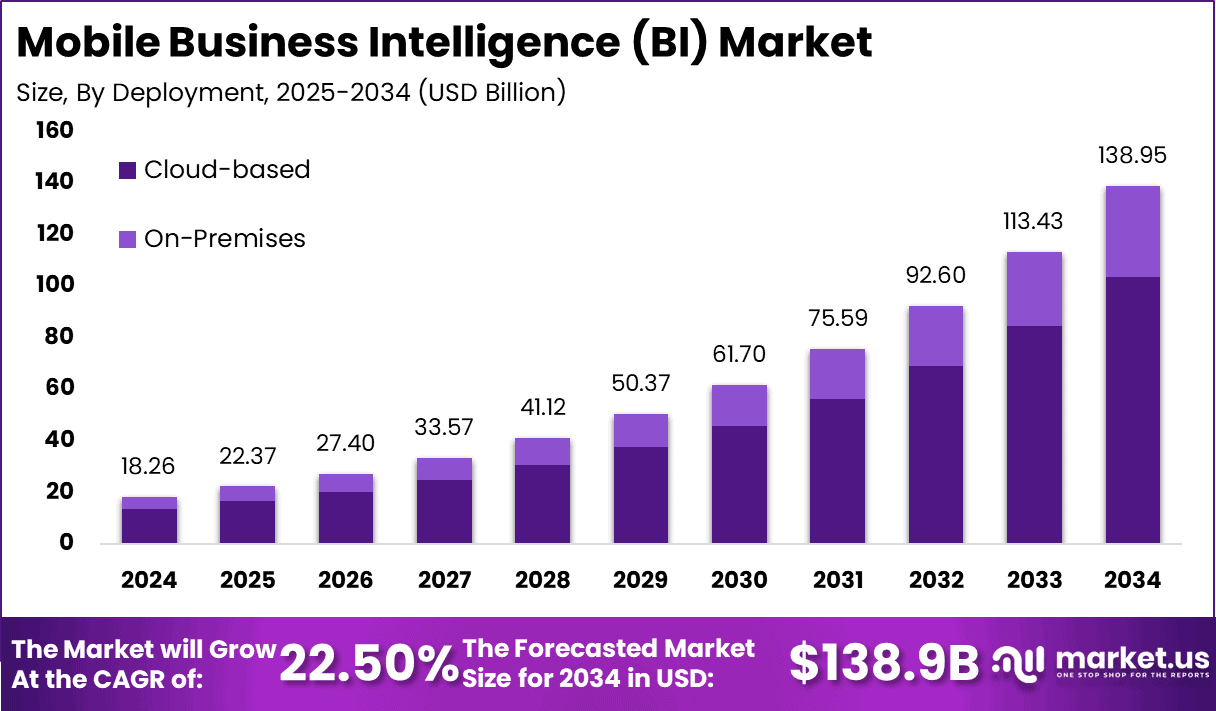
The Mobile Business Intelligence market is gaining strong traction as enterprises increasingly demand real-time insights that can be accessed anywhere through smartphones and tablets. The market generated USD 18.26 billion in 2024 and is projected to expand at a CAGR of 22.5% through 2034, reaching nearly USD 138.9 billion.
This growth reflects the rising need for faster decision-making, cloud-connected analytics, and user-friendly reporting tools for distributed teams. Strong software demand, growing cloud deployment, and wider business use across sales and BFSI are shaping the market. Mobile BI is becoming an important layer in modern enterprise data strategy.
Key Takeaways
- Market size in 2024: USD 18.26 billion
- Forecast value by 2034: USD 138.9 billion
- CAGR 2025 to 2034: 22.5%
- North America’s share in 2024: 39.3%
- North America value in 2024: USD 7.17 billion
- U.S. market value in 2024: USD 6.29 billion
- U.S. forecast by 2034: USD 39.93 billion
- Software segment share: 62.8%
- Cloud deployment share: 74.5%
- Large enterprises share: 73.6%
- Sales function share: 25.7%
- BFSI sector share: 23.4%
Role of AI
Artificial intelligence is strengthening the value proposition of mobile BI by turning dashboards into intelligent decision tools rather than simple reporting interfaces. AI helps users detect patterns, identify anomalies, forecast outcomes, and receive automated recommendations directly on mobile devices. This is especially useful for sales teams, financial managers, and executives who need fast answers while traveling or working remotely.
AI also improves natural language querying, making data access easier for non-technical users. As businesses continue to prioritize speed and usability, AI-integrated mobile BI platforms are expected to improve adoption, reduce manual analysis time, and support more confident operational and strategic decisions.
Analyst’s Viewpoint
The Mobile BI market is moving beyond convenience and becoming a core productivity tool for enterprises that depend on distributed workforces and continuous performance monitoring. The strong share of software and cloud deployment shows that buyers are prioritizing flexibility, usability, and faster implementation over legacy analytics models.
Large enterprises remain the leading adopters because they manage higher data volumes and more complex reporting needs, but the long-term opportunity also extends to mid-sized businesses seeking affordable cloud analytics. From an analyst perspective, the market outlook remains highly favorable as enterprises increasingly demand mobile-first intelligence, AI-supported insights, and faster decision cycles across all business functions.
Regional Highlights
North America led the Mobile BI market in 2024 with a 39.3% share, supported by strong enterprise mobility infrastructure, early cloud adoption, and higher spending on analytics technologies. The region generated USD 7.17 billion, with the U.S. alone contributing USD 6.29 billion. This leadership reflects mature digital transformation strategies and strong demand for real-time business visibility.
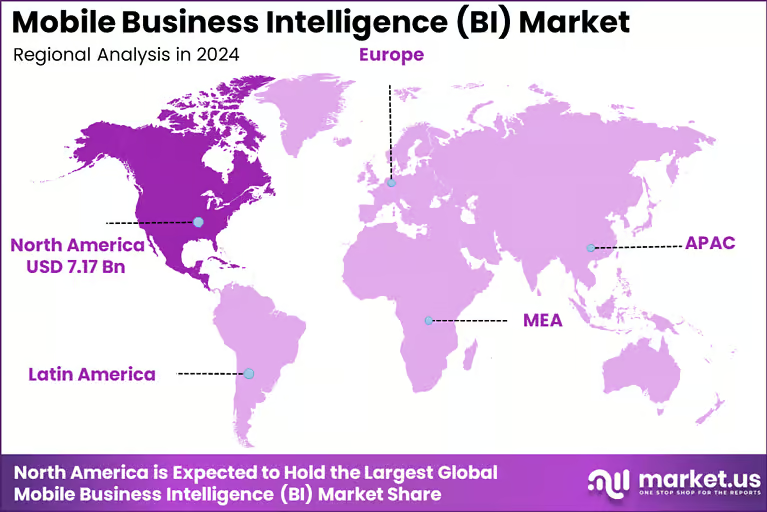
The U.S. is expected to maintain momentum through 2034, reaching USD 39.93 billion at a 20.3% CAGR. Other regions are also advancing as remote work, cloud adoption, and mobile device usage increase, but North America continues to set the pace for deployment maturity and enterprise-scale use.
Key Market Segmentation
- By Component: Software leads with 62.8% because mobile BI depends heavily on visualization tools, reporting platforms, and analytics applications.
- By Deployment: Cloud holds 74.5% due to its scalability, lower upfront cost, and easier access for remote and mobile teams.
- By Enterprise Size: Large enterprises account for 73.6% as they generate large data volumes and require real-time monitoring across locations.
- By Business Function: Sales represents 25.7% because mobile BI supports field performance tracking, lead analysis, and revenue visibility.
- By End Use Industry: BFSI captures 23.4% as institutions rely on mobile analytics for customer insights, fraud monitoring, and faster financial decisions.
Emerging Trends
- Growing integration of AI-driven predictive analytics into mobile dashboards
- Rising use of natural language search for faster data interaction
- Higher demand for personalized mobile reports and role-based dashboards
- Expansion of cloud native BI platforms built for remote collaboration
- Increased focus on secure mobile analytics for regulated industries
Top Use Cases
- Sales pipeline tracking and field force performance monitoring
- Executive dashboard access for real-time business reviews
- Financial reporting and risk analysis on mobile devices
- Customer engagement monitoring for service and marketing teams
- Fraud detection and compliance reporting in banking environments
Major Challenges
- Data security concerns linked to mobile access and remote usage
- Integration issues with legacy enterprise systems and data sources
- Limited screen size affects complex data visualization
- User adoption gaps among teams unfamiliar with analytics tools
- Governance challenges in maintaining data consistency across devices
Attractive Opportunities
- Expansion into mid-sized enterprises through subscription-based cloud models
- Greater adoption in healthcare, retail, manufacturing, and logistics
- AI-powered self-service analytics for non-technical users
- Industry-specific mobile BI applications tailored to business workflows
- Strong demand for real-time analytics in remote and hybrid work models
Business Benefits
Mobile BI delivers clear business value by making analytics available at the point of action. It helps decision makers respond faster to operational issues, track performance in real time, and stay connected to business metrics outside traditional office settings. Sales teams benefit from immediate access to revenue and customer data, while executives gain instant visibility into trends and exceptions. Cloud deployment improves flexibility and reduces infrastructure burden, making adoption easier across multiple business units. Mobile BI also supports faster collaboration, better accountability, and improved responsiveness. As organizations seek efficiency and agility, mobile BI offers both productivity gains and stronger data-driven execution.
Recent Developments
Vendors are increasingly enhancing mobile BI platforms with AI-based forecasting, automated alerts, stronger mobile security, and cloud native architecture. Market activity also shows growing interest in industry-focused analytics apps and simpler mobile interfaces that improve adoption among business users across distributed enterprise environments.
Key Players Analysis
The competitive landscape is shaped by providers focused on analytics software, cloud delivery, and user-friendly mobile reporting. Leading companies are strengthening their positions through AI integration, better dashboard design, cross-device compatibility, and enterprise-grade security. Competition remains centered on ease of use, scalability, and faster insight delivery.
Customer Insights
Buyer behavior in the Mobile BI market shows a clear preference for platforms that are easy to deploy, simple to use, and accessible across multiple devices. Customers increasingly favor cloud-based solutions because they reduce infrastructure complexity and support remote work. Large enterprises remain the biggest buyers due to broader analytics requirements, yet customer expectations are shifting toward self-service features and faster implementation.
Purchasing decisions are often influenced by security, dashboard flexibility, integration with existing systems, and AI-based insight generation. From a segmentation perspective, customer needs vary by function, with sales, finance, and BFSI users placing higher value on real-time visibility and mobile responsiveness.
Future Outlook
The future of the Mobile BI market remains highly promising as organizations continue to move toward mobile-first, cloud-connected, and AI-assisted decision environments. Demand is expected to remain strong as enterprises seek faster access to data across field operations, executive management, finance, and customer-facing teams. Cloud deployment is likely to stay dominant, while AI capabilities are expected to become a standard feature rather than a differentiator. Large enterprises will continue to lead spending, but broader adoption among smaller firms is expected as platforms become more affordable and intuitive. Over the next decade, mobile BI is anticipated to become a standard enterprise analytics channel.
Conclusion
The Mobile Business Intelligence market is evolving into a critical part of enterprise analytics as businesses increasingly need real-time, mobile accessible, and actionable insights. Strong growth expectations, high cloud adoption, and broad demand from large enterprises, sales teams, and BFSI users highlight a solid market foundation. The role of AI is further strengthening platform value by improving prediction, automation, and usability. North America remains the leading region, while long-term global opportunities continue to expand across industries. Overall, the market is well positioned for sustained expansion as enterprises place greater emphasis on speed, flexibility, and data-driven decision-making in everyday operations.
Discuss your needs with our analyst
Please share your requirements with more details so our analyst can check if they can solve your problem(s)