Introduction
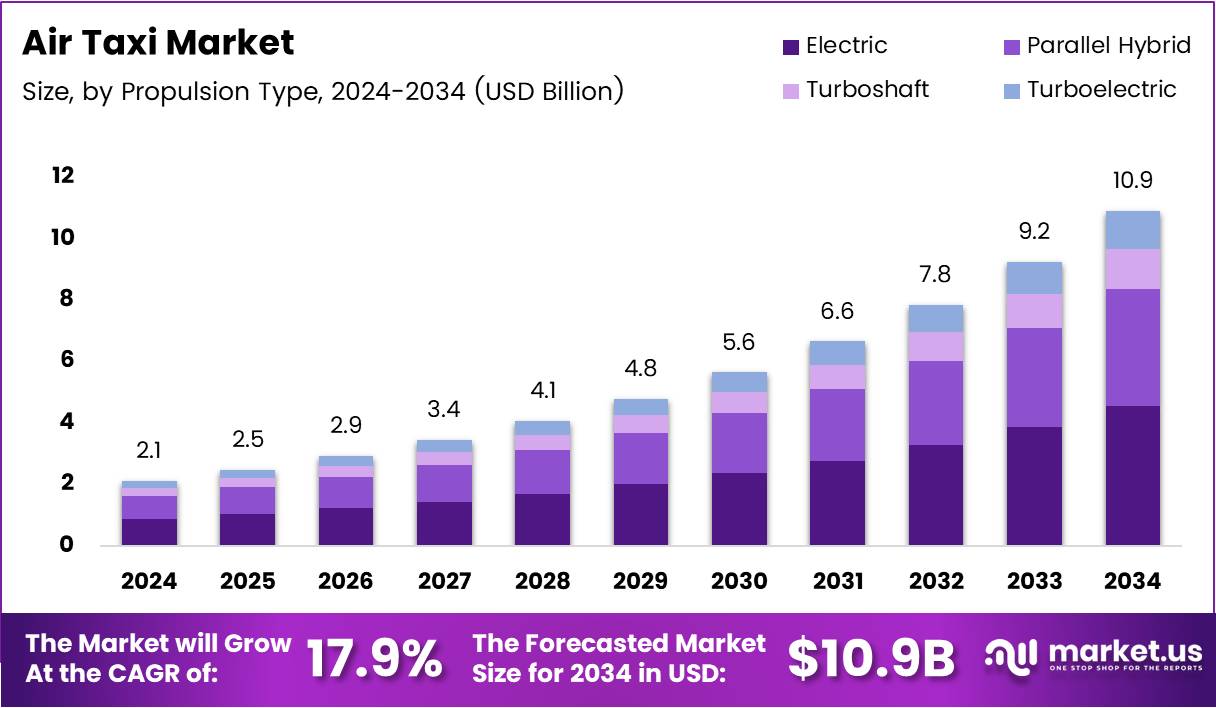
Market.us has released a comprehensive analysis of the Global Air Taxi Market, projecting robust expansion from USD 2.1 Billion in 2024 to USD 10.9 Billion by 2034. The market is forecast to grow at a CAGR of 17.9% over the 2025–2034 period, reflecting accelerating demand for rapid, on-demand aerial transport solutions that reduce urban congestion and shorten travel times across metropolitan environments.
Consequently, growing urbanization is intensifying pressure on road networks, compelling authorities and city planners to explore vertical mobility pathways that increase transportation efficiency. Air taxis offer a compelling alternative by operating above congested ground infrastructure, supporting smarter city designs and fostering long-term mobility transformation across highly populated regions.
Furthermore, technological innovation is strengthening commercial viability at a rapid pace. Developers are continuously optimizing battery density, autonomous guidance systems, and lightweight structural components to improve safety, extend range, and reduce operating costs. These advancements reshape the economic case for air taxis, enabling operators to explore scalable service offerings across diverse urban and peri-urban environments.
Additionally, growing venture capital investment and supportive government funding are accelerating commercialization timelines. Authorities prioritize air mobility innovation through strategic incentive programs, cooperative test environments, and targeted research assistance, reducing development risks and motivating stakeholders to scale production capacity for broader international deployment.
Finally, public sentiment is gradually shifting in favor of urban air mobility. An Airbus perception study across 1,540 participants reported 44.5% initial support for UAM and 41.4% rating it safe or very safe, confirming steadily increasing awareness and laying the foundation for broader market adoption as system reliability and noise optimization continue to improve.
Key Takeaways
- The Global Air Taxi Market is projected to grow from USD 2.1 Billion in 2024 to USD 10.9 Billion by 2034 at a CAGR of 17.9%.
- Electric propulsion leads market share with 47.9%.
- Multicopter aircraft type dominates with a 44.1% share.
- Two-passenger capacity segment holds the leading share at 39.8%.
- North America leads regionally with a 37.8% share valued at USD 0.7 Billion.
Market Segmentation Overview
By propulsion type, Electric dominates with a 47.9% share, driven by reduced noise levels, lower emissions, and efficient operating structures well suited for dense urban deployments. Parallel Hybrid systems serve early-stage networks lacking comprehensive charging infrastructure, while Turboshaft and Turboelectric platforms address routes requiring stronger endurance and extended operational range.
By aircraft type, Multicopter leads with 44.1%, reflecting its exceptional maneuverability, vertical lift efficiency, and reduced mechanical complexity suited to short-range urban operations. By passenger capacity, Two-seat configurations dominate with 39.8%, offering the ideal balance between cost efficiency, compact design, and route suitability for urban commuting patterns. Larger configurations serving four or more passengers are gaining traction as infrastructure expands and shared travel demand grows.
Drivers
Rapid urbanization intensifying demand for high-efficiency on-demand mobility is a primary market driver. As metropolitan populations grow, traffic complexity increases and travel time costs rise, making vertical mobility pathways economically attractive. Advancements in electric propulsion and lightweight airframes simultaneously reduce fuel consumption, boost battery endurance, and strengthen environmental compatibility, reinforcing air taxis as reliable long-term alternatives to ground-based transport.
AI-enabled air traffic management solutions are providing an equally critical growth catalyst. Intelligent systems improve route planning, collision avoidance, and predictive monitoring, supporting controlled airspace integration and enabling coordinated fleet movements across densely populated regions. Their adoption strengthens operational trust and encourages regulators to define wider commercial approval frameworks, accelerating the transition from pilot programs to commercial-scale deployment.
Use Cases
Airport shuttle and intra-city transfer services represent the most commercially mature use case. Two and four-seat air taxi configurations are well positioned for premium point-to-point routes connecting airports, business districts, and transit hubs, reducing journey times significantly compared to ground-based alternatives. These high-frequency, high-visibility routes build passenger familiarity and generate the operational data needed to refine service models and justify infrastructure investment.
Tourism, emergency logistics, and medical transport represent high-value specialized applications. These missions demonstrate strong operational feasibility in varied environments, helping cities adopt air taxis for niche services while improving overall value-chain diversification. Expanding into these applications increases commercial attractiveness, strengthens investor confidence, and allows operators to refine service design based on real-world performance feedback ahead of broader urban deployment.
Major Challenges
Complex regulatory certification frameworks remain the most significant deployment barrier. Air taxi manufacturers undergo extensive testing and documentation processes governed by stringent aviation safety regulations, extending timelines and increasing cost structures considerably. Although global aviation agencies are working toward clearer certification pathways, the length and unpredictability of approval processes continue to delay commercial readiness for many developers targeting near-term market entry.
Battery technology limitations present a parallel technical constraint. Current battery density struggles to meet extended-distance flight requirements, restricting operational range and payload capacity for electric air taxi platforms. Ongoing challenges in battery chemistry and thermal management require continued aggressive research investment, and until meaningful breakthroughs are achieved, range limitations will constrain the geographic scope and commercial scalability of electric-propulsion air taxi services.
Business Opportunities
Development of vertiport infrastructure networks across smart cities represents a compelling near-term commercial opportunity. Planned vertiports, advanced landing zones, and intelligent air traffic management frameworks provide structured platforms for seamless takeoff, landing, and passenger handling. Vendors and real estate developers investing in vertiport design and construction are positioned to capture long-term revenue as air taxi operators scale fleet deployments across major urban centers.
Partnerships between automotive and aerospace manufacturers present a parallel opportunity to accelerate production scalability. Collaborative development models combining mobility engineering expertise, safety system design, and mass manufacturing capabilities reduce overall system costs and improve fleet readiness timelines. The emergence of hybrid-electric and hydrogen-powered eVTOL platforms additionally opens significant long-term potential, extending range capabilities and aligning with global sustainability objectives across a broader spectrum of operational environments.
Regional Analysis
North America leads the global market with a 37.8% share valued at USD 0.7 Billion, driven by strong regulatory support, established aerospace capabilities, and extensive public-private research programs. Pilot projects across major U.S. cities are strengthening commercial readiness, while coordinated investment in air traffic systems and vertiport infrastructure is laying the foundation for long-term urban air mobility expansion across the region.
Europe demonstrates strong momentum underpinned by sustainability-driven transportation goals, EU-standardized operational guidelines, and expanding pilot corridors across member states. Asia Pacific is rising rapidly as megacities confront severe traffic congestion, governments support prototype testing and infrastructure incentives, and rapid technological adoption accelerates interest in commercial air mobility. Middle East & Africa and Latin America are emerging as promising long-term markets, supported by smart-city programs, tourism demand, and modernizing regulatory frameworks.
Recent Developments
- In October 2025, Archer Aviation acquired approximately 300 advanced-air-mobility patent assets from Lilium for €18 Million, strengthening its intellectual property base and accelerating development of next-generation electric vertical lift platforms.
- In August 2025, Joby Aviation confirmed a USD 125 Million acquisition of Blade Air Mobility’s passenger operations, expanding its service portfolio and enhancing route accessibility across major transit markets.
- In May 2025, Joby Aviation secured a strategic USD 250 Million equity investment from Toyota, enabling scaled production and deeper supply-chain collaboration to accelerate mass production of eVTOL aircraft.
- In December 2025, GACA signed an MoU with Archer to advance air taxi deployment across Saudi Arabia, supporting infrastructure development and regulatory enablement for early operational rollout across key metropolitan regions.
Conclusion
The Global Air Taxi Market is entering a transformative growth phase anchored by electric propulsion advances, expanding vertiport infrastructure, and strengthening regulatory frameworks supporting urban air mobility commercialization. With the market forecast to grow from USD 2.1 Billion in 2024 to USD 10.9 Billion by 2034 at a CAGR of 17.9%, stakeholders across aviation, automotive, infrastructure, and smart-city sectors face significant opportunities to shape the future of on-demand aerial transport.
As autonomous flight control systems mature, battery technology advances, and public acceptance deepens, air taxis are positioned to transition from high-profile pilot programs to integrated components of urban mobility ecosystems globally. Organizations that invest decisively in scalable platforms, strategic partnerships, and infrastructure development today will define the competitive landscape of urban air mobility through the decade ahead.
Discuss your needs with our analyst
Please share your requirements with more details so our analyst can check if they can solve your problem(s)