Introduction
The Global CNC Machine Shop Insurance Market generated USD 3,605.1 million in 2024 and is predicted to register growth from USD 3,839.4 million in 2025 to about USD 6,767.3 million by 2034, recording a CAGR of 6.50% throughout the forecast span. In 2024, Asia Pacific held a dominan market position, capturing more than a 43.2% share, holding USD 1,557.40 Million revenue.
CNC machine shop insurance is a specialized insurance segment designed for businesses that use computer controlled machinery to produce precision parts and components. These shops operate expensive equipment, handle raw materials, and serve industries that require strict quality standards such as automotive, aerospace, medical, and industrial manufacturing.
Insurance solutions help protect operators against risks such as property damage, equipment breakdown, workplace injuries, product liability, and interruption to production. As machine shops become more advanced and interconnected, insurance is becoming an important part of financial protection and business continuity planning.
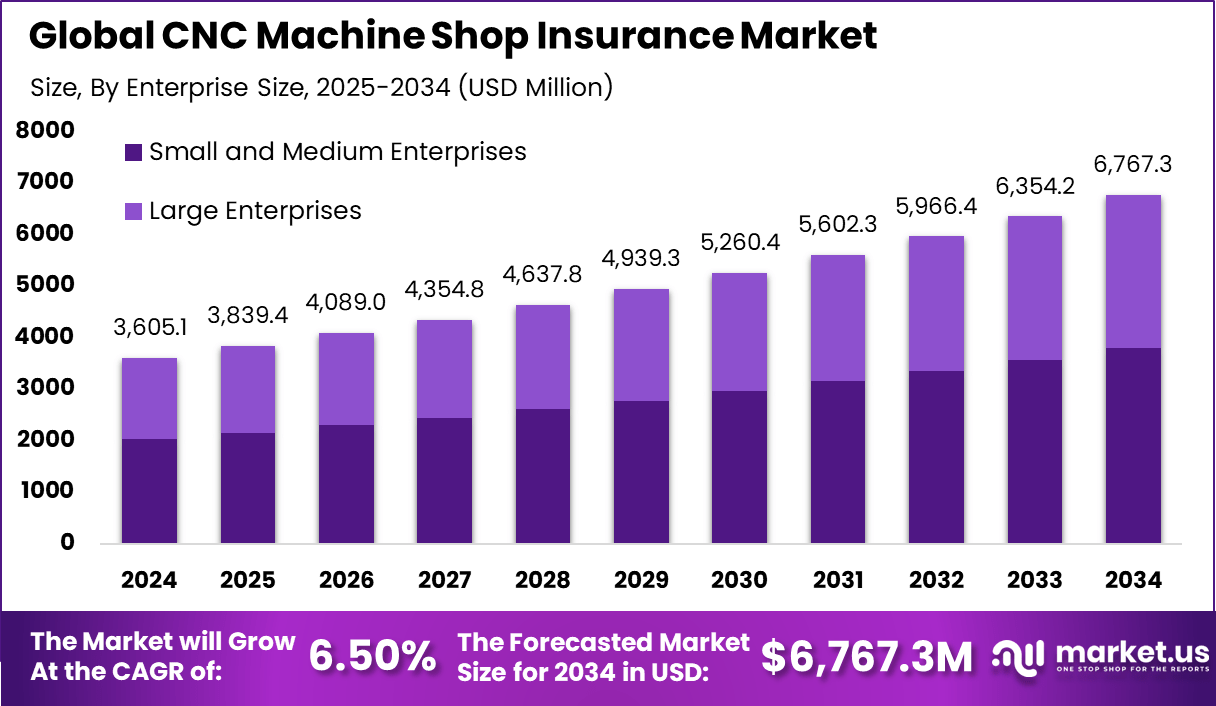
One of the main driving factors is the growing demand for precision manufacturing across multiple industries. As production volumes increase, machine shops face higher exposure to equipment failure, fire, tool damage, and delivery delays. In addition, modern CNC machines involve significant capital investment, creating stronger demand for policies that cover repair and replacement costs. Rising customer expectations around quality and delivery timelines are also increasing the need for liability and interruption coverage. The use of connected machines and digital production systems is further driving interest in broader protection that includes cyber and operational risks.
Demand for CNC machine shop insurance is rising as manufacturers seek tailored policies that match their operating environment. There is a strong preference for coverage that combines property, machinery breakdown, liability, workers compensation, and income protection within one structured package. Shop owners are also looking for insurers that understand contract manufacturing risks, supply chain exposure, and sector specific compliance needs.
The demand is particularly strong among small and mid sized fabrication shops as well as larger precision manufacturing facilities serving high value industries. As machining operations continue to modernize and customer standards become stricter, the need for specialized and dependable insurance solutions is expected to grow steadily.
Top Key Market Segment
- Coverage Type (Property Insurance) Property insurance holds 34.7% of the market as CNC machine shops need protection for equipment, buildings, and assets.
- Enterprise Size (Small and Medium Enterprises) Small and medium enterprises account for 56.3% as many CNC shops operate on a smaller scale.
- Distribution Channel (Brokers/Agents) Brokers and agents dominate with 86.9% since businesses rely on experts to select suitable insurance policies.
- End-User (Industrial Manufacturing) Industrial manufacturing leads with 35.2% due to high usage of CNC machines in production processes.
- Region (Asia Pacific) Asia Pacific holds 43.2% of the market driven by strong manufacturing activity and industrial growth.
- Country (China) China is valued at USD 473.4 million and is expected to grow at a CAGR of 3.8%.
How AI is Reshaping the Future of this market?
AI is reshaping the future of the CNC machine shop insurance market by making risk assessment more precise and more connected to actual shop operations. In the past, insurers often relied on broad business categories, past claims history, and manual inspections. Now, AI is helping insurers study equipment usage, maintenance patterns, downtime signals, workplace incidents, and production environments in a more detailed way. This gives insurers a clearer view of how a CNC machine shop operates and where the real risks are.
AI is also improving loss prevention, which is becoming one of the most important shifts in this market. CNC machine shops depend heavily on machine performance, operator safety, and production continuity. AI tools can help detect early signs of equipment failure, unsafe operating conditions, or process issues before they turn into major losses. This is important for insurance providers because it supports a more preventive model, where the goal is not only to cover damage but also to reduce the chance of claims happening in the first place.
Another major change is in underwriting and claims handling. AI can speed up document review, analyze shop data more efficiently, and support quicker claim assessment after machine damage, fire, or business interruption. For CNC machine shops, this can improve response time and reduce administrative delays. Over time, the market is expected to move toward more customized insurance products, where pricing, policy terms, and risk support are shaped by real-time operational behavior rather than only past records.
AI is also likely to influence how insurers work with CNC machine shops on safety and compliance. Instead of only checking conditions at renewal time, insurers may increasingly offer continuous monitoring, risk alerts, and tailored recommendations. This creates a more active relationship between insurer and insured. As CNC machine shops continue adopting digital production systems, the insurance market is anticipated to become more data-driven, more responsive, and more focused on prevention, resilience, and operational stability.
Driver
The main driver in the CNC machine shop insurance market is the rising need to protect high value production assets and business operations. CNC machine shops depend on expensive machinery, skilled labor, precision output, and steady workflow. Even a small equipment failure, fire incident, electrical fault, or shop floor accident can disrupt production and affect delivery schedules. This makes insurance an important part of business continuity rather than just a legal or financial formality.
As CNC shops take on more custom work and tighter delivery commitments, their exposure to operational risk becomes broader. Shop owners are looking for coverage that supports property protection, equipment breakdown, liability, and income loss during downtime. This growing awareness is pushing demand for insurance products that are more aligned with the real operating conditions of machine shops.
Restraints
A key restraint in this market is the difficulty of underwriting highly specialized machine shop risks. CNC operations are not uniform. Risk levels vary based on machine type, materials handled, workforce training, maintenance quality, safety practices, and the industries served. Because of this variation, insurers often find it difficult to standardize policies or price risk accurately across different shops.
This creates a challenge for both insurers and policy buyers. Some machine shops may face limited coverage options, stricter policy terms, or higher premiums due to incomplete risk visibility. Smaller shops may also struggle to explain their risk controls in a way that supports better policy terms. As a result, market growth can be held back by complexity in risk assessment and policy design.
Opportunity
A major opportunity in the CNC machine shop insurance market lies in the development of more tailored and modular insurance solutions. Many machine shops need coverage that reflects their actual exposure, including machine damage, cyber risk in connected production systems, supply chain delays, product liability, and workforce injury. Insurers that can design flexible packages for these needs are likely to gain stronger market relevance.
There is also room to expand value through risk prevention services. Machine shops are becoming more open to support such as safety audits, maintenance guidance, training recommendations, and digital monitoring insights. Insurance providers that combine coverage with practical risk management support can improve customer retention and build stronger long term relationships in this market.
Challenge
The biggest challenge in this market is the changing risk profile of modern CNC machine shops. Many shops are moving toward automation, digital controls, remote monitoring, and integrated software systems. While these changes improve efficiency, they also introduce new forms of risk that traditional insurance models may not fully capture, especially where physical and digital risks overlap.
This puts pressure on insurers to update policy wording, claims handling, and technical understanding of machine shop operations. They must evaluate not only physical damage and workplace accidents, but also interruption caused by software faults, data issues, or connected system failures. Keeping pace with this changing operating environment remains a major challenge for the market.
Regional Analysis
In 2024, Asia Pacific held a dominant Market position, capturing more than a 43.2% share, holding USD 1557.40 Million revenue. The region led the CNC machine shop insurance market due to its large concentration of manufacturing hubs, strong base of precision engineering businesses, and high presence of small and mid-sized machine shops.
Countries such as China, Japan, South Korea, and India continue to support large-scale industrial production, which creates steady demand for insurance products that cover machinery damage, worker-related risks, operational liability, and property loss. The wide use of CNC systems across automotive, electronics, metal fabrication, and industrial equipment manufacturing also strengthens the need for specialized insurance coverage in the region.
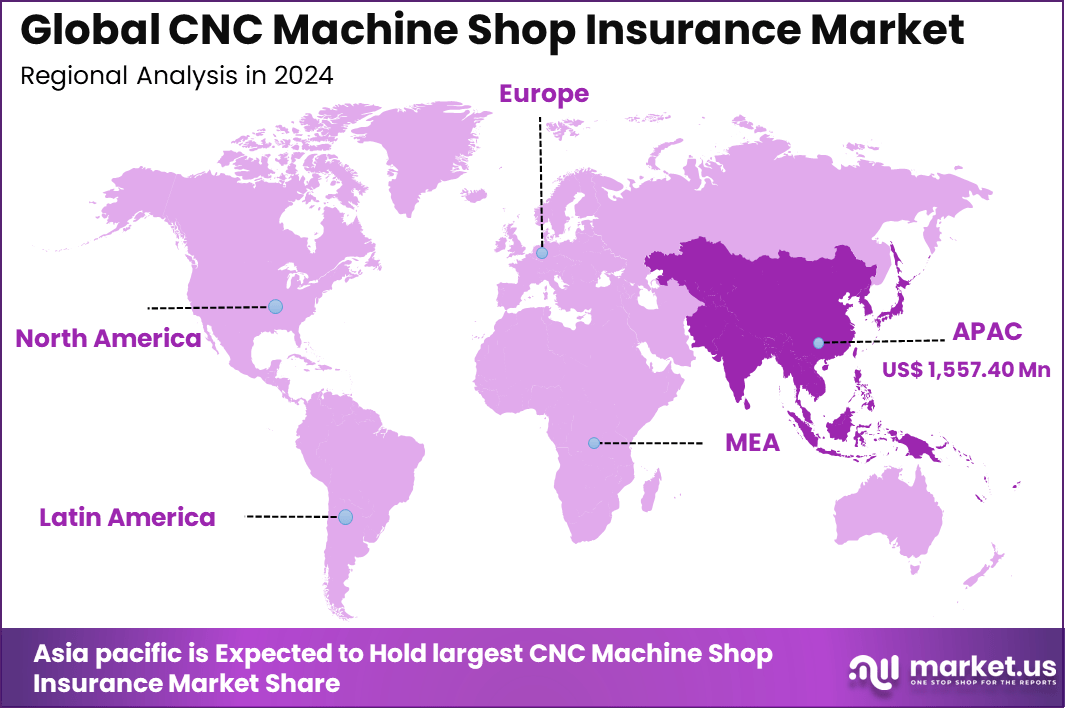
Asia Pacific also benefits from ongoing industrial expansion, export-oriented production, and rising investments in factory modernization. As more machine shops adopt automated and high-value CNC equipment, the cost of downtime, repair, and business interruption becomes more serious, encouraging owners to secure broader insurance protection. In many parts of the region, the insurance market is also becoming more responsive to the needs of smaller industrial firms, with policies increasingly designed around operational risk, equipment value, and sector-specific exposures. This combination of manufacturing scale, equipment intensity, and growing awareness of risk management is the key reason Asia Pacific remained the leading regional market.
North America represents a mature and well-structured market for CNC machine shop insurance, supported by a strong industrial base and a high level of insurance awareness among business owners. Machine shops in the US and Canada generally operate with advanced equipment, strict safety standards, and complex contractual obligations, which increases the need for policies covering liability, cyber exposure, equipment breakdown, and business interruption. The region also benefits from a developed commercial insurance ecosystem where specialized industrial coverage is widely available.
Europe holds a notable position in the market due to its established manufacturing sectors, especially in automotive, aerospace, industrial machinery, and precision engineering. CNC machine shops across countries such as Germany, Italy, France, and the UK often work within highly regulated environments, which supports demand for comprehensive and compliant insurance solutions. The region’s focus on quality manufacturing, workplace protection, and operational continuity continues to support stable demand for tailored insurance coverage.
Latin America is an emerging market for CNC machine shop insurance, with demand growing alongside the expansion of local manufacturing and industrial processing activities. Many machine shops in the region are gradually moving toward modern production systems, which is increasing the value of insured assets and raising awareness of operational risk. While insurance penetration remains lower than in more mature regions, the need for protection against equipment failure, workplace incidents, and property-related loss is becoming more recognized.
The Middle East and Africa region is still developing in this market, but it shows potential as industrial diversification and infrastructure development continue across selected countries. Manufacturing growth in areas such as metalworking, construction components, and industrial services is creating a base for CNC machine shop activity, which in turn supports demand for insurance solutions. Market growth in this region is shaped by improving business formalization, rising investment in industrial assets, and a gradual shift toward stronger risk protection practices among commercial operators.
Key Market Segment
By Coverage Type
- Property Insurance
- Liability Insurance
- Equipment Breakdown Insurance
- Business Interruption Insurance
- Workers’ Compensation
- Others
By Enterprise Size
- Small and Medium Enterprises
- Large Enterprises
By Distribution Channel
- Direct Sales
- Brokers/Agents
- Online Platforms
- Others
By End-User
- Automotive
- Aerospace
- Industrial Manufacturing
- Medical Devices
- Others
Competetive Analysis
The competitive landscape of the CNC Machine Shop Insurance Market is led by large commercial insurers and specialty risk providers with strong industrial underwriting experience. Companies such as The Hartford, Chubb, Travelers Insurance, Nationwide, Liberty Mutual, Zurich Insurance Group, AXA XL, Allianz Global Corporate & Specialty, and AIG (American International Group) focus on insurance solutions for manufacturing businesses.
These players provide coverage for property damage, machinery breakdown, general liability, workers compensation, and business interruption risks common in CNC machine shop operations. Their strong financial strength, broad distribution networks, and experience in industrial sectors help them maintain a leading position in the market.
At the same time, companies such as CNA Financial Corporation, Hiscox, Berkshire Hathaway GUARD Insurance Companies, Markel Corporation, Tokio Marine HCC, Sompo International, and Munich Re compete through specialty coverage, reinsurance support, and customized risk management programs.
These players focus on tailored policies for precision manufacturing, product liability, cyber risk, and supply chain disruptions. Competition in this market is driven by pricing flexibility, claims service quality, industry-specific coverage options, and the ability to address evolving operational risks faced by CNC machine shops.
Recent Development
- March, 2026 – The Hartford updates its machine shop program with enhanced equipment breakdown and business‑income extensions for CNC downtime. Coverage now more clearly addresses damage from programming errors, power surges, and mechanical failures, and risk‑engineering services include on‑site safety reviews tailored to automated machining lines.
- February, 2026 – Chubb expands its CNC Machine Shop package with broader property, cyber, and product liability limits for precision aerospace and medical parts makers. The company also deepens partnerships with technology vendors to use IoT and predictive analytics from CNC machines in underwriting, rewarding shops that deploy sensors and preventive maintenance with premium credits.
Conclusion
The CNC machine shop insurance market is expected to remain important as machine shops continue to face a mix of operational, financial, and liability-related risks. Businesses in this space need coverage that matches the real conditions of modern manufacturing, including equipment breakdown, workplace safety concerns, property damage, cyber exposure, and business interruption. Demand is anticipated to stay supported by the growing need for specialized policies that go beyond standard commercial insurance and address the specific nature of precision machining operations.
Looking ahead, the market is likely to benefit from rising awareness among shop owners about risk preparedness and long term business stability. Insurers that offer flexible coverage, faster claims support, and better risk assessment for small and mid-sized machine shops are expected to strengthen their position.
At the same time, the market may remain shaped by underwriting complexity, changing compliance needs, and the need to price policies carefully for high value industrial environments. Overall, the market outlook appears steady, with growth expected to come from more tailored insurance solutions and stronger focus on protection across day to day shop operations.
Discuss your needs with our analyst
Please share your requirements with more details so our analyst can check if they can solve your problem(s)