Table of Contents
Introduction
The Global 5G Smartphone Antenna Tuner Market generated USD 2.9 billion in 2024 and is predicted to register growth from USD 3.6 billion in 2025 to about USD 28.0 billion by 2034, recording a CAGR of 25.60% throughout the forecast span. In 2024, North America held a dominan market position, capturing more than a 33.2% share, holding USD 0.95 Billion revenue.
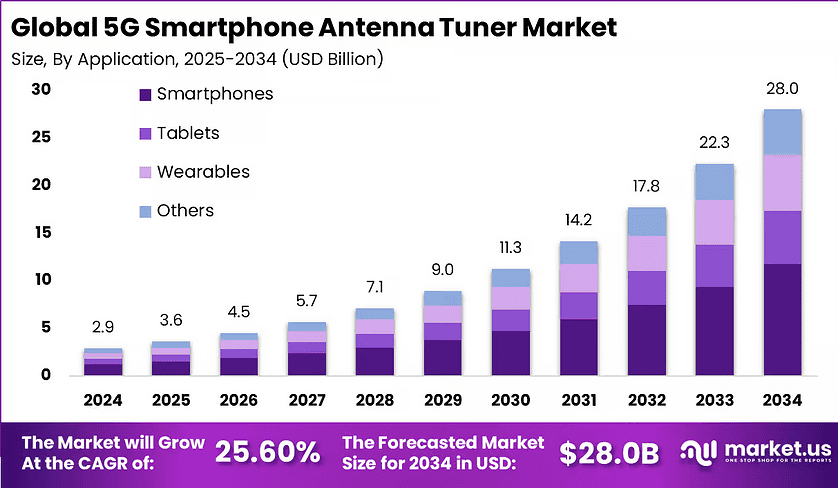
5G smartphone antenna tuners are electronic components used to optimize antenna performance in mobile devices across different frequency bands. They adjust the antenna settings in real time to maintain strong signal quality, improve data speed, and reduce power loss as the device operates under varying conditions. With 5G networks using a wider range of frequencies and more complex signal environments, antenna tuning has become a critical function in smartphone design. These tuners help ensure stable connectivity, better call quality, and efficient data transmission in modern devices.
One of the main driving factors is the increasing complexity of 5G communication, which requires devices to support multiple frequency bands and operate efficiently in changing signal conditions. Smartphones need to maintain strong connectivity while users move between different network environments, and antenna tuners help manage this transition smoothly.
In addition, the push toward slimmer device designs with more internal components is creating challenges for antenna placement and performance, which increases the importance of advanced tuning solutions. The growing demand for high speed data services such as streaming, gaming, and real time applications is also supporting the need for improved signal optimization.
Demand for 5G smartphone antenna tuners is rising as device manufacturers focus on delivering consistent network performance and efficient power usage. There is a strong preference for tuners that can operate across multiple bands, respond quickly to signal changes, and integrate easily into compact device designs.
Manufacturers are also looking for solutions that support longer battery life by reducing power consumption during signal transmission. The demand is particularly strong in high end smartphones where performance expectations are higher. As 5G adoption continues to expand and device capabilities evolve, the need for reliable and advanced antenna tuning solutions is expected to grow steadily.
How AI is Reshaping the Future of this market?
AI is reshaping the 5G Smartphone Antenna Tuner Market by making antenna tuning more adaptive, efficient, and responsive to real-world smartphone use. As 5G devices support more frequency bands, carrier aggregation, and compact antenna layouts, traditional tuning methods are becoming less effective. AI helps antenna tuners adjust to changing signal conditions, hand grip position, device orientation, and surrounding network quality in real time. This improves signal stability, reduces RF loss, and supports smoother connectivity in dense urban areas, indoor spaces, and weak coverage zones.
AI is also improving power efficiency in 5G smartphones. Antenna tuners play an important role in how efficiently the device sends and receives signals, and poor tuning can increase battery drain. With AI-based optimization, smartphones can select better tuning states based on usage patterns, network behavior, and radio conditions. This supports longer battery performance while maintaining stronger data speeds and lower connection drops during gaming, video streaming, video calls, and high-data applications.
Another major change is in smartphone design and testing. AI can help engineers simulate antenna behavior, predict tuning performance, and reduce repeated hardware testing during product development. This is becoming important as smartphone makers try to fit more RF components into thinner devices without affecting antenna performance. AI-driven design support can shorten development cycles, improve RF reliability, and help manufacturers build antenna tuner systems that work across wider 5G band combinations.
In the future, AI is expected to make antenna tuners more intelligent as smartphones move toward 5G Advanced and early 6G-ready architectures. The market is likely to shift from simple tuning components toward smarter RF control systems that work closely with modems, sensors, and power management units. This creates stronger demand for advanced antenna tuners that can support real-time decision-making, better connectivity, and improved user experience without adding unnecessary power load.
Top Keytake away
- Type MEMS-based antenna tuners account for 45.5% of the 5G Smartphone Antenna Tuner market, as they offer compact size and fast tuning suitable for integration in modern 5G devices.
- Application Smartphones represent 42.0% of the market, because antenna tuners are widely used to maintain signal quality and data speeds across multiple 5G bands in mobile handsets.
- Technology Tunable capacitors hold 38.8% of the market, since they allow dynamic adjustment of antenna impedance to optimize performance under changing network and usage conditions.
- Distribution Channel OEMs account for 52.6%, reflecting that most antenna tuners are sold directly to smartphone manufacturers for integration during device design and production.
- Region North America represents 33.2% of the global market, supported by strong 5G adoption and demand for high-performance smartphones.
- Country The U.S. market is valued at 0.80 billion and is expected to grow at a CAGR of 22.2%, driven by rapid 5G network expansion and user demand for premium 5G handsets with reliable connectivity.
Regional Analysis
In 2024, North America held a dominant Market position, capturing more than a 33.2% share, holding USD 0.95 Billion revenue in the 5G Smartphone Antenna Tuner Market. The region led the market due to strong 5G network coverage, early adoption of premium smartphones, and higher demand for devices that support multiple frequency bands. Smartphone users in the US and Canada are increasingly shifting toward advanced 5G handsets, which require efficient antenna tuning to maintain stable connectivity, improve signal quality, and reduce power loss across different network conditions.
North America’s leadership is also supported by a mature telecom infrastructure and a strong ecosystem of smartphone component suppliers, chipset developers, and wireless technology providers. The region has been quicker in adopting advanced radio frequency solutions as mobile operators continue to improve 5G performance in urban, suburban, and enterprise environments. This has increased the use of antenna tuners in smartphones to manage complex frequency requirements, carrier aggregation, and better indoor coverage.
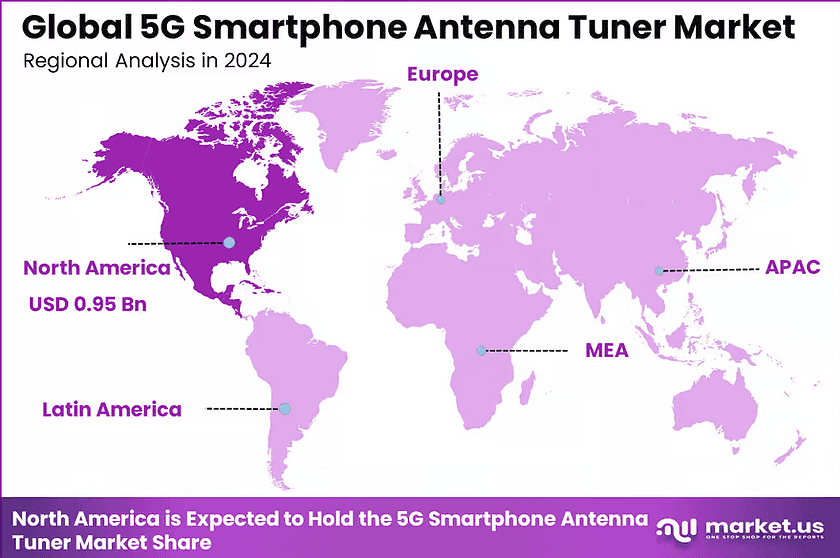
Compared with Europe, Latin America, and the Middle East and Africa, North America benefits from higher consumer spending on advanced mobile devices and faster replacement cycles for premium smartphones. While Europe remains a key market due to its ongoing 5G rollout and strong regulatory focus on connectivity, growth is relatively balanced across countries.
Latin America and the Middle East and Africa are still developing their 5G ecosystems, which limits near-term adoption of high-end antenna tuning technologies. As a result, North America continues to remain the leading region in the market.
Driver
Rising need for stable 5G connectivity
The main driver for the 5G smartphone antenna tuner market is the growing need for stable signal performance across different network bands. Smartphones now handle heavier data use, video streaming, gaming, and real time communication, which increases pressure on antenna systems to maintain strong connectivity.
Antenna tuners help smartphones adjust signal paths based on hand position, device design, and changing network conditions. This makes them important for improving call quality, data speed, and battery performance in compact smartphone designs.
Restraint
Design complexity in slim smartphones
A major restraint is the rising complexity of antenna placement inside slim and feature packed smartphones. Modern devices include larger batteries, advanced cameras, sensors, and multiple wireless components, leaving limited space for antenna systems.
This creates technical pressure for tuner integration, as even small design changes can affect signal quality. Higher engineering effort, testing requirements, and component coordination can slow adoption among cost sensitive smartphone models.
Opportunity
Growth in premium and connected smartphones
A strong opportunity lies in the growing demand for premium smartphones with better network performance. Users expect faster downloads, smoother video calls, and reliable connectivity in crowded indoor and outdoor environments.
This creates demand for advanced antenna tuning solutions that can support multiple frequency bands and changing usage conditions. As smartphone makers focus more on network experience, tuner suppliers can gain wider design opportunities across new device platforms.
Challenge
Managing performance across different network environments
A key challenge is maintaining consistent antenna performance across varied network environments. Smartphone users move between cities, rural areas, buildings, vehicles, and crowded public spaces, where signal strength and interference levels change often.
Antenna tuners must respond quickly without affecting battery life or device temperature. Balancing signal quality, power efficiency, and compact design remains a difficult task for manufacturers working on next generation 5G smartphones.
Key Market Segment
By Type
- MEMS
- Passive
- Active
By Application
- Smartphones
- Tablets
- Wearables
- Others
By Technology
- Tunable Capacitors
- Tunable Inductors
- Switches
- Others
By Distribution Channel
- OEMs
- Aftermarket
Competetive Analysis
The competitive landscape of the 5G Smartphone Antenna Tuner Market is driven by leading semiconductor and RF component manufacturers. Companies such as Qorvo, Skyworks Solutions, Murata Manufacturing, TDK Corporation, STMicroelectronics, Analog Devices, Infineon Technologies, and NXP Semiconductors focus on advanced RF tuning solutions that improve signal performance and power efficiency in 5G smartphones.
These players invest in miniaturization, integration of multiple frequency bands, and high-speed switching technologies to support complex 5G network requirements. Their strong relationships with smartphone manufacturers and global supply chains help them maintain a leading position in the market.
At the same time, companies such as Johanson Technology, Psemi (formerly Peregrine Semiconductor), Taoglas, TE Connectivity, Amphenol Corporation, Antenova, Yageo Corporation, AVX Corporation, Vishay Intertechnology, Molex (a Koch company), Sunlord Electronics, and Pulse Electronics compete by offering specialized antenna components, passive devices, and customized RF solutions. These players focus on compact designs, cost efficiency, and support for multi-band connectivity. Competition in this market is driven by demand for better signal quality, reduced power consumption, and the ability to deliver high-performance antenna tuning solutions for next-generation mobile devices.
Recent Development
- March 2026, Skyworks Solutions – Skyworks and MediaTek demo early 6G FR3 RF front‑end and an Ultra High Band PC1 power‑amplifier module at MWC 2026; the design work also improves switch and tuning requirements for future 5G/6G phones that must cover 6.4–7 GHz bands.
- October 2025, Qorvo – On the same day as the merger announcement, Qorvo highlights that its antenna swap and antenna tuning switch portfolios will be combined with Skyworks’ products, creating a broad RF front‑end offering for 5G phones and tunable antennas.
Conclusion
The 5G smartphone antenna tuner market is expected to grow steadily as smartphone brands focus on better signal quality, faster connectivity, and smoother user experience across different network bands. Antenna tuners are becoming more important because modern smartphones need to support compact designs, multiple frequency bands, and stable performance in different usage conditions.
Demand is also supported by the wider use of 5G services, rising mobile data consumption, and the need for efficient power use in smartphones. However, design complexity, cost pressure, and integration challenges may remain key concerns for manufacturers. Overall, the market is likely to remain important for the smartphone industry as antenna performance becomes a core factor in device quality and network reliability.
Discuss your needs with our analyst
Please share your requirements with more details so our analyst can check if they can solve your problem(s)