Market Overview
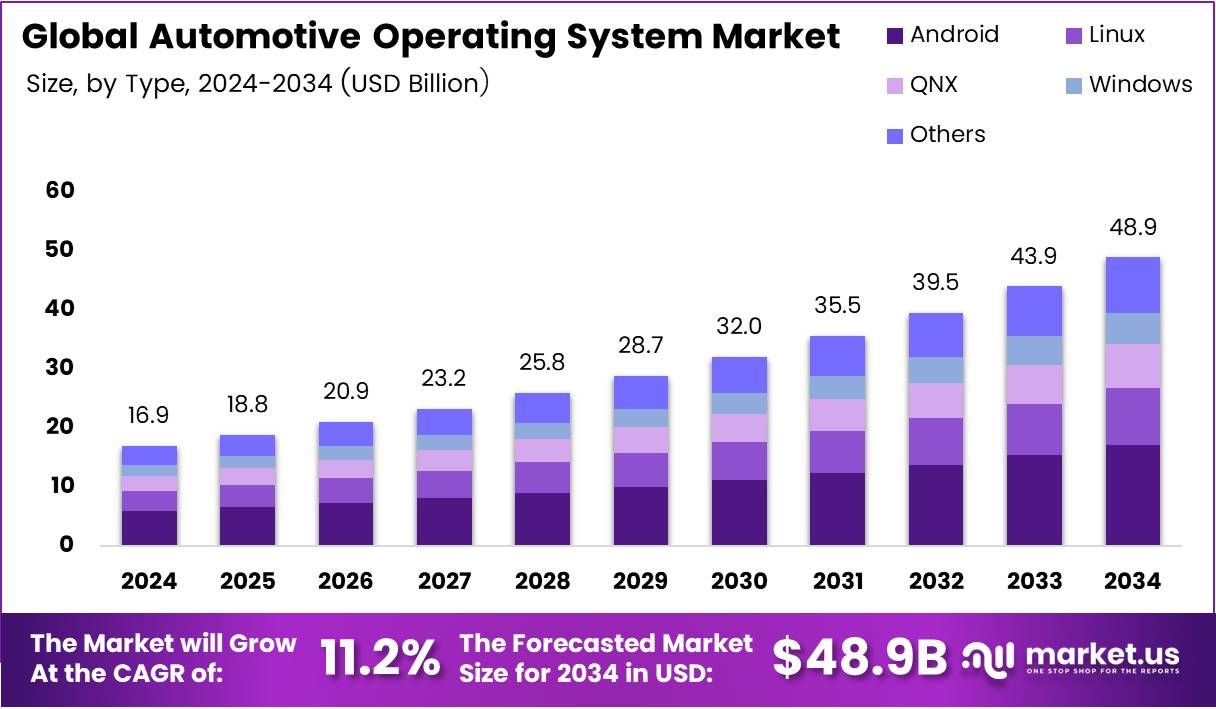
The global Automotive Operating System Market was valued at USD 16.9 Billion in 2024 and is projected to reach USD 48.9 Billion by 2034. The market is expected to grow at a CAGR of 11.2% during the forecast period from 2025 to 2034. Rising demand for connected vehicles and software-defined mobility continues driving strong industry expansion.
Automotive operating systems are embedded software platforms that manage infotainment, connectivity, safety functions, and vehicle performance operations. Automakers use these systems to support seamless communication between hardware and software components. Additionally, advanced automotive OS platforms enable over-the-air updates, cloud integration, and personalized in-car experiences across modern vehicle ecosystems.
Data-Driven Insights for Smarter Business Decisions: Explore the Full Report
Passenger vehicle manufacturers, electric vehicle producers, and fleet operators are major adopters of automotive operating systems. Automotive companies use these platforms to improve navigation, telematics, predictive maintenance, and advanced driver assistance functions. Consequently, increasing digitalization across mobility services continues expanding software integration within both consumer and commercial vehicle categories.
Technology companies continue enhancing automotive operating systems through artificial intelligence, edge computing, and cybersecurity integration. Advanced OS platforms now support real-time analytics, predictive diagnostics, and secure data management capabilities. Consequently, automakers improve system reliability, reduce maintenance complexity, and deliver enhanced human-machine interaction across software-defined vehicle architectures.
Governments worldwide continue supporting digital mobility initiatives and intelligent transportation infrastructure development. Regulatory frameworks focused on data security, autonomous driving compliance, and emission reduction further increase demand for advanced automotive operating systems. Additionally, long-term software lifecycle management requirements encourage automakers to prioritize scalable and regulation-ready software platforms.
Consumer behavior strongly influences software adoption trends across the automotive sector. Research findings show that 55% of Chinese respondents and 57% of battery-electric vehicle users would switch vehicle brands for better connectivity features. Additionally, 49% of U.S. respondents and 55% of German consumers prefer superior connected-car services, highlighting rising demand for software-centric mobility solutions.
Key Takeaways
- The global Automotive Operating System Market is expected to reach USD 48.9 Billion by 2034 from USD 16.9 Billion in 2024.
- The market is projected to grow at a CAGR of 11.2% during the forecast period from 2025 to 2034.
- Android dominated the operating system segment with a market share of 34.8% due to strong open-source flexibility.
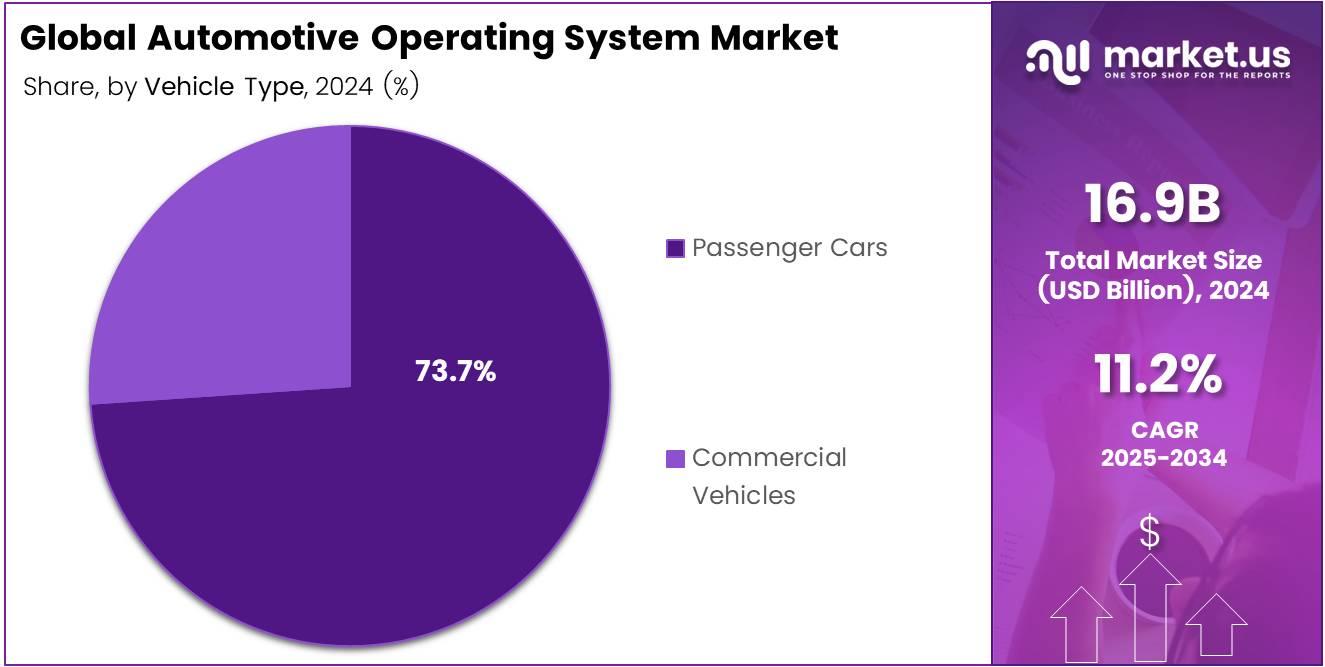
- Passenger Cars led the vehicle type segment with a dominant share of 73.7% driven by digital feature integration.
- Infotainment Systems accounted for the largest application share at 28.2% because of rising demand for connected experiences.
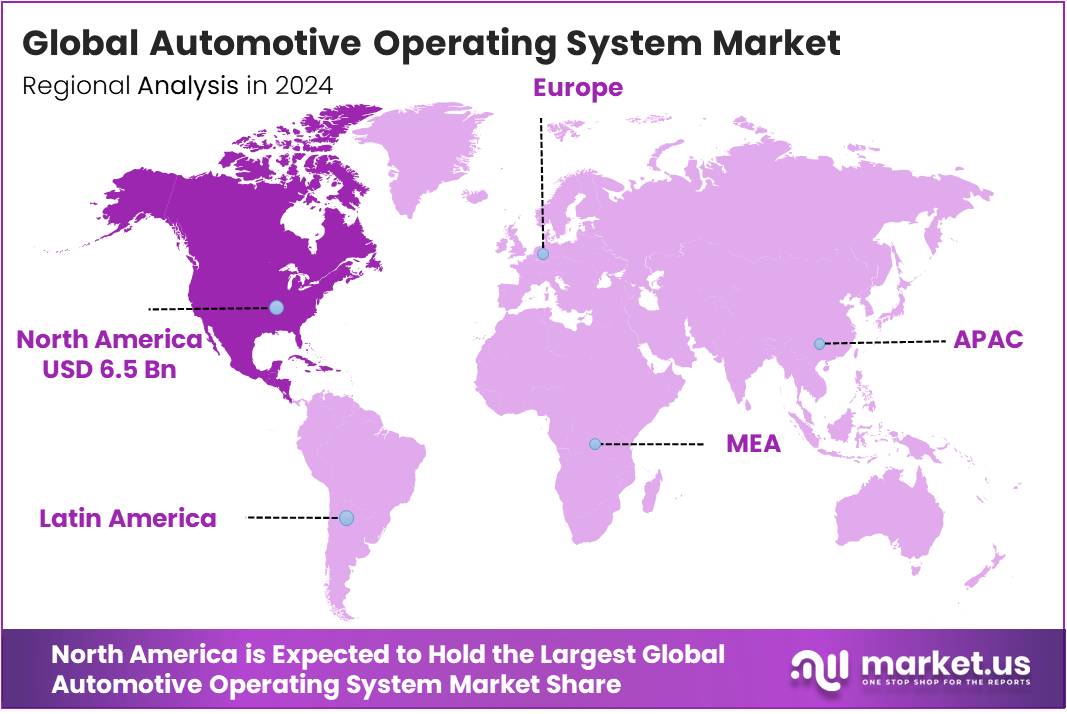
- North America held the leading regional share of 38.9%, valued at USD 6.5 Billion in 2024.
Market Segmentation Overview
Android dominated the Automotive Operating System Market with a share of 34.8% in 2024. Automakers increasingly prefer Android platforms because they support scalable integrations, flexible application development, and advanced infotainment experiences. Consequently, vehicle manufacturers improve digital cockpit functionality while accelerating software innovation across connected mobility ecosystems.
Linux and QNX continue gaining strong adoption across advanced vehicle architectures. Linux supports modular customization and long-term software flexibility for automotive manufacturers. Meanwhile, QNX remains popular for safety-critical functions because it delivers real-time processing and reliable system stability. Additionally, Windows and proprietary platforms continue serving legacy and specialized automotive applications.
Passenger Cars accounted for a dominant market share of 73.7% due to rising integration of infotainment, connectivity, and safety technologies. Consumers increasingly demand seamless digital experiences and personalized in-car services. Consequently, automakers continue investing heavily in software-defined passenger vehicle architectures to improve user engagement and brand competitiveness.
Infotainment Systems held the leading application share at 28.2% in 2024 due to growing demand for immersive in-car experiences. Drivers increasingly prefer real-time navigation, connected applications, and intuitive user interfaces. Additionally, connected services, ADAS systems, telematics, and powertrain management applications continue expanding as software integration becomes central to modern vehicle operations.
Drivers
Rising demand for connected and software-defined vehicles strongly drives the Automotive Operating System Market. Consumers increasingly expect advanced infotainment, seamless connectivity, and intelligent digital features in modern vehicles. Consequently, automakers adopt advanced operating systems to support cloud services, real-time data processing, and integrated mobility experiences across global automotive platforms.
Growing adoption of advanced driver assistance systems further accelerates market expansion worldwide. Features such as adaptive cruise control, automatic braking, and lane monitoring require powerful software frameworks capable of processing real-time data. Additionally, centralized vehicle computing architectures simplify software management and increase demand for scalable automotive operating systems.
Use Cases
Automotive manufacturers use operating systems to power infotainment systems and connected cockpit experiences in passenger vehicles. These platforms support navigation, voice assistants, smartphone integration, and multimedia applications. Consequently, automakers improve customer satisfaction while strengthening brand loyalty through personalized and continuously updated digital driving environments.
Fleet operators and commercial vehicle providers increasingly use automotive operating systems to support telematics and predictive maintenance applications. These systems collect real-time operational data and improve route optimization, fuel efficiency, and vehicle monitoring capabilities. Additionally, over-the-air update functionality reduces maintenance downtime and improves long-term operational efficiency.
Major Challenges
High software development complexity continues limiting broader market expansion across the automotive industry. Advanced automotive operating systems require significant investment in engineering, cybersecurity, and testing capabilities. Consequently, smaller manufacturers face difficulties competing with larger technology providers that possess stronger software development infrastructure and specialized technical expertise.
Lack of standardization across automotive software frameworks creates integration and interoperability challenges for suppliers and automakers. Different vehicle architectures often require customized operating system configurations, increasing development costs and slowing innovation. Additionally, cybersecurity risks and shortages of skilled automotive software engineers continue creating operational and scalability concerns.
Business Opportunities
Artificial intelligence-driven predictive diagnostics create major opportunities for automotive operating system providers. AI-enabled platforms help detect mechanical issues before failure occurs, improving vehicle safety and reducing maintenance expenses. Consequently, automakers increasingly prioritize operating systems capable of supporting advanced analytics and intelligent vehicle management applications.
Cloud-native automotive operating systems also present strong long-term growth potential for software developers and OEMs. Automakers increasingly shift vehicle functions toward cloud-connected platforms to improve scalability and update efficiency. Additionally, autonomous mobility services such as self-driving taxis and shared transport fleets require stable and highly secure software infrastructures.
Regional Analysis
North America dominated the Automotive Operating System Market with a leading share of 38.9%, valued at USD 6.5 Billion in 2024. Strong investments in connected vehicles, autonomous driving technologies, and software-defined mobility continue supporting regional leadership. Additionally, advanced digital infrastructure and technology partnerships strengthen innovation across the North American automotive ecosystem.
Asia Pacific is emerging as a rapidly expanding market due to rising automotive production and increasing demand for connected electric vehicles. China, Japan, South Korea, and India continue investing heavily in EV infrastructure and digital mobility technologies. Moreover, regional technology companies and automotive OEMs increasingly collaborate to accelerate software innovation and connected transportation development.
Recent Developments
- December 2024 — Accenture agreed to acquire AOX to strengthen embedded automotive software and next-generation vehicle engineering capabilities.
- January 2025 — Red Hat achieved ISO 26262 ASIL-B functional-safety certification for its in-vehicle operating system platform.
- June 2025 — NXP Semiconductors completed the acquisition of TTTech Auto to strengthen scalable automotive middleware solutions.
- April 2025 — Marvell Technology announced a US$2.5 billion agreement to sell its Automotive Ethernet business to Infineon Technologies AG.
Conclusion
The Automotive Operating System Market continues expanding rapidly due to rising demand for connected, intelligent, and software-defined vehicles. Automakers increasingly rely on advanced operating systems to support infotainment, autonomous driving, and cloud-enabled services. Consequently, software platforms have become critical components within modern digital mobility ecosystems.
Android remains the leading operating system segment with a market share of 34.8% because of its flexibility and scalable ecosystem. Passenger Cars continue dominating vehicle adoption with a share of 73.7%. Additionally, North America maintains regional leadership through strong investments in advanced mobility technologies and connected vehicle infrastructure.
Companies must prioritize cybersecurity, AI integration, cloud connectivity, and scalable software frameworks to remain competitive in evolving automotive markets. Strategic partnerships between OEMs and technology providers will continue accelerating innovation across software-defined mobility ecosystems. The market is projected to reach USD 48.9 Billion by 2034.
Looking for data tailored to your specific market, region, or business need? Request a custom report or consultation — write to us at sales@market.us
Discuss your needs with our analyst
Please share your requirements with more details so our analyst can check if they can solve your problem(s)