Market Overview
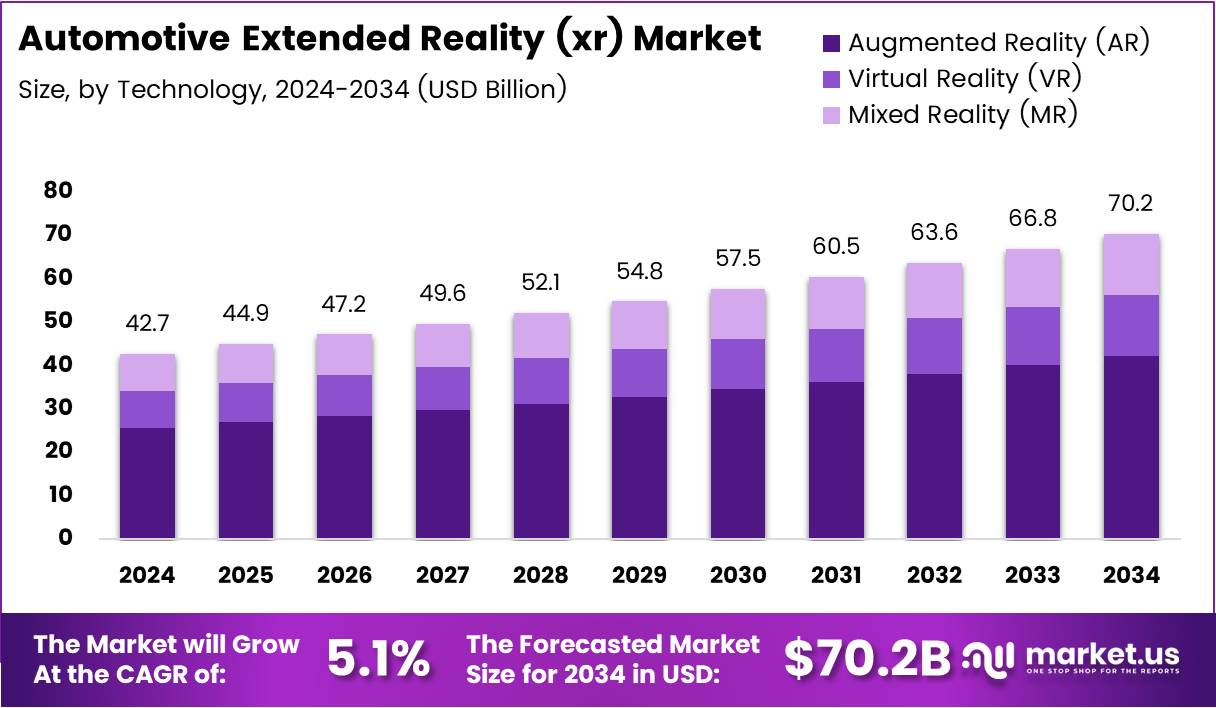
The global Automotive Extended Reality (XR) market was valued at USD 42.7 Billion in 2024. Analysts expect the market to reach nearly USD 70.2 Billion by 2034, expanding at a CAGR of 5.1% during 2025–2034. Strong adoption of immersive automotive technologies continues driving market expansion across vehicle manufacturing, retail, and engineering operations worldwide.
Automotive XR combines augmented reality, virtual reality, and mixed reality technologies for automotive applications. Automakers, dealerships, suppliers, and training institutes use these immersive tools to improve vehicle design, testing, maintenance, and customer engagement. Consequently, manufacturers accelerate development timelines while improving operational precision and digital collaboration across automotive ecosystems.
Data-Driven Insights for Smarter Business Decisions: Explore the Full Report
Automotive manufacturers increasingly deploy XR platforms across electric vehicles, autonomous driving, and connected mobility projects. Vehicle designers use immersive visualization to validate prototypes and optimize cockpit interfaces. Additionally, dealerships rely on virtual showrooms and interactive demonstrations to improve customer experiences while reducing physical infrastructure and inventory management costs.
Technology companies continue improving XR systems through artificial intelligence, cloud connectivity, and advanced sensors. AI-powered spatial mapping enhances navigation overlays and driver-assistance visualization for safer driving experiences. Moreover, digital twins and real-time simulation tools help engineering teams reduce testing errors and improve decision-making across global automotive development programs.
Government policies supporting smart manufacturing and simulation-based validation continue strengthening market demand. Regulators increasingly encourage digital testing methods to reduce physical prototyping expenses and improve safety compliance. Therefore, automotive companies integrate XR technologies into workforce training, mobility infrastructure testing, and sustainability planning initiatives supporting long-term industrial modernization.
Consumer behavior trends further reinforce market momentum worldwide. Survey data shows 35% of consumers prefer VR or AR-based vehicle walkthroughs before purchasing cars. Additionally, 38% of users prefer more voice controls inside vehicles, compared with 33% before COVID-19. These trends indicate growing acceptance of immersive automotive experiences and intelligent in-vehicle technologies.
Key Takeaways
- The Automotive XR market will grow from USD 42.7 Billion in 2024 to USD 70.2 Billion by 2034 at a CAGR of 5.1%.
- Augmented Reality (AR) dominates the technology segment with a leading market share of 49.8% due to strong automotive integration.
- Hardware components captured 56.2% market share in 2024 as manufacturers increased adoption of headsets, displays, and sensors.
- Automotive OEMs accounted for 45.4% share because companies accelerated XR deployment across design and production workflows.
- North America leads the global market with a share of 37.9%, reaching a regional value of USD 16.1 Billion.
- Virtual showrooms, XR-based training, and autonomous vehicle simulations continue creating strong long-term growth opportunities.
Market Segmentation Overview
Augmented Reality (AR) held the largest technology segment with a market share of 49.8% in 2024. Automakers increasingly integrate AR into vehicle design, production, and advanced driver-assistance systems. Consequently, automotive companies improve prototyping accuracy, driver visualization, and assembly-line productivity while reducing operational inefficiencies across manufacturing facilities.
Virtual Reality (VR) and Mixed Reality (MR) technologies continue expanding across automotive engineering and immersive simulations. VR helps manufacturers accelerate design validation and customer demonstrations through realistic virtual environments. Additionally, MR supports remote maintenance, collaborative engineering, and real-time visualization by combining digital overlays with physical automotive components.
Hardware components dominated the market with a leading share of 56.2% in 2024. Rising demand for headsets, sensors, and advanced displays strengthened adoption across automotive training and manufacturing operations. Therefore, companies continue investing in hardware infrastructure to support precise visualization, enhanced simulations, and immersive employee learning environments.
Software platforms and integration services also gained strong traction across automotive operations. XR software tools simplify digital twin modeling, CAD simulations, and immersive engineering collaboration. Moreover, consulting and deployment services help automotive firms integrate XR technologies smoothly into existing manufacturing and operational ecosystems without disrupting production efficiency.
Automotive OEMs represented the largest end-user category with a market share of 45.4% in 2024. Manufacturers adopted XR technologies to accelerate prototyping, reduce production errors, and improve testing workflows. Consequently, OEMs improved organizational productivity while shortening development cycles for next-generation vehicles and mobility solutions.
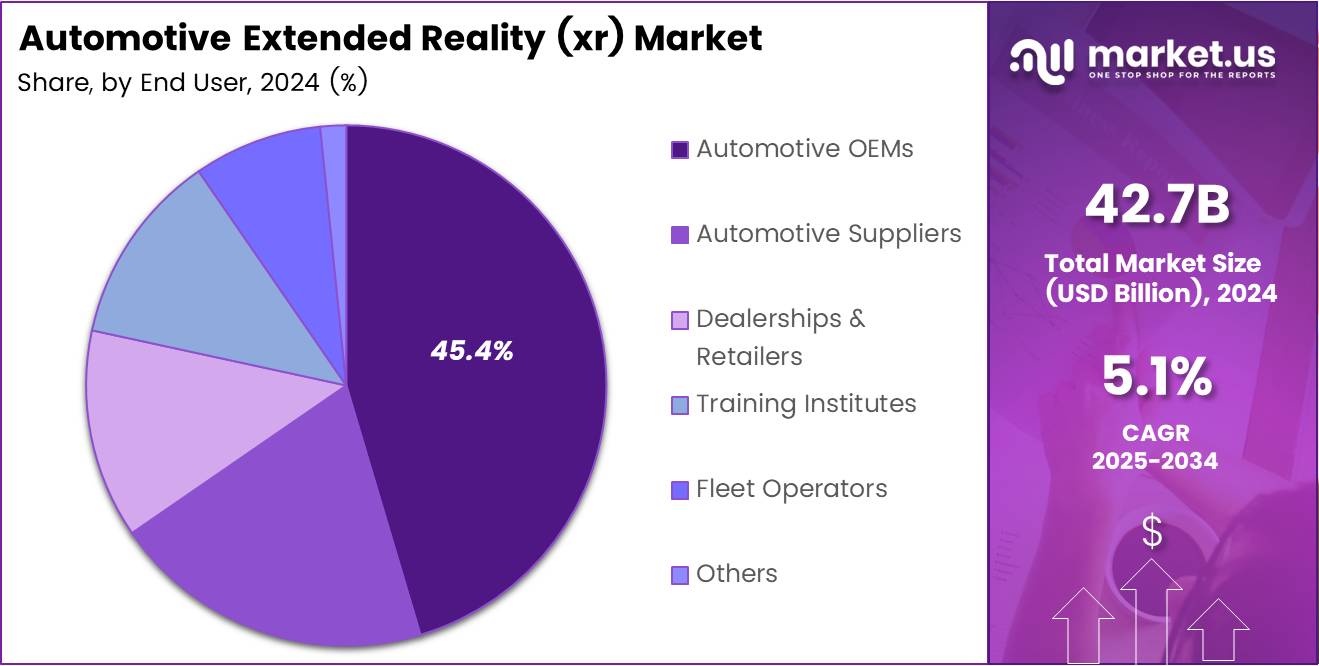
Automotive suppliers, dealerships, training institutes, and fleet operators also increased XR adoption steadily. Suppliers use immersive visualization for component validation and remote diagnostics. Additionally, dealerships deploy virtual showrooms to improve consumer engagement, while training institutes use XR simulations to enhance technical education and automotive workforce development.
Drivers
Automakers increasingly integrate XR technologies into advanced driver-assistance systems and smart cockpit platforms. These immersive overlays improve navigation clarity, hazard visualization, and driver awareness during real-time driving conditions. Consequently, automotive companies strengthen road safety while meeting growing consumer demand for connected and intelligent in-vehicle experiences.
Automotive manufacturers continue expanding XR-based workforce training across assembly operations and maintenance programs. Immersive simulations allow employees to learn complex tasks safely without damaging equipment or vehicles. Moreover, companies reduce training time and improve operational consistency, helping manufacturers increase productivity while lowering long-term operational expenses.
Use Cases
Automotive dealerships increasingly use XR-powered virtual showrooms and interactive configurators to improve vehicle purchasing experiences. Customers can explore models, customize interiors, and evaluate features remotely through immersive digital environments. Consequently, dealerships strengthen customer engagement while reducing showroom operating costs and inventory management challenges.
Automotive engineering teams rely on XR simulation platforms to test autonomous driving systems and vehicle ergonomics safely. Virtual environments allow developers to validate algorithms, cockpit interfaces, and driving scenarios without real-world risks. Additionally, companies accelerate innovation while reducing development costs and improving testing accuracy across autonomous mobility programs.
Major Challenges
High deployment costs continue limiting XR adoption across smaller automotive manufacturers and suppliers. Companies must invest heavily in advanced headsets, sensors, software platforms, and computing infrastructure to support immersive technologies. Consequently, budget constraints slow adoption rates and reduce technology accessibility across cost-sensitive automotive organizations.
Automotive companies also face challenges from limited standardization across XR platforms and vehicle interfaces. Different protocols and software environments create integration difficulties during deployment and testing processes. Moreover, compatibility issues increase development timelines and create uncertainty regarding future system upgrades and long-term technology investments.
Business Opportunities
Remote vehicle diagnostics and XR-assisted maintenance services present significant growth opportunities across the automotive ecosystem. Technicians can identify faults visually and guide customers through repair procedures using immersive tools. Consequently, manufacturers improve after-sales efficiency, reduce downtime, and strengthen customer satisfaction through faster maintenance support services.
Automotive brands continue investing in lightweight XR wearables and cloud-based immersive platforms for next-generation mobility experiences. These solutions improve navigation, infotainment, and digital assistance inside connected vehicles. Additionally, cloud-delivered XR services help automakers scale digital features efficiently while supporting continuous software updates and personalized customer experiences.
Regional Analysis
North America dominated the Automotive XR market with a regional share of 37.9% and a market value of USD 16.1 Billion. Strong investment in smart manufacturing, connected mobility, and digital engineering supports regional leadership. Consequently, automotive firms across the United States and Canada accelerate immersive technology integration throughout production and customer engagement operations.
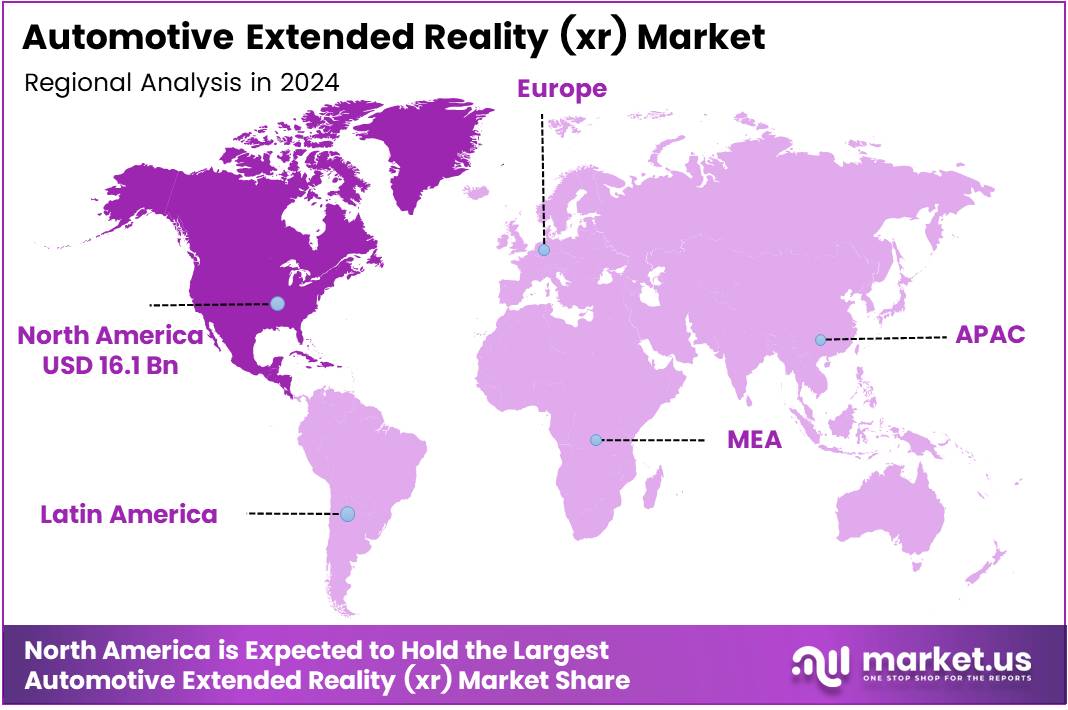
Asia Pacific continues emerging as a high-growth region due to expanding automotive production and increasing digital transformation investments. Countries including China, Japan, South Korea, and India continue strengthening smart factory infrastructure and connected vehicle initiatives. Moreover, rising demand for immersive customer experiences supports broader XR adoption across automotive retail and engineering sectors.
Recent Developments
- September 2025 — Valeo Racer launched an extended-reality in-car gaming experience across Asian automotive markets, improving passenger entertainment and smart-mobility engagement.
- September 2025 — EON Reality introduced a Spatial AI Training Platform supporting electric-vehicle workforce development through advanced XR and AI-powered learning tools.
- September 2024 — Finnish startup Distance Technologies secured €10 Million in funding led by Google Ventures to expand spatial computing technologies globally.
Conclusion
The Automotive XR market continues demonstrating stable long-term growth as automakers expand immersive technologies across manufacturing, design, retail, and autonomous mobility applications. Rising adoption of AI-enabled simulations, advanced driver-assistance visualization, and XR-based workforce training continues strengthening market momentum across global automotive ecosystems.
Augmented Reality remains the leading technology segment with a share of 49.8%, while hardware components dominate due to rising demand for sensors and immersive displays. Additionally, North America maintains regional leadership through strong investment in connected mobility, digital engineering, and advanced automotive innovation infrastructure.
Automotive companies must prioritize scalable XR platforms, cloud integration, and collaborative digital ecosystems to remain competitive. Manufacturers that improve immersive customer experiences and operational efficiency will capture stronger market opportunities over the coming decade. Consequently, analysts expect the industry to reach USD 70.2 Billion by 2034.
Looking for data tailored to your specific market, region, or business need? Request a custom report or consultation — write to us at sales@market.us
Discuss your needs with our analyst
Please share your requirements with more details so our analyst can check if they can solve your problem(s)