Market Overview
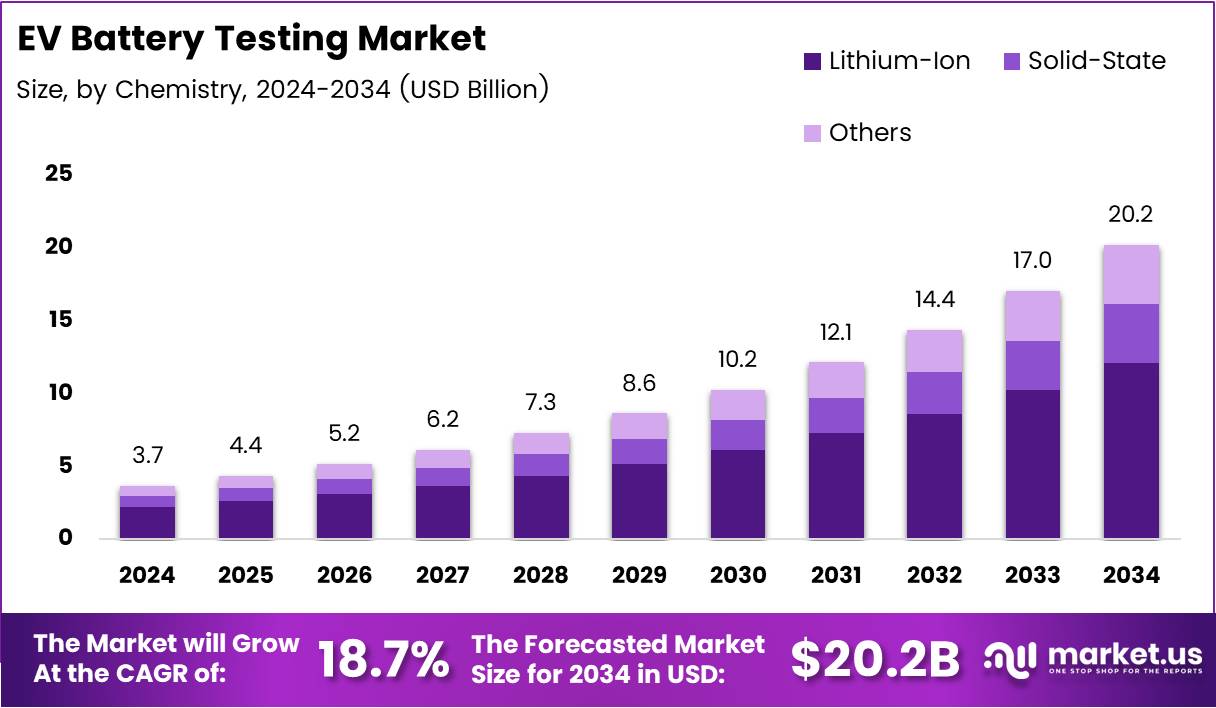
The global EV Battery Testing market was valued at USD 3.7 Billion in 2024. Analysts project the market will reach approximately USD 20.2 Billion by 2034, growing at a CAGR of 18.7% during 2025–2034. Rapid electrification and expanding battery manufacturing continue driving strong demand for advanced testing and validation systems worldwide.
EV battery testing involves specialized solutions that evaluate battery safety, durability, lifecycle, and performance for electric vehicles. Automotive OEMs, battery manufacturers, and testing laboratories use these systems to ensure batteries meet reliability and compliance standards. Consequently, testing frameworks help reduce product failures while improving vehicle safety and operational efficiency.
Get further insight into the global trends shaping the future of the EV Battery Testing industry. Request Sample
Automotive manufacturers increasingly deploy battery testing solutions across passenger EVs, commercial fleets, and energy-storage applications. Testing providers validate thermal stability, charging reliability, and mechanical endurance for advanced battery systems. Additionally, growing charging infrastructure and battery production capacity continue strengthening testing demand throughout global automotive supply chains.
Technology advancements in automated diagnostics, predictive analytics, and simulation software continue transforming the testing ecosystem. AI-powered testing platforms help manufacturers detect battery failures earlier and improve development accuracy. Moreover, digital twin models and automated high-voltage testing systems accelerate validation cycles while reducing manual intervention across production environments.
Government regulations and safety mandates continue supporting market expansion globally. Regulatory agencies increasingly require detailed testing for thermal management, charging compatibility, and long-term battery durability. Therefore, manufacturers invest heavily in advanced testing benches and certification systems to maintain compliance while improving product quality and operational consistency.
Industry statistics further highlight strong market momentum. Research shows electric vehicle sales reached 17 million units in 2024, representing over 20% of global new-car sales. Additionally, lithium-ion battery demand climbed from 330 GWh in 2021 to 550 GWh in 2022. These trends significantly increase the need for advanced battery testing solutions worldwide.
Key Takeaways
- The global EV Battery Testing market will expand from USD 3.7 Billion in 2024 to USD 20.2 Billion by 2034 at a CAGR of 18.7%.
- Lithium-Ion chemistry dominates the market with a leading share of 72.5% due to strong commercial adoption and safety validation demand.
- Prismatic battery forms accounted for 42.1% share because automakers prioritize structural rigidity and packaging efficiency.
- Battery Electric Vehicles captured the largest propulsion share at 56.6%, reflecting accelerating global EV adoption.
- Cell-To-Pack battery technology holds a dominant market share of 44.8% as manufacturers pursue higher energy density and simplified architectures.
- Light-Duty Vehicles dominate the EV type segment with an impressive share of 82.3% driven by strong passenger EV demand.
- Asia Pacific leads the global market with a regional share of 45.9%, reaching a value of USD 1.6 Billion.
Market Segmentation Overview
Lithium-Ion batteries dominated the chemistry segment with a market share of 72.5% in 2024. Manufacturers increased testing volumes to improve thermal stability, cycle life, and operational safety for lithium-ion systems. Consequently, growing EV adoption and continuous battery innovation continue strengthening demand for advanced testing and certification procedures.
Solid-state and other emerging battery chemistries also generated rising testing requirements across automotive applications. Manufacturers increasingly evaluate energy density, safety performance, and environmental stability for next-generation batteries. Additionally, automakers continue exploring alternative chemistries to improve sustainability, cost efficiency, and long-term operational reliability in electric mobility platforms.
Prismatic battery forms led the market with a dominant share of 42.1% in 2024. Automakers increasingly prefer these structured cells because they offer higher packaging efficiency and mechanical stability. Therefore, testing providers focus heavily on durability, thermal behavior, and structural integrity assessments for prismatic battery systems under demanding vehicle conditions.
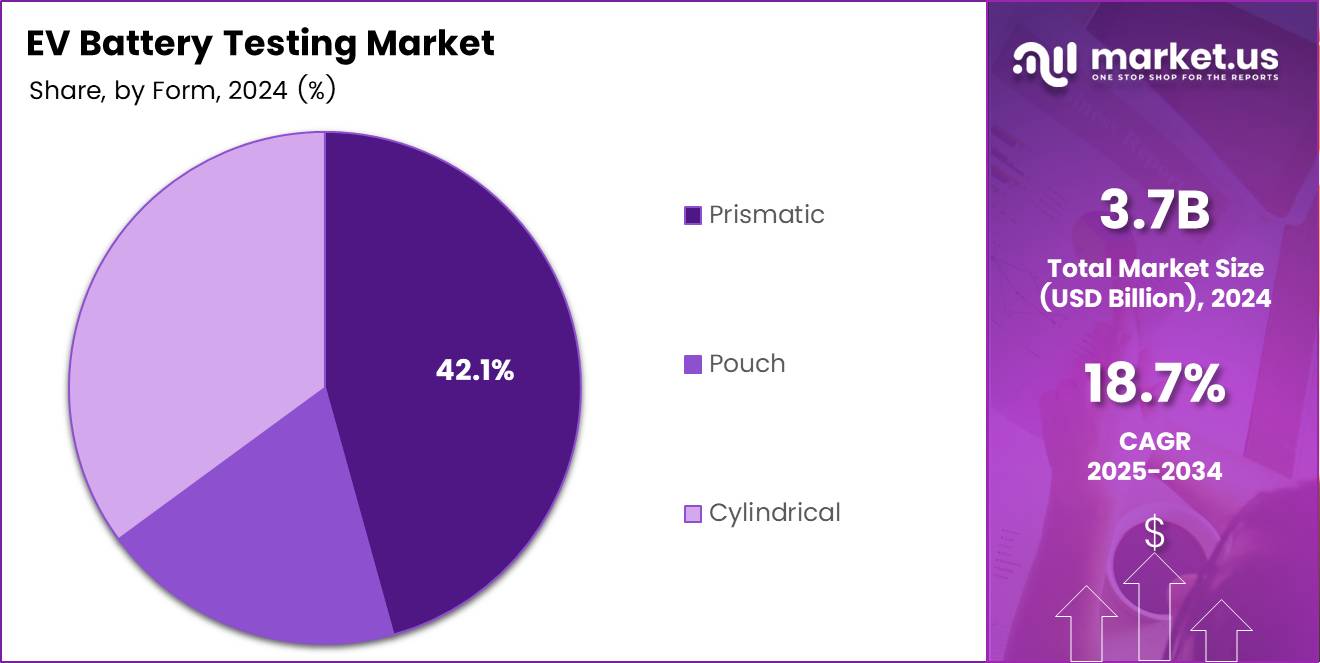
Pouch and cylindrical battery formats also generated strong testing demand across global EV production ecosystems. Pouch cells require extensive evaluation for swelling behavior and thermal management. Moreover, cylindrical batteries undergo repetitive validation cycles to ensure consistent safety and thermal performance across large-scale manufacturing operations.
Battery Electric Vehicles represented the largest propulsion segment with a market share of 56.6% in 2024. BEVs require comprehensive testing for high-capacity battery packs, fast-charging compatibility, and long-cycle performance validation. Consequently, rising consumer demand for fully electric mobility continues driving large-scale investment in testing infrastructure worldwide.
Cell-To-Pack architectures held the leading battery technology share at 44.8%, while Light-Duty Vehicles dominated EV type analysis with 82.3% share. Manufacturers increasingly prioritize these technologies to improve driving range and efficiency. Additionally, mass passenger EV adoption continues generating high testing volumes across automotive development and production facilities.
Drivers
Rapid global adoption of electric vehicles continues driving strong demand for battery testing solutions across consumer and commercial transportation sectors. Manufacturers must validate battery safety, charging reliability, and operational durability before vehicles reach the market. Consequently, automotive companies increase investment in advanced testing systems supporting high-volume EV production.
Governments worldwide continue enforcing stricter battery safety regulations and compliance standards for electric mobility systems. These regulations require detailed thermal stability and long-term performance validation for advanced battery technologies. Moreover, expanding gigafactory investments and EV manufacturing infrastructure further increase demand for automated and scalable testing environments.
Use Cases
Automotive manufacturers increasingly use battery testing platforms to validate fast-charging compatibility for next-generation electric vehicles. Engineers evaluate thermal stress, charging speed, and power efficiency during repeated charging cycles. Consequently, companies improve battery reliability while supporting growing consumer demand for shorter EV charging times.
Battery developers also rely on testing solutions to validate solid-state and advanced chemistry batteries before commercial deployment. Testing laboratories assess energy density, environmental stability, and lifecycle performance under real-world operating conditions. Additionally, these evaluations help manufacturers reduce safety risks while accelerating commercialization of emerging battery technologies.
Major Challenges
High installation costs for advanced battery testing facilities continue limiting market expansion among smaller manufacturers and emerging EV startups. Companies must invest heavily in safety chambers, environmental control systems, and high-precision testing equipment. Consequently, financial barriers reduce accessibility to advanced testing infrastructure across developing automotive ecosystems.
Manufacturers also face operational challenges due to inconsistent global testing standards and certification frameworks. Different regional regulations require multiple compliance procedures and testing cycles for battery systems. Moreover, fragmented standards increase development complexity, delay product launches, and create additional administrative costs for EV developers worldwide.
Business Opportunities
Growing development of solid-state and next-generation battery technologies creates significant opportunities for specialized testing providers. These advanced systems require new validation methods covering safety, performance, and lifecycle assessments. Consequently, testing laboratories and equipment suppliers continue expanding service capabilities to support future battery commercialization strategies.
AI-powered predictive analytics and battery lifecycle assessment tools also present strong long-term business opportunities. Companies increasingly integrate AI into testing systems to detect early battery failures and improve testing efficiency. Additionally, growing focus on battery recycling and second-life applications strengthens demand for sustainability-focused testing services globally.
Regional Analysis
Asia Pacific dominated the EV Battery Testing market with a regional share of 45.9% and a market value of USD 1.6 Billion. Strong EV manufacturing growth, supportive government policies, and expanding battery innovation ecosystems continue supporting regional leadership. Consequently, countries such as China, Japan, and South Korea strengthen testing infrastructure aggressively.
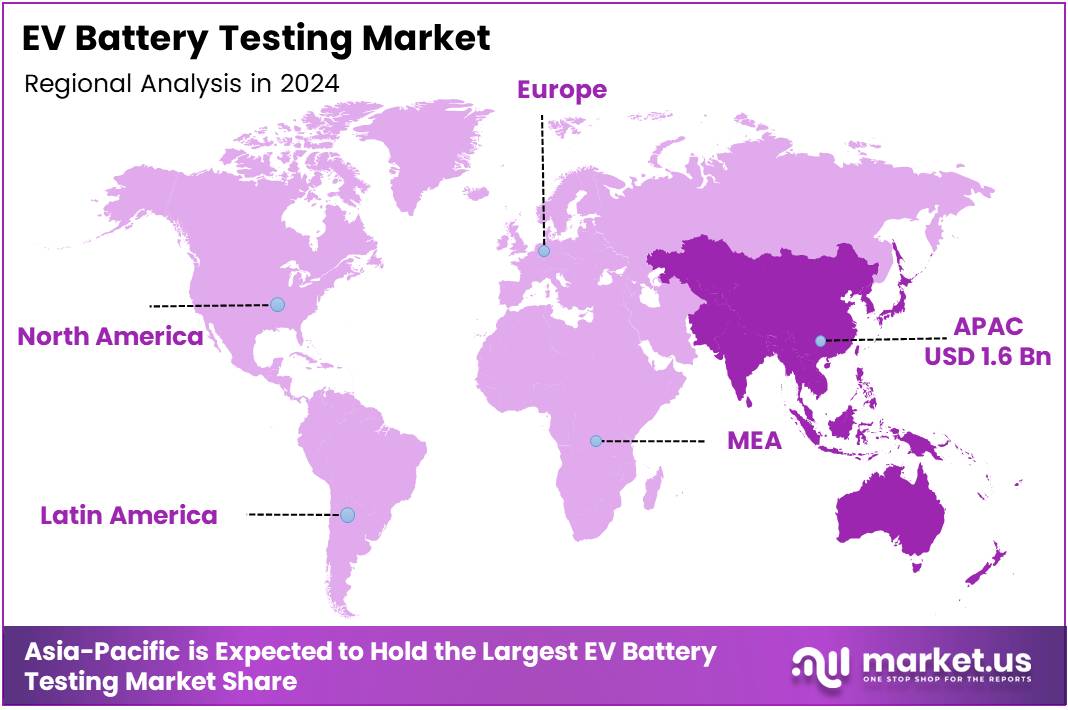
North America and Europe continue demonstrating strong market growth driven by regulatory emphasis on battery safety and domestic EV manufacturing expansion. Both regions invest heavily in advanced testing laboratories and sustainable battery technologies. Moreover, rising electrification targets and clean-energy initiatives continue strengthening long-term testing demand across automotive industries.
Recent Developments
- May 2025 — UL Solutions launched its Europe Advanced Battery Laboratory in Aachen, Germany, expanding advanced automotive battery testing and certification capabilities.
- January 2024 — Unico LLC acquired Present Power Systems to strengthen its battery testing and EV charging technology portfolio across electrification markets.
- May 2024 — UL Solutions acquired BatterieIngenieure GmbH to expand EV battery simulation and performance testing operations in Europe.
- November 2024 — TÜV SÜD acquired the remaining 30% stake in TÜV SÜD Battery Testing GmbH, making it a wholly owned subsidiary.
- November 2024 — AVL received a contract from PowerCo SE to establish a battery-cell testing laboratory in Salzgitter, Germany, targeted for completion in 2025.
Conclusion
The EV Battery Testing market continues experiencing rapid expansion as electric mobility adoption accelerates worldwide. Growing demand for battery safety validation, fast-charging compatibility, and lifecycle testing strengthens investment in advanced testing infrastructure. Consequently, manufacturers and testing providers continue scaling capabilities to support rising EV production volumes globally.
Lithium-Ion batteries remain the leading chemistry segment with a share of 72.5%, while Battery Electric Vehicles dominate propulsion demand at 56.6%. Additionally, Asia Pacific maintains strong regional leadership due to extensive EV manufacturing capacity, aggressive battery investments, and supportive clean-energy regulations.
Testing companies must prioritize automation, AI-driven analytics, and next-generation battery validation technologies to remain competitive in evolving electrification markets. Manufacturers that strengthen compliance capabilities and scalable testing infrastructure will capture emerging opportunities effectively. Therefore, analysts expect the market to reach USD 20.2 Billion by 2034.
Looking for data tailored to your specific market, region, or business need? Request a custom report or consultation — write to us at sales@market.us
Discuss your needs with our analyst
Please share your requirements with more details so our analyst can check if they can solve your problem(s)