Market Overview
The Global Automotive Network Testing Market was valued at USD 1.5 Billion in 2024 and is projected to reach USD 3.3 Billion by 2034. The market is expected to grow at a CAGR of 8.3% during 2025–2034. Rising software-defined vehicle adoption continues driving demand for advanced automotive communication validation systems.
Automotive network testing solutions verify communication reliability between vehicle systems such as CAN, LIN, Ethernet, and FlexRay. Automakers, suppliers, and software developers use these tools to ensure secure and stable data transmission. These platforms also help manufacturers improve vehicle safety, cybersecurity, and software performance across connected automotive ecosystems.
Get further insight into the global trends shaping the future of the Automotive Network Testing industry. Request Sample
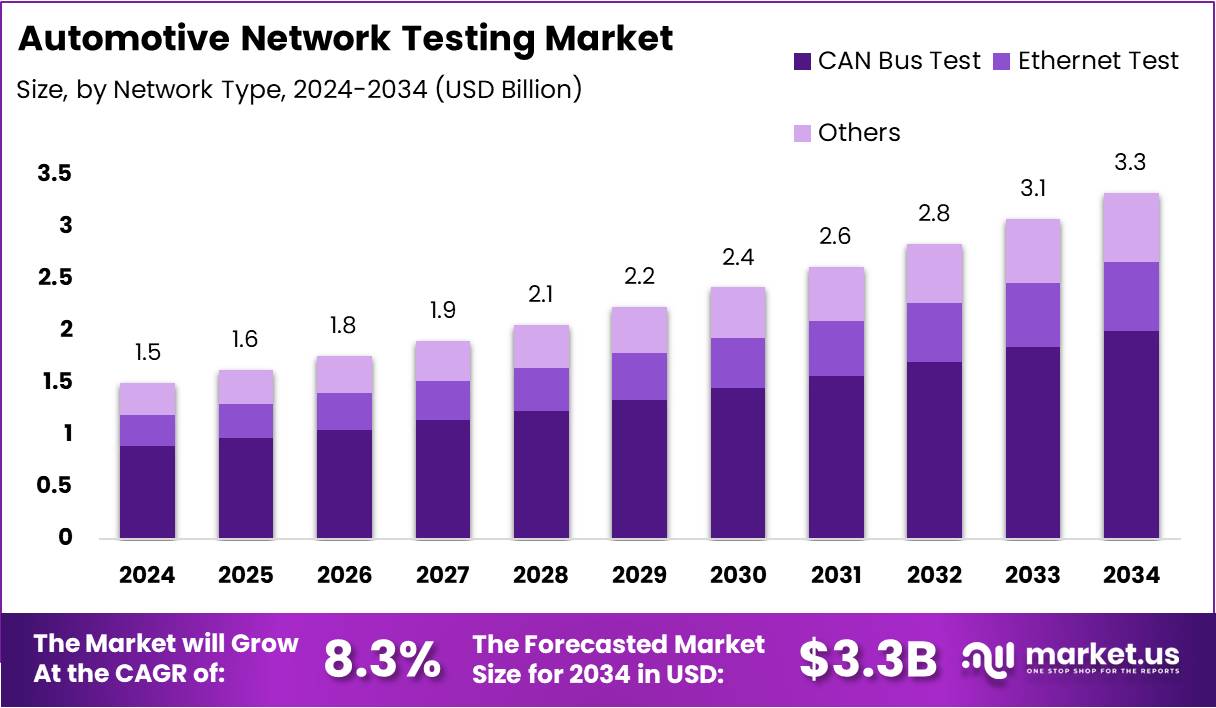
Passenger vehicle manufacturers, electric vehicle producers, and commercial fleet operators are increasing investments in network validation technologies. ADAS deployment, infotainment integration, and telematics expansion continue accelerating testing requirements. Additionally, autonomous mobility developers use advanced communication testing systems to validate latency-sensitive applications and high-bandwidth in-vehicle communication architectures.
Technology companies are integrating AI-driven diagnostics, digital twins, and cloud-based validation workflows into automotive testing platforms. These innovations reduce development time and improve fault detection accuracy. Consequently, automotive engineers can manage complex ECU communication environments more efficiently while supporting scalable validation across connected and electrified vehicle architectures.
Governments worldwide are introducing cybersecurity regulations, ADAS safety mandates, and vehicle connectivity standards that support testing platform adoption. OTA software update requirements also increase demand for secure communication validation systems. Therefore, automotive OEMs continue investing in automated testing infrastructures to meet evolving compliance requirements and improve operational reliability.
Industry reports state Android Auto will support nearly 200 million vehicles globally by the end of this year. This rapid connectivity expansion increases communication complexity and testing requirements across automotive systems. Additionally, less than 6% of new vehicles are expected to ship with Android Automotive OS by 2025, highlighting future software integration opportunities.
Key Takeaways
- The Global Automotive Network Testing Market reached USD 1.5 Billion in 2024 and may achieve USD 3.3 Billion by 2034.
- The industry is projected to expand at a CAGR of 8.3% during the forecast period from 2025 to 2034.
- CAN Bus Test dominated the network type segment with a market share of 49.2% in 2024 due to strong protocol adoption.
- Passenger Cars accounted for 71.9% share in 2024 as automakers integrated more ADAS and infotainment technologies.
- Asia Pacific held the leading regional position with a market share of 49.2% valued at USD 0.7 Billion in 2024.
- Automotive Ethernet testing gained strong momentum because automakers increasingly adopted high-bandwidth zonal vehicle architectures.
- AI-driven diagnostics, cloud-based validation, and digital twin environments continue creating long-term market growth opportunities.
Market Segmentation Overview
CAN Bus Test dominated the network type segment with a 49.2% market share in 2024. Automakers continue relying on CAN-based communication because it delivers stable diagnostics and efficient ECU validation. Consequently, manufacturers prioritize CAN testing platforms to improve interoperability, streamline software integration, and maintain reliable vehicle communication performance across modern automotive systems.
Ethernet Test experienced strong growth as automotive companies shifted toward high-speed communication architectures supporting ADAS and infotainment systems. Automotive Ethernet improves bandwidth performance and supports latency-sensitive applications in connected vehicles. Additionally, mixed-protocol testing platforms remain important because manufacturers still use LIN, FlexRay, and proprietary systems across specialized automotive applications.
Passenger Cars held the leading application position with a market share of 71.9% in 2024. This dominance reflects strong integration of connectivity systems, infotainment platforms, and software-driven mobility features. Consequently, passenger vehicle manufacturers require advanced testing frameworks to validate OTA updates, cybersecurity layers, and complex in-vehicle communication networks.
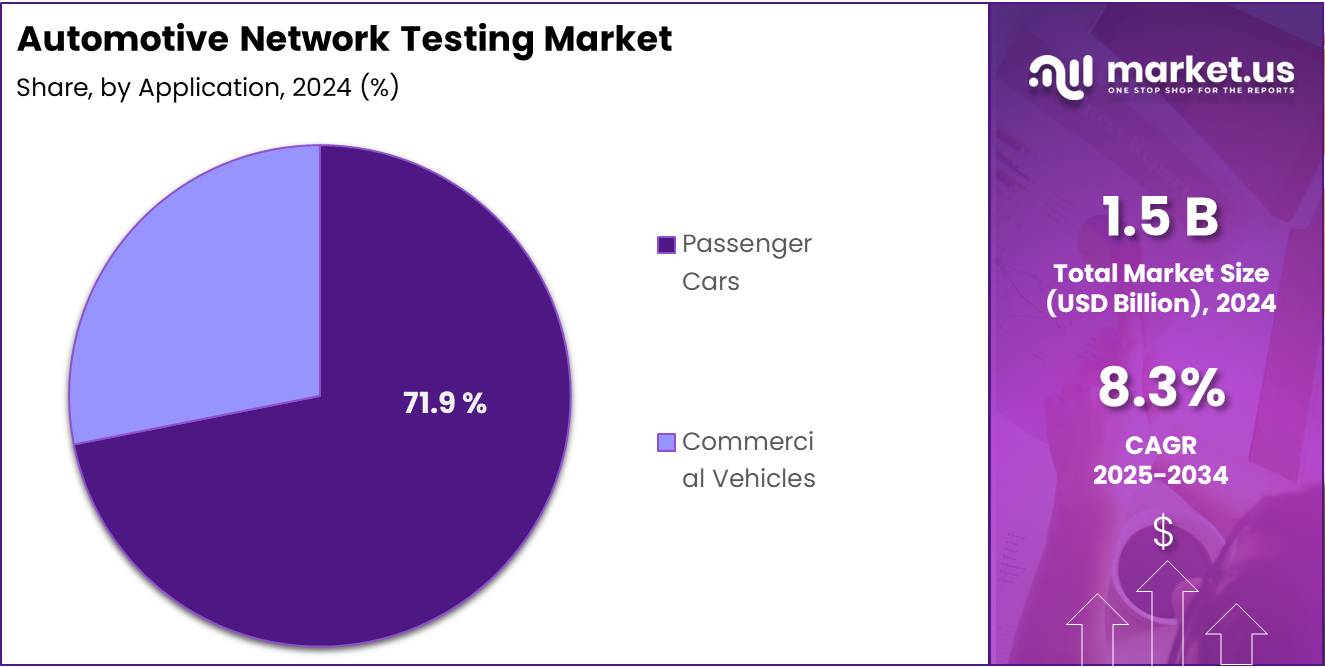
Commercial Vehicles expanded steadily as fleet operators increased investments in telematics, remote diagnostics, and connected logistics systems. Heavy-duty vehicle manufacturers also adopted advanced communication validation to improve operational uptime and compliance performance. Therefore, rising electrification across commercial transportation continues supporting long-term growth in automotive network testing requirements.
Drivers
Automakers are rapidly deploying Ethernet-based vehicle communication systems to support ADAS, sensor fusion, and high-speed infotainment features. These advanced architectures require accurate latency and bandwidth validation during vehicle development. Consequently, automotive companies continue investing heavily in real-time testing platforms that ensure reliable communication performance across complex electronic environments.
OTA software update ecosystems are significantly increasing demand for secure automotive communication testing solutions. Vehicle manufacturers now deliver software patches and cybersecurity updates remotely through connected platforms. Therefore, engineers require scalable testing systems that validate cyber resilience, protocol stability, and secure data transmission before large-scale deployment across connected vehicle fleets.
Use Cases
Passenger vehicle manufacturers use automotive network testing platforms to validate ADAS communication and infotainment connectivity across software-defined vehicle architectures. These systems help engineers identify communication delays and software faults during development. Consequently, automakers improve vehicle safety, reduce software failures, and accelerate product launch timelines in competitive mobility markets.
Commercial fleet operators increasingly deploy network validation tools to support telematics, predictive maintenance, and connected logistics applications. These platforms verify communication reliability between ECUs and remote monitoring systems. Additionally, testing frameworks help fleet companies improve operational uptime, reduce maintenance disruptions, and maintain regulatory compliance across heavy-duty transportation networks.
Major Challenges
Automotive manufacturers face major difficulties due to limited technical expertise in handling multi-protocol vehicle communication systems. Engineers must manage CAN, LIN, Ethernet, and FlexRay environments simultaneously during testing procedures. Consequently, skill shortages increase validation complexity, slow software integration cycles, and create operational inefficiencies for automotive development teams.
Global automotive communication standards remain fragmented across regions and manufacturers, creating major validation challenges for testing providers. Different compliance requirements force suppliers to customize testing environments for individual markets. Therefore, companies experience higher development costs, delayed product approvals, and slower adoption of advanced automotive communication technologies.
Business Opportunities
AI-driven diagnostics and predictive testing platforms are creating strong commercial opportunities across automotive validation ecosystems. These intelligent systems identify communication faults before failures affect vehicle performance. Consequently, automakers can reduce testing costs, improve software reliability, and accelerate vehicle development processes within increasingly software-centric automotive environments.
5G-enabled V2X communication certification services are opening new growth opportunities for automotive testing providers worldwide. Connected and autonomous vehicles require low-latency and secure communication infrastructure to operate safely. Additionally, rising investments in cloud-based simulation platforms are expanding scalable validation capabilities across global automotive R&D operations.
Regional Analysis
Asia Pacific dominated the Automotive Network Testing Market with a market share of 49.2% valued at USD 0.7 Billion in 2024. Strong vehicle manufacturing activity, expanding EV production, and government investments in connected mobility continue supporting regional growth. Consequently, automotive OEMs across China, Japan, and South Korea maintain significant testing infrastructure investments.
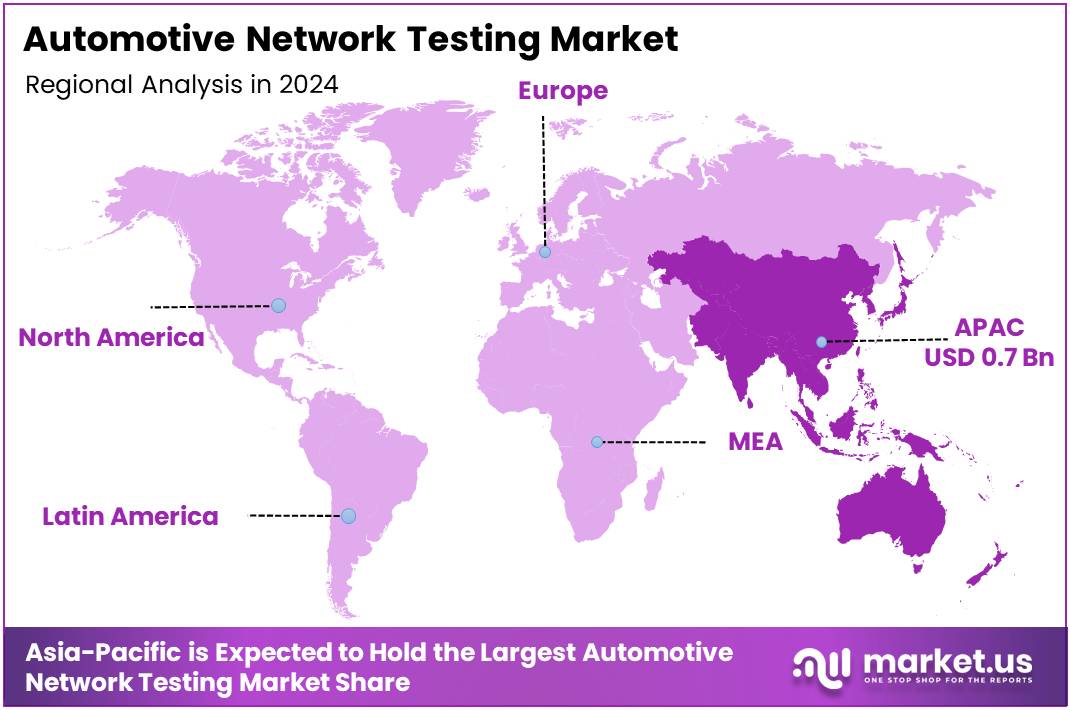
North America continues emerging as a major growth region due to increasing adoption of OTA updates, ADAS technologies, and connected vehicle services. Automotive companies across the United States and Canada are investing heavily in cybersecurity validation and telematics testing systems. Therefore, regional demand for advanced automotive communication testing platforms remains strong.
Recent Developments
- December 2024 — Accenture announced plans to acquire AOX to strengthen software-defined vehicle engineering and accelerate automotive software development capabilities.
- November 2024 — An automotive systems division partnered with a major processor-IP company to standardize software architectures and improve interoperability for software-defined vehicles.
- May 2024 — Daimler Truck and Volvo Group announced a joint venture focused on developing software-defined vehicle platforms for commercial transportation markets.
Conclusion
The Automotive Network Testing Market is experiencing strong growth due to increasing software-defined mobility adoption and rising communication complexity across connected vehicles. Automakers continue prioritizing cybersecurity validation, OTA testing, and high-speed network reliability. Consequently, advanced validation systems are becoming essential for future automotive innovation and operational safety.
CAN Bus Test and Passenger Cars remain dominant segments because manufacturers continue integrating advanced infotainment, telematics, and ADAS features across consumer vehicles. Asia Pacific also maintains regional leadership through strong automotive production and connected mobility investments. Therefore, regional OEMs continue expanding network validation capabilities to support future transportation technologies.
Automotive testing providers must expand AI-driven diagnostics, cloud-based simulation, and 5G-enabled validation capabilities to remain competitive in evolving mobility ecosystems. Companies that support scalable and software-centric testing environments will capture long-term market opportunities. The market is projected to reach USD 3.3 Billion by 2034.
Looking for data tailored to your specific market, region, or business need? Request a custom report or consultation — write to us at sales@market.us
Discuss your needs with our analyst
Please share your requirements with more details so our analyst can check if they can solve your problem(s)