Overview
New York, NY – May 18, 2026 – Global Generative AI in Pharmaceutical Market size is expected to be worth around US$ 40.88 billion by 2034 from US$ 2.92 billion in 2024, growing at a CAGR of 30.2% during the forecast period 2025 to 2034.
The adoption of Generative AI in the pharmaceutical industry is transforming drug discovery, clinical development, manufacturing, and commercialization processes. Generative AI refers to advanced artificial intelligence models capable of generating new data, molecular structures, research insights, and predictive outcomes based on large datasets. The technology is increasingly being utilized to accelerate innovation, reduce research timelines, and improve operational efficiency across the pharmaceutical value chain.
Pharmaceutical companies are leveraging Generative AI to identify potential drug candidates, optimize clinical trial designs, and support personalized medicine development. The technology enables researchers to analyze complex biological data and simulate molecular interactions with higher speed and accuracy compared to traditional methods. In addition, Generative AI supports regulatory documentation, medical content generation, and patient engagement initiatives.
The growing demand for faster drug development, rising investments in AI-driven healthcare technologies, and increasing availability of healthcare data are major factors driving market growth. Strategic collaborations between pharmaceutical companies and AI technology providers are further strengthening innovation in this sector.
North America currently represents a leading market due to strong digital healthcare infrastructure and significant research investments, while Asia-Pacific is emerging as a high-growth region supported by expanding pharmaceutical manufacturing capabilities and increasing AI adoption.
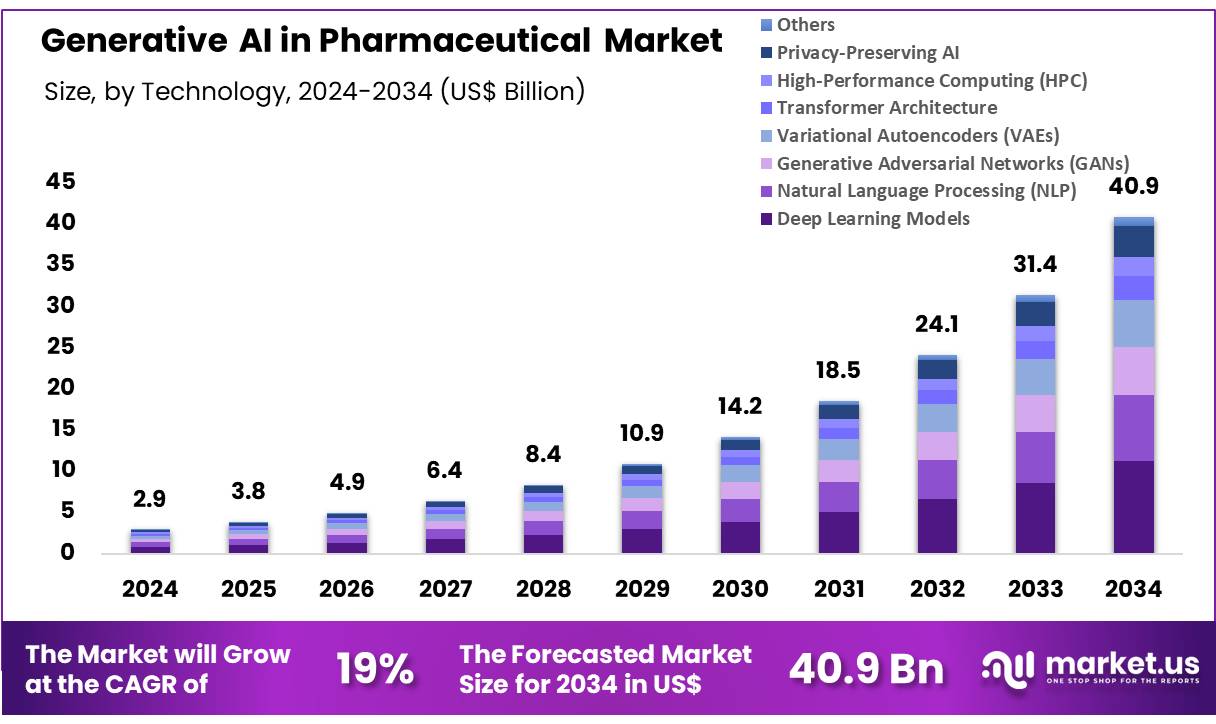
The market is expected to witness substantial expansion over the coming years as pharmaceutical organizations continue integrating AI-powered solutions to enhance productivity, reduce costs, and improve treatment outcomes.
Key Takeaways
- In 2024, the Generative AI in Pharmaceutical market was valued at US$ 2.92 billion and is projected to reach US$ 40.88 billion by 2034, expanding at a CAGR of 30.2% during the forecast period.
- Based on technology, the market is segmented into Deep Learning Models, Natural Language Processing (NLP), Generative Adversarial Networks (GANs), Variational Autoencoders (VAEs), Transformer Architecture, High-Performance Computing (HPC), Privacy-Preserving AI, and Others. Among these, Deep Learning Models dominated the market in 2024, accounting for a 27.4% share.
- By method, the market is categorized into Text Generation, Image Generation, Audio Generation, and Others. The Text Generation segment emerged as the leading category with a market share of 39.7% in 2024.
- In terms of application, the market is classified into Commercial, Research and Development, Drug Discovery, Clinical Development, Operations, and Others. The Research and Development segment held the largest revenue share of 22.4% in 2024.
- North America accounted for the largest regional share in the Generative AI in Pharmaceutical market, representing 46.8% of the global market revenue in 2024.
Regional Analysis
North America dominated the Generative AI in Pharmaceutical market in 2024, accounting for a 46.8% share of the global revenue. The region’s leadership is primarily supported by the strong presence of major pharmaceutical companies, biotechnology firms, and advanced artificial intelligence research organizations, particularly in the United States. The growing integration of generative AI technologies in drug discovery, clinical trial optimization, and personalized medicine development has significantly enhanced research efficiency and accelerated product development timelines.
The region also benefits from substantial investments by leading technology companies that provide AI platforms, cloud infrastructure, and advanced computing capabilities to pharmaceutical organizations. The increasing collaboration between healthcare companies and AI solution providers is further strengthening innovation across the pharmaceutical value chain.
Moreover, the regulatory landscape in the United States is evolving to support AI-driven healthcare innovations, creating favorable conditions for the adoption of generative AI solutions. Regulatory agencies are increasingly recognizing the potential of AI in improving drug development and operational efficiency.
In September 2024, Deloitte introduced its AI Factory as a Service solution powered by the NVIDIA AI platform and Oracle AI technologies. The initiative combines advanced AI software, accelerated computing, and industry expertise to support scalable and customized generative AI workflows for pharmaceutical and healthcare applications.
Emerging Trends in Generative AI in Pharmaceutical
- Generative AI is increasingly used for faster drug discovery by analyzing large biological datasets and designing new molecules in less time. Pharmaceutical companies are adopting AI models to reduce research timelines, improve compound prediction, and lower overall drug development costs.
- AI-powered clinical trial optimization is becoming a major trend in the pharmaceutical sector. Companies are using generative AI to identify suitable patients, improve trial design, automate documentation, and reduce delays, helping pharmaceutical firms accelerate regulatory approval processes.
- Regulatory agencies such as the U.S. Food and Drug Administration are developing frameworks for AI-based drug development. The growing focus on explainable and transparent AI models is supporting safe adoption of generative AI across pharmaceutical manufacturing and clinical research activities.
- Pharmaceutical companies are investing heavily in AI partnerships and infrastructure to strengthen research productivity. AI-based platforms are supporting protein structure prediction, disease modeling, and molecule generation, creating new opportunities for precision medicine and targeted therapies.
- The emergence of autonomous AI agents and foundation models is transforming pharmaceutical R&D operations. These systems can automate scientific document drafting, statistical analysis, and research workflows, helping organizations improve operational efficiency and reduce manual workloads.
Use Cases of Generative AI in Pharmaceutical
- Generative AI is widely used in drug molecule design, where AI models generate new chemical structures with desired therapeutic properties. This approach helps researchers identify promising drug candidates faster compared to traditional laboratory-based discovery methods.
- Pharmaceutical companies are using generative AI for protein structure prediction and disease analysis. AI tools can analyze complex biological information and identify disease mechanisms, supporting the development of personalized medicines and innovative treatment solutions for chronic diseases.
- AI-driven platforms are supporting automated clinical documentation and medical writing. Generative AI can prepare clinical study reports, summarize patient records, and draft regulatory documents, significantly reducing administrative workload and improving operational productivity in pharmaceutical companies.
- Generative AI is being applied in clinical trial recruitment and patient monitoring. AI systems analyze healthcare records and real-world data to identify eligible participants, improve diversity in trials, and enhance overall clinical trial efficiency and accuracy.
- Pharmaceutical manufacturers are utilizing generative AI for process optimization and predictive manufacturing. AI models help improve production quality, optimize chemical formulation processes, and reduce manufacturing errors, supporting cost-efficient and scalable pharmaceutical production operations.
Frequently Asked Questions on Generative AI in Pharmaceutical
- What is Generative AI in Pharmaceutical?
Generative AI in pharmaceutical refers to advanced artificial intelligence systems capable of creating new molecular structures, predicting drug interactions, generating research insights, and supporting clinical decision-making. The technology helps pharmaceutical companies accelerate innovation, improve efficiency, and reduce the overall time required for drug development processes. - What factors are driving the growth of the Generative AI in Pharmaceutical Market?
The market growth is primarily driven by increasing demand for faster drug discovery, rising healthcare data availability, growing investments in AI technologies, and the need to reduce research costs. Expanding collaborations between pharmaceutical companies and AI solution providers are also supporting market expansion globally. - How is Generative AI used in drug discovery?
Generative AI assists researchers by analyzing large biological datasets, identifying promising drug candidates, and predicting molecular behavior with improved speed and accuracy. This technology reduces the early-stage drug discovery timeline and enhances the probability of successful therapeutic development in pharmaceutical research. - Which technologies are commonly used in the Generative AI in Pharmaceutical Market?
The market utilizes technologies such as Deep Learning Models, Natural Language Processing, Generative Adversarial Networks, Transformer Architecture, and High-Performance Computing. These technologies support applications including molecule generation, clinical data analysis, automated documentation, and personalized medicine development across pharmaceutical operations. - Why is North America leading the Generative AI in Pharmaceutical Market?
North America leads the market due to the presence of major pharmaceutical companies, strong AI research infrastructure, advanced healthcare systems, and significant investments in digital technologies. Supportive regulatory developments and collaborations between technology providers and pharmaceutical firms further strengthen regional market growth. - What are the major applications of Generative AI in pharmaceuticals?
Generative AI is widely applied in research and development, drug discovery, clinical trial optimization, medical content generation, and operational management. The technology also supports personalized treatment planning and predictive analytics, helping pharmaceutical companies improve productivity and decision-making capabilities. - What is the future outlook for the Generative AI in Pharmaceutical Market?
The market is expected to witness substantial growth over the coming years due to increasing AI adoption, continuous technological advancements, and growing demand for efficient drug development solutions. Expanding investments in digital healthcare transformation are also expected to create new market opportunities globally.
Conclusion
The Generative AI in Pharmaceutical market is witnessing rapid growth due to increasing demand for faster, cost-effective, and data-driven drug development solutions. The technology is transforming pharmaceutical research, clinical development, manufacturing, and commercialization processes through improved automation and predictive capabilities.
Rising investments in AI infrastructure, growing collaborations between pharmaceutical and technology companies, and expanding healthcare datasets are further supporting market expansion. North America currently leads the market, while Asia-Pacific is emerging as a strong growth region. As pharmaceutical companies continue adopting AI-powered solutions, the market is expected to experience substantial long-term growth, improving operational efficiency, innovation, and patient treatment outcomes globally.
Discuss your needs with our analyst
Please share your requirements with more details so our analyst can check if they can solve your problem(s)