Overview
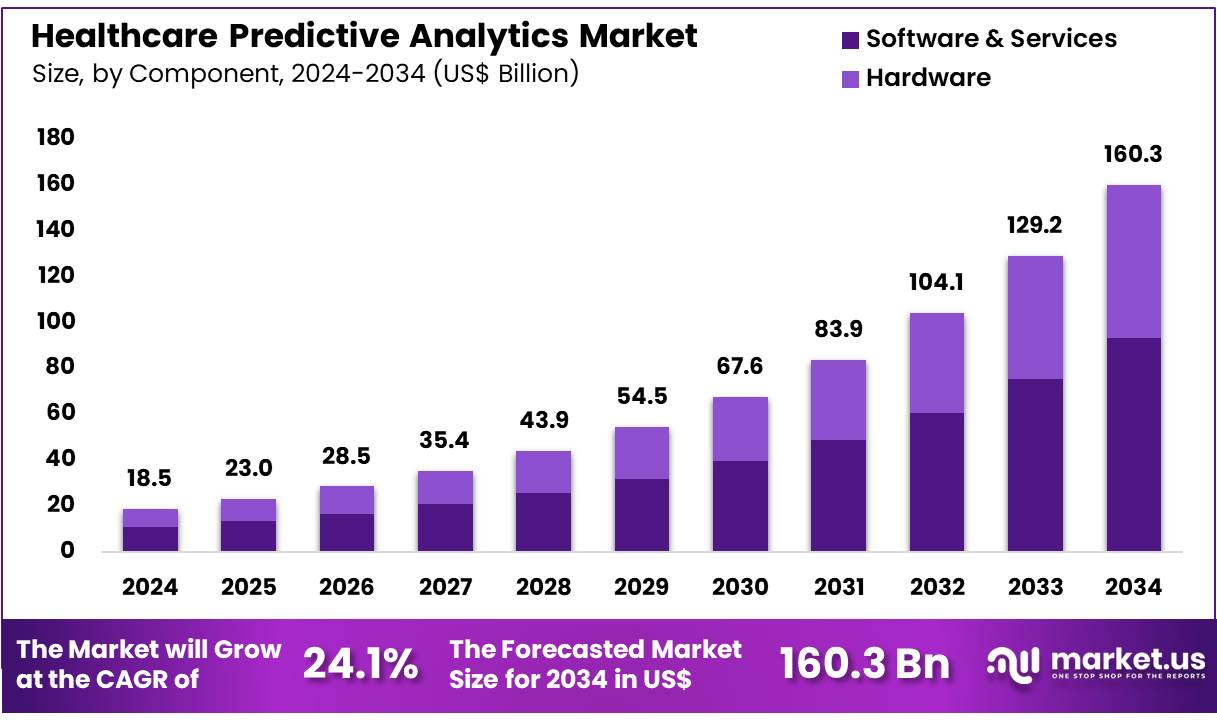
New York, NY – May 20, 2026 –Global Healthcare Predictive Analytics Market size is expected to be worth around US$ 160.3 Billion by 2034 from US$ 18.5 Billion in 2024, growing at a CAGR of 24.1% during the forecast period 2025 to 2034. In 2024, North America led the market, achieving over 40.1% share with a revenue of US$ 7.4 Billion.
The global Healthcare Predictive Analytics market is witnessing steady growth due to the increasing adoption of data-driven technologies across hospitals, healthcare providers, insurance companies, and pharmaceutical organizations. Predictive analytics in healthcare involves the use of advanced statistical tools, artificial intelligence (AI), machine learning, and big data technologies to analyze historical and real-time patient data for predicting future health outcomes and operational trends.
The market growth is supported by the rising demand for early disease detection, personalized treatment planning, reduction in healthcare costs, and improvement in patient care quality. Healthcare organizations are increasingly utilizing predictive analytics solutions to identify high-risk patients, reduce hospital readmissions, optimize clinical workflows, and improve population health management.
North America holds a significant share of the Healthcare Predictive Analytics market due to strong healthcare infrastructure, high digitalization, and increasing investments in AI-enabled healthcare technologies. Meanwhile, the Asia-Pacific region is expected to witness substantial growth owing to the rapid expansion of healthcare IT infrastructure, growing patient data generation, and rising government initiatives supporting digital healthcare transformation.
Key market participants are focusing on technological advancements, cloud-based analytics platforms, strategic collaborations, and integration of AI technologies to strengthen their market presence. The increasing adoption of electronic health records (EHRs) and value-based healthcare models is further expected to create long-term growth opportunities for the Healthcare Predictive Analytics industry over the forecast period.
Key Takeaways
- The Healthcare Predictive Analytics market generated revenue of US$ 18.5 billion in 2024 and is projected to reach US$ 160.3 billion by 2033, expanding at a CAGR of 24.1% during the forecast period.
- Based on component, the market is segmented into hardware and software & services. Among these, the software & services segment dominated the market in 2023, accounting for a revenue share of 58.3%.
- By application, the market is categorized into operational analytics, financial analytics, population health, and clinical analytics. The financial analytics segment held the largest market share of 39.4% in 2023.
- In terms of deployment mode, the market is divided into on-premise and cloud-based solutions. The on-premise segment emerged as the leading category, capturing 54.2% of the total market revenue.
- Based on end user, the market is segmented into payers, providers, and others. The payers segment led the market with a revenue share of 47.6%.
- North America dominated the global Healthcare Predictive Analytics market in 2023, securing a market share of 40.1%.
Market Segmentation Analysis
- Component Analysis: The software & services segment accounted for 58.3% of the market share in 2023, driven by rising demand for data-driven healthcare solutions. Healthcare providers increasingly adopt predictive analytics software to improve patient outcomes, optimize operations, enhance decision-making, and forecast patient trends, resource utilization, and financial performance effectively.
- Application Analysis: The financial analytics segment captured 39.4% of the market share due to growing pressure on healthcare organizations to reduce costs and improve revenue cycle management. Financial analytics solutions support real-time financial monitoring, reimbursement optimization, cost reduction, pricing strategies, and effective financial planning under value-based care models.
- Mode of Deployment Analysis: The on-premise segment held 54.2% of the revenue share as healthcare providers prioritized data security, regulatory compliance, and infrastructure control. On-premise deployment enables secure handling of sensitive patient information, faster data processing, reduced latency, and efficient management of large real-time healthcare datasets and analytics operations.
- End-user Analysis: The payers segment generated 47.6% of market revenue, supported by increasing adoption of predictive analytics for underwriting, fraud detection, and claims management. Insurance providers utilize analytics to assess risks, forecast claims, identify high-risk patients, optimize pricing models, and improve preventive care and cost management strategies.
Regional Analysis
North America dominated the Healthcare Predictive Analytics market, accounting for the largest revenue share of 40.1% in 2023. The regional market growth is driven by rapid advancements in artificial intelligence, increasing healthcare IT investments, and the growing adoption of remote patient monitoring technologies. The expansion of AI-enabled predictive analytics solutions in cardiology and critical care has further strengthened market growth.
Rising cases of chronic diseases such as cardiovascular disorders and diabetes have increased the demand for predictive tools that support early diagnosis, personalized treatment planning, and efficient hospital resource management. In addition, supportive government initiatives promoting value-based care and healthcare data interoperability have accelerated the adoption of predictive analytics across healthcare systems.
Meanwhile, the Asia Pacific region is expected to register the fastest CAGR during the forecast period. The growth is primarily attributed to increasing healthcare digitalization, expanding telehealth infrastructure, and rising investments in artificial intelligence and cloud-based healthcare solutions.
Countries such as China, India, and Japan are increasingly adopting predictive analytics tools for preventive healthcare and real-time patient monitoring. Furthermore, the growing prevalence of non-communicable diseases, along with the emergence of smart hospitals and digital healthcare ecosystems, is expected to create significant growth opportunities across the regional market.
Emerging Trends in Healthcare Predictive Analytics
- Hospitals using predictive AI integrated with electronic health records increased from 66% in 2023 to 71% in 2024. Predictive models are increasingly applied for inpatient risk scoring, treatment recommendations, scheduling optimization, and billing automation across healthcare systems.
- Predictive analytics for administrative automation expanded significantly, with billing automation adoption increasing from 36% to 61% between 2023 and 2024. Scheduling optimization usage also increased from 51% to 67%, reducing operational burden and improving hospital workflow efficiency.
- AI-driven sepsis prediction models are gaining adoption due to improved clinical accuracy. Advanced predictive algorithms achieved 0.94 AUC performance and improved early sepsis detection rates by 32%, while reducing false positives by 17% using clinical and unstructured healthcare data.
- FDA-cleared predictive healthcare tools are expanding rapidly. In 2026, an AI-based sepsis early warning system developed by researchers at Johns Hopkins University demonstrated nearly 20% reduction in sepsis-related mortality through earlier detection and intervention capabilities.
- Predictive analytics adoption disparities remain significant across healthcare institutions. System-affiliated hospitals reported 86% predictive AI adoption in 2024 compared with 37% among independent hospitals, highlighting continuing infrastructure and technology access gaps within healthcare ecosystems.
Use Cases of Healthcare Predictive Analytics
- Predictive analytics is widely used for hospital readmission risk assessment. Healthcare systems analyze historical patient records, chronic disease patterns, and discharge data to identify high-risk patients, supporting preventive interventions and reducing avoidable 30-day hospital readmissions and healthcare expenditures.
- Early sepsis detection represents a major predictive analytics application in intensive care environments. Machine learning algorithms analyze physiological signals, laboratory values, and clinical notes to identify sepsis risks up to 12 hours before clinical diagnosis, improving survival outcomes significantly.
- Population health management increasingly depends on predictive analytics for chronic disease forecasting. Healthcare providers utilize electronic health records and risk stratification models to identify vulnerable patient populations, enabling proactive disease management and optimized healthcare resource allocation.
- Pediatric intensive care units are implementing predictive analytics systems for age-specific sepsis identification. Multivariate predictive models analyzing physiological and biochemical patterns improved early recognition of pediatric sepsis cases, supporting faster intervention and critical care decision-making processes.
- Wearable healthcare technologies increasingly integrate predictive analytics for remote patient monitoring. Machine learning models using heart rate signals and wearable sensor data enable early sepsis prediction outside hospital environments, supporting continuous patient monitoring and preventive healthcare management applications.
Frequently Asked Questions on Healthcare Predictive Analytics
- What factors are driving the growth of the Healthcare Predictive Analytics market?
The market growth is driven by rising adoption of AI-based healthcare technologies, increasing electronic health record usage, growing demand for personalized medicine, and the need to reduce healthcare costs. Expanding telehealth services and chronic disease prevalence also support market expansion. - Which component segment dominates the Healthcare Predictive Analytics market?
The software & services segment dominates the Healthcare Predictive Analytics market due to the increasing demand for cloud-based analytics platforms, AI-driven solutions, and advanced data management tools. Healthcare organizations are increasingly investing in predictive software to improve operational and clinical efficiency. - Why is predictive analytics important in healthcare?
Predictive analytics plays an important role in healthcare by enabling early disease detection, improving patient risk assessment, reducing hospital readmissions, and optimizing treatment planning. It also supports healthcare providers in managing resources efficiently while enhancing overall patient outcomes and care quality. - Which region leads the Healthcare Predictive Analytics market?
North America leads the Healthcare Predictive Analytics market owing to strong healthcare infrastructure, rapid adoption of artificial intelligence technologies, and increasing investments in digital healthcare systems. The presence of major market players and supportive government initiatives further strengthen regional growth. - Which region is expected to witness the fastest market growth?
Asia Pacific is expected to witness the fastest growth due to increasing healthcare digitalization, expanding telehealth infrastructure, and rising government initiatives supporting AI integration in healthcare. Growing investments in cloud computing and smart hospital technologies are also contributing to market development. - Who are the major end users in the Healthcare Predictive Analytics market?
Major end users in the Healthcare Predictive Analytics market include payers, providers, and healthcare organizations. The payers segment holds a leading market share due to increasing adoption of predictive tools for fraud detection, risk assessment, and healthcare cost management activities. - How does artificial intelligence support healthcare predictive analytics?
Artificial intelligence enhances healthcare predictive analytics by processing large volumes of patient data, identifying disease patterns, and generating accurate predictions. AI-powered tools assist healthcare professionals in clinical decision-making, personalized treatment planning, and improving operational workflow efficiency across healthcare facilities.
Conclusion
The global Healthcare Predictive Analytics market is expected to witness substantial growth over the forecast period due to the increasing adoption of artificial intelligence, machine learning, and advanced healthcare data management technologies. Rising demand for early disease detection, personalized treatment planning, and cost optimization is accelerating market expansion across healthcare providers and payers.
North America continues to dominate the market owing to strong healthcare infrastructure and digitalization, while Asia Pacific is emerging as a high-growth region supported by expanding healthcare IT investments. Increasing integration of predictive analytics with electronic health records and remote monitoring technologies is expected to create long-term opportunities for market participants globally.
Discuss your needs with our analyst
Please share your requirements with more details so our analyst can check if they can solve your problem(s)