Overview
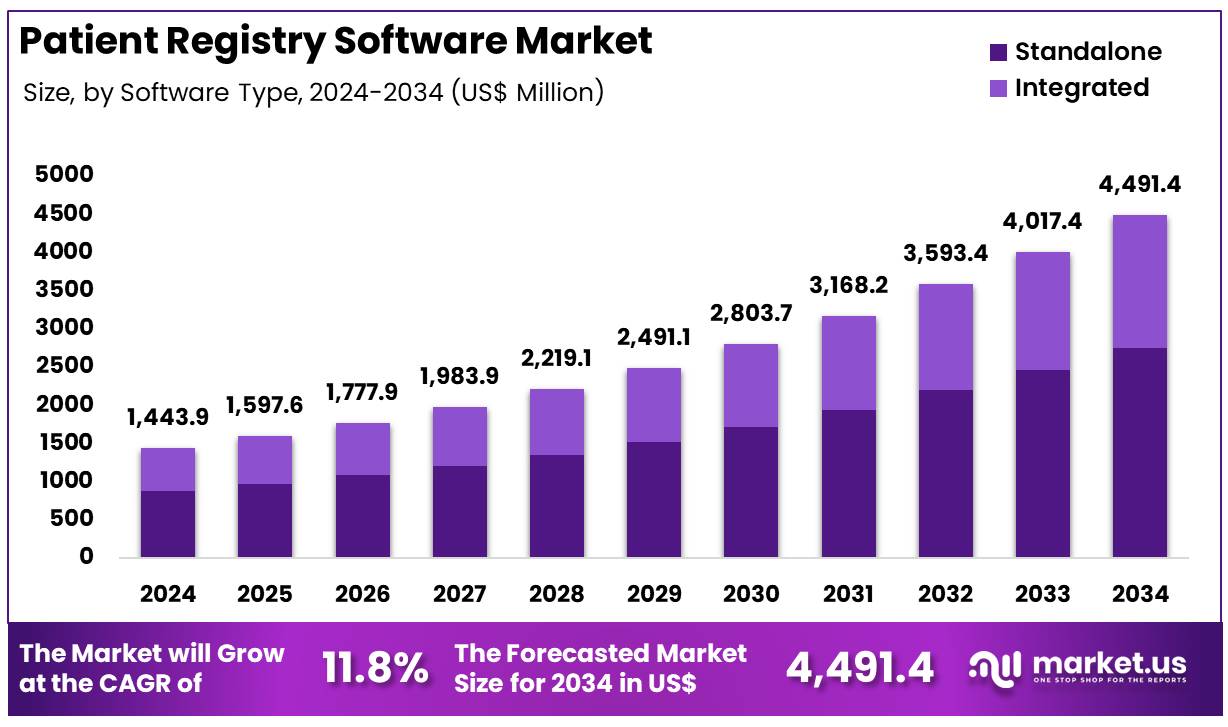
New York, NY – June 09, 2026 – Global Patient Registry Software Market was valued at US$ 1443.9 Million in 2024 and is expected to grow at a CAGR of 11.8% from 2024 to 2034. In 2024, North America led the market, achieving over 39.2% share with a revenue of US$ 566.0 Million.
Patient Registry Software is a specialized healthcare information management solution designed to collect, organize, store, and analyze patient data related to specific diseases, medical conditions, treatments, or population groups. The software enables healthcare providers, research organizations, pharmaceutical companies, and government agencies to maintain comprehensive patient databases that support clinical decision-making, disease surveillance, and long-term patient monitoring.
The growing emphasis on evidence-based medicine, personalized healthcare, and real-world data collection has increased the adoption of patient registry software across the healthcare ecosystem. These platforms facilitate the systematic capture of demographic, clinical, treatment, and outcomes data, helping stakeholders gain valuable insights into disease progression, treatment effectiveness, and patient care quality.
Advanced patient registry solutions often incorporate features such as electronic health record (EHR) integration, data analytics, reporting dashboards, regulatory compliance management, patient engagement tools, and secure cloud-based storage. These capabilities improve data accuracy, streamline workflows, and support clinical research initiatives.
Patient registry software plays a critical role in supporting observational studies, post-market surveillance, rare disease tracking, chronic disease management, and public health programs. The increasing prevalence of chronic diseases, rising healthcare digitization, and growing investments in healthcare IT infrastructure continue to drive market growth.
As healthcare organizations focus on improving patient outcomes and advancing clinical research, patient registry software is expected to remain an essential tool for efficient data management and population health monitoring worldwide.
Key Takeaways
- The global patient registry software market was estimated at USD 1,443.9 million in 2024 and is projected to reach USD 4,491.4 million by 2034, expanding at a CAGR of 11.8% during the forecast period.
- The disease registry segment accounted for the largest market share of 62.9% in 2024, driven by increasing demand for disease-specific patient data management and clinical research.
- Based on product type, the standalone segment dominated the market in 2024, capturing 61.3% of total revenue.
- By deployment mode, the on-premise segment held the highest revenue share of 69.5% in 2024, supported by strong preferences for data security and regulatory compliance.
- The commercial segment emerged as the leading end-user category, representing 63.5% of the global market revenue in 2024.
- North America remained the largest regional market, contributing more than 39.2% of the global revenue share in 2024, owing to advanced healthcare infrastructure and widespread adoption of healthcare IT solutions.
Regional Analysis
North America represents a prominent market for patient registry software, supported by the increasing focus on healthcare data management and digital health transformation across the region. Healthcare providers, hospitals, research institutions, and government agencies are investing in advanced technologies that enable efficient collection, storage, and analysis of patient information. Patient registry software has become an essential tool for consolidating clinical data, monitoring patient outcomes, supporting evidence-based decision-making, and improving the overall quality of care.
The widespread adoption of electronic health records (EHRs) and growing demand for real-world evidence have further accelerated the implementation of patient registry solutions. These platforms help healthcare organizations streamline workflows, enhance data accuracy, and facilitate long-term disease monitoring and population health management.
A key factor supporting market growth is the expansion of Health Information Exchanges (HIEs) across the United States and Canada. HIEs enable secure sharing of patient information among healthcare providers, improving care coordination and reducing data fragmentation. Patient registry software serves as a critical component of these systems by maintaining comprehensive and accessible patient records.
Furthermore, a 2022 publication titled “How A Clinical Data Registry Can Work With Your EHR” highlighted that data stored within clinical registries assists healthcare professionals in identifying effective treatment strategies for patients with similar diseases or medical conditions, thereby supporting improved clinical outcomes and informed healthcare decisions.
Emerging Trends
- Integration with Electronic Health Records (EHRs): Patient registry software is increasingly being connected directly with electronic health records, allowing patient information to flow automatically into registries. This reduces manual data entry, improves data accuracy, and helps healthcare providers maintain updated patient records. The FDA recognizes EHRs and registries as important sources of real-world data for healthcare decision-making.
- Growing Use of Real-World Evidence (RWE): Healthcare organizations are using registry data to generate real-world evidence for treatment effectiveness, safety monitoring, and regulatory decisions. The FDA has expanded the use of registry-based evidence in drug and medical device evaluations. Real-world data from disease registries is now considered a valuable complement to traditional clinical trials.
- Expansion of Rare Disease Registries: Rare disease registries are becoming more common because patient populations are often small and geographically dispersed. The NIH-supported Rare Diseases Registry Program (RaDaR) promotes standardized registry development to improve research and treatment discovery. Larger patient participation improves the quality and reliability of research outcomes.
- AI and Advanced Analytics Adoption: Artificial intelligence and machine learning are being incorporated into registry platforms to analyze large patient datasets, identify treatment patterns, predict outcomes, and improve clinical decision-making. AI-supported analysis helps healthcare organizations extract meaningful insights from growing volumes of registry data while reducing analysis time.
- Long-Term Patient Monitoring and Remote Data Collection: Modern registry platforms increasingly support long-term patient follow-up through mobile applications, wearable devices, and remote monitoring technologies. The FDA notes that patient registries can collect long-term outcome information and support continuous safety surveillance of medical products after approval.
Key Use Cases
- Disease Surveillance and Population Health Management: Healthcare organizations use patient registries to track disease prevalence, treatment outcomes, and population health trends. Registries help identify high-risk patient groups, monitor disease progression, and support public health initiatives. Standardized data collection enables healthcare providers to make evidence-based decisions for large patient populations.
- Medical Device and Drug Safety Monitoring: Patient registries are widely used to monitor the safety and performance of approved medical devices and therapies. For example, the FDA-supported Transcatheter Valve Therapy Registry contains data from more than 27,000 patients and tracks over 300 clinical data elements per participant.
- Clinical Research and Patient Recruitment: Registry software helps researchers identify eligible participants for clinical studies more efficiently. By maintaining structured patient information, registries accelerate patient recruitment, reduce study timelines, and improve research productivity. This is particularly valuable for rare diseases where eligible patients are difficult to locate.
- Outcome Measurement and Quality Improvement: Hospitals and healthcare systems use registries to compare treatment outcomes, evaluate care quality, and identify areas for improvement. Continuous outcome tracking allows providers to benchmark performance, improve clinical protocols, and enhance patient care delivery through data-driven quality initiatives.
- Regulatory and Post-Market Evidence Generation: Registry software supports regulatory submissions by providing real-world evidence regarding treatment effectiveness and safety. The FDA’s guidance on registry-based evidence highlights the growing role of patient registries in supporting post-approval studies, label expansions, and regulatory decision-making throughout a product’s lifecycle.
Frequently Asked Questions On Patient Registry Software
- How does Patient Registry Software support clinical research?
Patient Registry Software provides researchers with structured, real-world patient data that can be used to study disease progression, treatment effectiveness, and long-term health outcomes. It simplifies patient cohort identification, data collection, and reporting, enabling faster and more efficient clinical and observational research activities. - What features are commonly included in Patient Registry Software?
Common features include patient data management, electronic health record integration, analytics and reporting tools, patient tracking, data visualization, regulatory compliance support, customizable workflows, and secure cloud-based storage. These capabilities help organizations efficiently manage and analyze patient information across healthcare programs. - How does Patient Registry Software improve patient outcomes?
By enabling continuous monitoring of patient data and treatment responses, Patient Registry Software helps healthcare professionals identify trends, assess risks, and implement timely interventions. The resulting insights contribute to personalized treatment strategies, improved disease management, and better long-term patient outcomes. - Can Patient Registry Software integrate with other healthcare systems?
Yes, most Patient Registry Software platforms support integration with electronic health records, laboratory information systems, billing systems, and other healthcare technologies. These integrations facilitate seamless data exchange, reduce duplicate data entry, and improve operational efficiency across healthcare organizations. - Why is data analytics important in Patient Registry Software?
Data analytics enables healthcare organizations to identify trends, measure treatment outcomes, evaluate healthcare quality, and generate actionable insights. Advanced analytics tools help transform large volumes of patient data into meaningful information that supports clinical decisions, policy development, and research initiatives. - How is cloud technology influencing the Patient Registry Software Market?
Cloud-based deployment models are gaining popularity due to their scalability, lower infrastructure costs, remote accessibility, and simplified maintenance requirements. Healthcare organizations are increasingly adopting cloud solutions to improve operational flexibility, facilitate data sharing, and support growing registry data volumes. - Which regions are leading the Patient Registry Software Market?
North America holds a significant market share due to advanced healthcare infrastructure, strong technology adoption, and extensive clinical research activities. Europe also demonstrates substantial growth, while Asia-Pacific is emerging as a rapidly expanding market driven by healthcare digitalization initiatives. - What is the future outlook for the Patient Registry Software Market?
The market is expected to experience sustained growth due to increasing healthcare data generation, rising demand for patient-centered care, and expanding research activities. Continued advancements in analytics, interoperability, and cloud technologies are anticipated to support long-term market development.
Conclusion
The Patient Registry Software market is experiencing steady growth as healthcare organizations increasingly focus on data-driven decision-making, population health management, and evidence-based care. The rising adoption of electronic health records, growing demand for real-world evidence, and increasing prevalence of chronic and rare diseases are driving the need for advanced registry solutions.
Modern platforms offer enhanced capabilities such as EHR integration, cloud deployment, AI-powered analytics, and remote patient monitoring, improving both operational efficiency and clinical outcomes. As healthcare digitization continues to expand worldwide, patient registry software is expected to play a vital role in supporting research, regulatory compliance, disease surveillance, and long-term patient care management.