
Market Overview
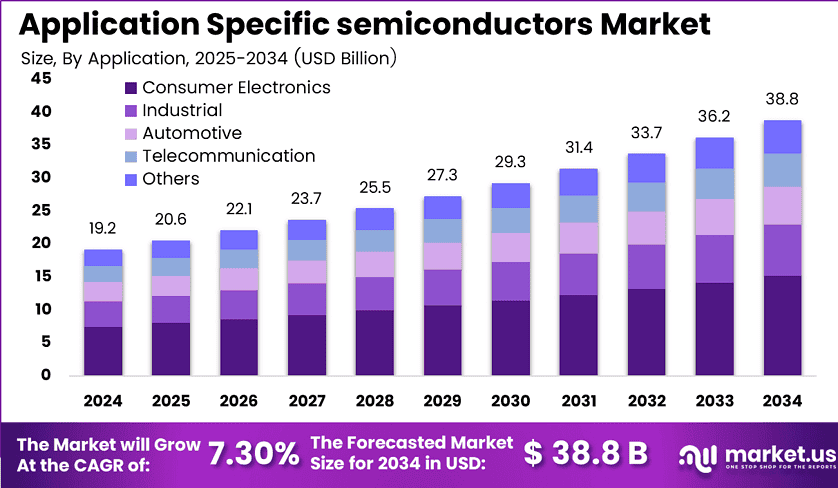
New York, NY – September 01, 2026 – The Global Application Specific Semiconductors Market reached USD 19.2 billion in 2024. Analysts expect this custom chip market to touch USD 38.8 billion by 2034, growing at a 7.3% CAGR. Rising demand for purpose-built silicon explains this steady climb across many industries. Asia Pacific captured more than 46.2% of the market in 2024, earning nearly USD 8.87 billion.
Global chip sales hit a record USD 630.5 billion in 2024, rising 19.1% over 2023. This jump shows strong buyer appetite for advanced components. Moreover, industry sales may near USD 701 billion in 2025. Therefore, tailored semiconductor suppliers gain a much wider revenue base to sell into.
The Americas generated close to USD 195.1 billion in chip sales during 2024. This figure reflects heavy regional spending on advanced and customized designs. Additionally, carmakers built roughly 92.7 million vehicles in the same year. Each vehicle now carries more electronic content, so demand for dedicated automotive chips keeps rising.
Connected devices reached about 18.5 billion units worldwide in 2024, a 12% gain over the previous year. This growth spreads across cars, factory sensors, smart homes, and medical tools. Consequently, device makers need low-power custom chips. This widening installed base supports the market path toward USD 38.8 billion.
Key Takeaways
- The Global Application-Specific Semiconductors Market stood at USD 19.2 billion in 2024 and should reach USD 38.8 billion by 2034 at a 7.3% CAGR.
- Semi-Custom ASIC led the product segment with a 51.4% share, helped by faster design cycles and lower development risk.
- Consumer Electronics led the application segment with a 39.1% share, driven by high-volume smart device production.
- Asia Pacific held more than 46.2% share in 2024 and generated about USD 8.87 billion in revenue.
➤ Evaluate the Report Quality with an Exclusive Sample Download – https://market.us/report/application-specific-semiconductors-market/request-sample/
Market Segmentation
By Product
Semi-Custom ASIC dominates with a 51.4% share because it balances speed, cost, and product fit. Designers reuse proven blocks such as processor cores, memory links, and input-output functions. Then they add device-specific features. Consequently, teams cut design work and reduce the risk of costly respins.
Frequent product refreshes in phones, laptops, and network gear also lift this segment. Global semiconductor sales reached USD 791.7 billion in 2025, while logic products alone contributed USD 301.9 billion. These figures show a large buyer base for chips that handle computing and control tasks.
Programmable ASIC grows fastest because customers want flexibility after production starts. Engineering teams update functions in the field, test new features, and shorten launch schedules. Moreover, 5G reached 36% of mobile broadband subscriptions in 2025. Equipment makers therefore adopt programmable designs to add network functions without a full redesign.
By Application
Consumer Electronics leads with a 39.1% share because smart devices ship in very high volumes. Semi-custom and full custom chips combine processing, graphics, camera, wireless, and power functions in small packages. Additionally, internet users reached 6 billion in 2025, growing by over 240 million people, which sustains device demand.
Automotive ranks as the fastest-growing application. Carmakers add driver support tools, displays, safety controls, and electric power systems to every model. Electric car sales passed 17 million units in 2024, rising over 25%. Therefore, suppliers win more designs in battery control, power conversion, sensing, and in-car computing.
Regional Analysis
Asia Pacific holds the strongest position, generating about USD 8.87 billion in 2024. Industrial automation, connected vehicles, and smart city programs in China, Japan, and India drive this demand. Furthermore, China should grow from USD 4.9 billion in 2024 to USD 11.0 billion by 2034, at an 8.4% CAGR.
North America remains the main innovation hub for custom silicon. The region hosts leading chip designers, deep design ecosystems, and heavy research budgets. Moreover, AI processors, cloud computing, and defense-grade parts lift regional volumes. Europe holds a stable share, supported by vehicle electronics and factory automation demand.
Drivers
AI accelerator and data center chip adoption adds an estimated 2.4% to forecast CAGR. Large cloud operators now shift from general-purpose GPUs toward custom accelerators built for specific AI workloads. This move improves performance per watt. Consequently, in-house silicon programs expanded quickly through 2024 and 2025.
Electric vehicle and driver assistance content contributes about 1.3% to growth. Each new safety or powertrain system needs chips that meet strict heat and reliability rules. Additionally, advanced fab expansion programs can exceed USD 20 billion in capital spending. Such investment secures the capacity that these vehicle programs require.
Use Cases
Cloud operators deploy custom accelerators to run large AI training and inference tasks. These chips process fixed workloads more efficiently than general-purpose hardware. Therefore, operators lower energy use per query and improve rack density. Networking ASICs then move data between servers with low delay and predictable throughput.
Vehicle makers use dedicated chips across zonal controllers, sensors, displays, and battery systems. These parts manage power conversion, monitor cell health, and support driver assistance features. Moreover, industrial buyers apply similar designs in factory controls, robotics, and medical monitors, where reliability matters more than raw flexibility.
Business Opportunities
Chiplet-based integration opens a strong licensing opportunity for design houses. Suppliers split a large chip into reusable blocks, then license those blocks across many customer programs. Consequently, they cut mask and engineering costs, improve manufacturing yield, and serve smaller buyers who cannot fund full custom development.
Sovereign AI infrastructure programs create another route to growth. Governments in the Middle East, Europe, and Asia Pacific now fund national compute capacity. Additionally, automotive zonal architecture redesigns invite fresh silicon wins. Domestic packaging services and industrial custom silicon acquisitions further widen the revenue mix for established vendors.
Major Challenges
A skilled engineering shortage remains the toughest challenge. Hiring demand outpaces the supply of qualified graduates, especially in North America and Europe. Moreover, retirements remove deep process knowledge from design and fab teams. Companies answer with vocational partnerships, skills-based hiring, and more automation, yet training costs rise first.
Advanced packaging capacity also limits delivery schedules. Custom chip programs compete for the same assembly lines, so lead times stretch. Additionally, rising mask and design costs push smaller buyers out of leading-edge nodes. Fragmented export compliance rules add legal work and slow cross-border product launches.
Top Key Players in the Market
- Intel Corporation
- ASIX Electronics
- OmniVision Technologies, Inc.
- Semiconductor Components Industries, LLC
- Seiko Epson Corporation
- DWIN Technology
- Socionext America Inc.
- Tekmos Inc.
- Broadcom Inc.
- STMicroelectronics
- Faraday Technology Corporation
- FUJITSU
- Infineon Technologies AG
- Comport Data
- Others
Conclusion
The application specific semiconductors market shows steady, broad-based growth through the forecast period. Semi-custom designs lead product demand, while consumer electronics leads end-use volumes. Asia Pacific keeps its regional lead, and North America drives design innovation. However, talent gaps, packaging limits, and trade rules test suppliers. Therefore, firms that invest in reusable silicon and skills will gain the most.
Discuss your needs with our analyst
Please share your requirements with more details so our analyst can check if they can solve your problem(s)