
Market Overview
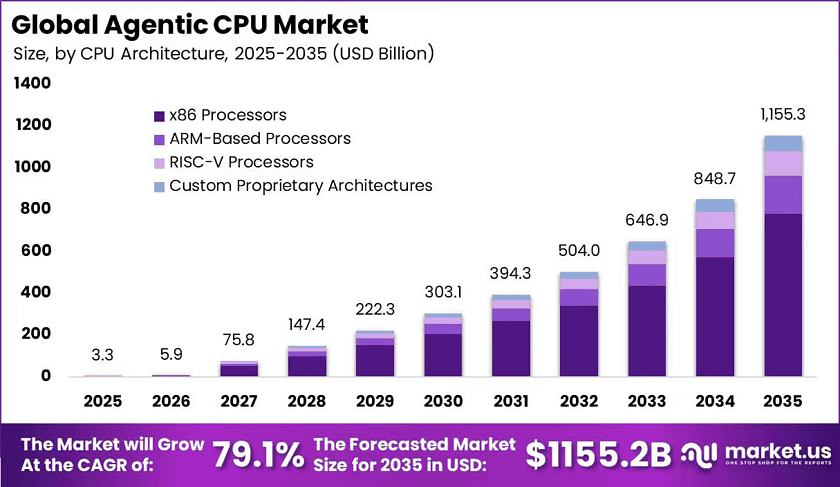
New York, NY – September 07, 2026 – The Global Agentic CPU Market reached USD 3.3 billion in 2025. Analysts expect the market to grow at a CAGR of 79.1% between 2026 and 2035. Consequently, revenue could reach about USD 1,155.2 billion by 2035, as autonomous AI agents move into daily business work.
North America led the global market in 2025 with more than 46.5% share and roughly USD 1.5 billion in revenue. Strong hyperscale infrastructure and deep chip design talent explain this lead. Therefore, regional suppliers win early access to large agentic computing contracts.
Data centre power use shows the scale of this shift. Global data centre electricity consumption reached 415 TWh in 2024 and may nearly double to 945 TWh by 2030. Moreover, accelerated server demand is growing by close to 30% yearly, which directly lifts processor orders.
Semiconductor sales rose from USD 630.5 billion in 2024 to a record USD 791.7 billion in 2025, a gain of 25.6%. Logic chip sales, which include CPUs, jumped 39.9% to USD 301.9 billion. Consequently, chipmakers add capacity for agentic workloads.
AI spending now moves the wider economy. AI-related investment added about 1.16 to 1.3 percentage points to U.S. real GDP growth in 2025. Additionally, U.S. data centre electricity use climbed 17%, well above total demand growth of 3%. Therefore, processor budgets keep expanding.
Key Takeaways
- The Agentic CPU Market stands at USD 3.3 billion in 2025 and may reach USD 1,155.2 billion by 2035 at a CAGR of 79.1%.
- x86 processors dominated the CPU architecture segment with a 67.5% share, while ARM-based processors grew the fastest.
- Cloud data centres held a 51.9% share of the deployment environment segment, while enterprise data centres grew fastest.
- AI copilots and digital agents led applications with a 27.4% share, while AI agent orchestration grows fastest.
- Hyperscale cloud providers held a 39.6% share among end users, while AI model developers grew the fastest.
- North America led the market with a 46.5% share and USD 1.5 billion in revenue in 2025.
➤ Download a Complimentary Sample of This Premium Report (Full TOC Included) – https://market.us/report/agentic-cpu-market/request-sample/
Market Segmentation
By CPU Architecture
x86 processors led this segment with a 67.5% share. Most enterprise servers and software already run on x86, so migration costs stay low. Moreover, ARM-based processors grow fastest, helped by 30.6 billion Arm chip shipments in fiscal 2025 and stronger energy efficiency per watt.
By Deployment Environment
Cloud data centres captured 51.9% of deployment demand, backed by hyperscale expansion. Amazon spent about USD 131 billion on data centre capital projects in 2025. However, enterprise data centres grow fastest because firms want lower latency, tighter data control, and clearer compliance for sensitive workloads.
By Application
AI copilots and digital agents led applications with a 27.4% share. These assistants answer requests and run inference all day, which raises steady processing needs. Meanwhile, AI agent orchestration grows fastest, as companies connect many agents instead of running single, isolated tools.
According to the OECD 2026 D4SME Survey, enterprise-wide agentic AI adoption reaches only 3.6%. Yet these deployments report transformational impact rates of 23%, against 2% for isolated AI use. Consequently, early adopters gain a measurable performance advantage over slower rivals.
By End User
Hyperscale cloud providers held 39.6% of end-user demand because they control the largest compute estates. Four major hyperscalers plan combined AI infrastructure spending above USD 700 billion. Therefore, every added gigawatt of capacity converts directly into fresh server and processor purchases.
AI model developers form the fastest-growing user group. OpenAI spent about USD 34 billion in 2025, including roughly USD 7.5 billion on inference computing. Moreover, Anthropic committed nearly USD 200 billion to Google Cloud over 5 years, signalling sustained compute demand.
Regional Analysis
North America held a 46.5% share and about USD 1.5 billion in revenue in 2025. U.S. data centre electricity use rose 17%, nearly 6 times faster than total demand growth of 3%. Therefore, the region remains the main hub for processor design and deployment.
Asia Pacific grows fastest, supported by heavy construction and chip investment. The regional data centre pipeline hit a record 26.5 GW in H1 2026, while regional investment reached USD 11.6 billion in 2025. Additionally, Japan raised its semiconductor budget to about USD 7.9 billion.
Drivers
AI data-centre buildout drives the largest share of current demand. Agentic systems need constant inference, memory handling, and orchestration, not one-time training runs. The International Energy Agency reports a 17% rise in data centre power use in 2025. Consequently, buyers shift toward continuous cluster expansion.
Enterprise agent adoption forms the second strong driver. Microsoft reported that 46% of surveyed leaders already use AI agents to automate full workflows. Moreover, 82% expect digital labour to widen workforce capacity soon. Therefore, companies buy more processor capacity for always-on agent workloads.
Use Cases
Enterprises deploy agentic processors for customer service and back-office automation. Digital agents read requests, check records, and complete routine steps without human handoffs. Moreover, finance and insurance teams use the same systems for document review. Therefore, service desks handle heavier volumes with steady response quality.
Software and research teams apply agentic computing to code generation and scientific analysis. Agents write tests, review pull requests, and run repeated simulations overnight. Additionally, factories and hospitals use local agent appliances for monitoring and quality checks. Consequently, technical teams shorten project cycles and reduce manual effort.
Business Opportunities
Agentic edge appliances open a clear growth path outside central data centres. Factories, hospitals, retail chains, and telecom sites need local, low-latency processing. Moreover, vendors can bundle processors, security, orchestration software, and maintenance. Therefore, integrated appliance sales support better margins than component-only supply models.
Sovereign AI platforms create a second strong opening across Europe, the Middle East, and Asia Pacific. Governments want national control over models, data, and hosting locations. Additionally, public agencies prefer trusted local suppliers. Consequently, chip vendors and cloud partners can win long-term national programmes.
Major Challenges
Power supply limits remain the hardest barrier for this market. Processor orders turn into revenue only after sites secure generation, transmission, and grid connection. Moreover, operators must add liquid cooling and on-site power. Therefore, commissioning timelines stretch even when customer demand stays very strong.
Trade restrictions and packaging concentration create further pressure. Export rules limit where advanced processors and servers can ship, while advanced packaging capacity sits in a few locations. Additionally, software porting between architectures slows migration. Consequently, buyers delay decisions and suppliers carry higher compliance costs.
Top Key Players in the Market
- NVIDIA Corporation
- Intel Corporation
- Advanced Micro Devices, Inc.
- Qualcomm Incorporated
- Arm Holdings plc
- Apple Inc.
- Amazon Web Services, Inc.
- Google LLC
- Microsoft Corporation
- Oracle Corporation
- Ampere Computing
- International Business Machines Corporation (IBM)
- Alibaba Group
Conclusion
The Agentic CPU Market moves into a strong growth phase as agent-based software spreads across business operations. North America leads today, while Asia Pacific expands fastest through new data centre capacity. Moreover, cloud providers and model developers anchor demand. However, power access and trade rules still shape delivery timelines. Therefore, vendors must align capacity plans with grid and policy conditions.
Discuss your needs with our analyst
Please share your requirements with more details so our analyst can check if they can solve your problem(s)