
Market Overview
New York, NY – September 08, 2026 – The Global AI Inference Market reached USD 108.05 billion in 2025. Analysts expect it to reach USD 513.1 billion by 2035, growing at a 16.6% CAGR. North America led the market in 2025 with a 40.9% share and about USD 44.1 billion in revenue. Companies now run trained models daily, which lifts steady demand for inference computing. Moreover, energy-efficient infrastructure now shapes buying decisions.
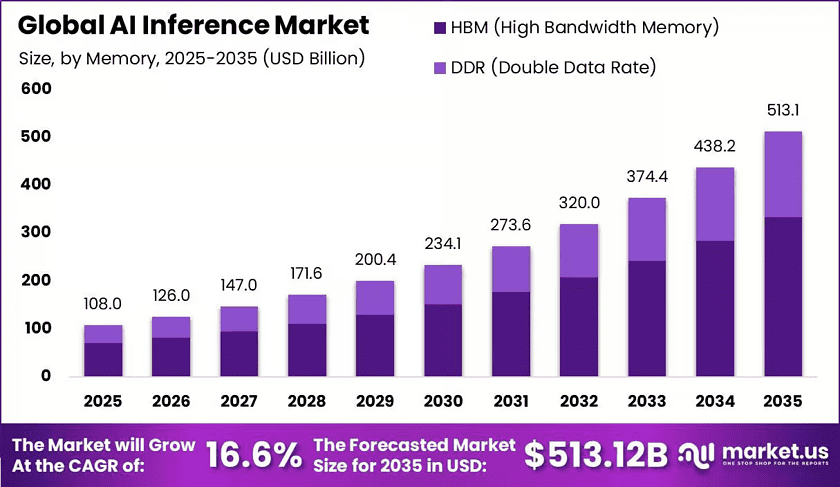
Businesses move AI from pilot projects into everyday operations. Inference lets models answer questions, read images, detect fraud, and guide decisions. Consequently, demand rises for AI chips, cloud capacity, model-hosting platforms, servers, and energy-efficient facilities. This shift turns AI spending into a recurring infrastructure cost, so buyers plan capacity years ahead.
According to Stanford University, global private generative AI investment reached USD 33.9 billion in 2024, up 18.7% year over year. Investors fund model builders and serving platforms. Therefore, more production models enter the market and create steady inference workloads. U.S. private AI investment also reached USD 109.1 billion in 2024.
Stanford University also reports that processing 1 million tokens at GPT-3.5-level quality fell from USD 20 in November 2022 to USD 0.07 by October 2024, a drop of over 280 times. Cheaper output lets firms serve far more users. Additionally, low prices push AI into mass-market products.
Key Takeaways
- The AI inference market reached USD 108.05 billion in 2025 and should reach USD 513.12 billion by 2035, at a 16.6% CAGR.
- By compute, GPUs led with a 51.55% share, while Other ASICs formed the fastest-growing device segment.
- By memory, HBM led with a 65.0% share, while DDR grew fastest.
- By deployment, edge inference led with a 71% share and also grew fastest.
- By application, machine learning led with a 36.85% share, while generative AI grew fastest.
- By end user, IT and telecommunications led with a 26.10% share, while manufacturing grew fastest.
- North America led in 2025 with a 40.9% share and USD 44.19 billion in revenue.
➤ Preview Key Insights with an Exclusive Sample Report Download – https://market.us/report/ai-inference-market/request-sample/
Market Segmentation
GPUs led the compute segment with a 51.5% share, helped by strong parallel processing and mature software support. GPUs handle language, vision, speech, and recommendation work on shared systems. Therefore, cloud providers reuse the same hardware as models, data sizes, and business needs keep changing.
Other ASICs grow fastest, because purpose-built chips cut power use and cost per query. According to Google Cloud, its Trillium TPU delivers 4.7 times higher peak compute per chip than TPU v5e. Consequently, large repeat workloads shift to dedicated accelerators, which lowers long-term serving costs.
HBM dominated the memory segment with a 65.0% share, since large models need very high bandwidth. Micron’s HBM3E supplies more than 1.2 TB/s per stack, which shortens response delays. However, DDR grows fastest, because servers also need large, lower-cost capacity for caching and multi-user tasks.
Edge inference led deployment with a 71% share and also grew fastest. Cameras, robots, vehicles, and phones analyse data locally, which cuts latency, bandwidth bills, and privacy risk. Moreover, GSMA reports global 5G connections passed 2 billion in 2024, so local processing now reaches more devices.
Machine learning held a 36.8% application share through fraud detection, forecasting, and quality checks. These jobs run continuously, so they create predictable inference demand. However, generative AI grows fastest, because Stanford University found 71% of organisations used it in at least one business function during 2024.
IT and telecommunications led end users with a 26.1% share. The ITU counted 5.5 billion internet users in 2024, or 68% of the world population, which raises traffic, support, and security workloads. Additionally, manufacturing grows fastest as plants adopt machine vision and predictive maintenance.
Regional Analysis
North America led the market in 2025 with a 40.9% share and roughly USD 44.1 billion in revenue. Stanford University reports that U.S. institutions built 40 notable AI models in 2024. Therefore, local model development feeds constant commercial inference demand across search, coding, and fraud tools.
Asia Pacific should grow fastest, supported by cloud expansion, factory automation, and rising digital use. The OECD expects Southeast Asian data-centre capacity demand to rise about 3 times between 2023 and 2030, while AI-compute demand may rise 10 times. Consequently, regional spending on accelerators and memory climbs sharply.
Drivers
Enterprise AI production rollout drives growth most strongly, because live models create recurring inference calls. Stanford University reports that 78% of surveyed organisations used AI in 2024, up from 55% in 2023. Therefore, this shift may add about +3.1% to the 16.6% baseline CAGR.
Cloud inference capacity expansion supports the second driver, worth about +2.4% extra CAGR. Eurostat reports that 20.0% of EU enterprises with at least 10 employees used AI in 2025, up 6.5 points. Consequently, providers add regional serving capacity to meet this rising business demand.
Use Cases
Banks and retailers use inference for fraud checks, credit scoring, and product recommendations. Models score each transaction or click within milliseconds, so speed matters more than training power. Therefore, these firms buy low-latency accelerators, fast memory, and reliable serving software for always-on customer platforms.
Factories and telecom operators apply inference to machine vision, defect checks, and network monitoring. Local processors inspect parts, guide robots, and flag faults without sending data to distant clouds. Moreover, operators tune network capacity in real time, which improves service quality and reduces downtime costs.
Business Opportunities
Sovereign AI inference platforms open a large opportunity, because many countries lack locally controlled serving infrastructure. New European rules for general-purpose model providers raise documentation and transparency duties. Therefore, vendors can sell regional hosting, auditable pipelines, and compliant model-serving services to governments and regulated industries.
Inference optimisation software and vertical appliances offer a second opening. Compression, batching, and caching tools stretch existing hardware, so buyers get more output per server. Additionally, ready-made appliances for healthcare, retail, and manufacturing shorten deployment time and attract customers with small technical teams.
Major Challenges
Power and cooling limits remain the biggest challenge, because new capacity depends on grid access. Utilities face long connection queues, while liquid cooling raises project complexity and cost. Consequently, operators delay builds, and inference buyers wait longer for promised accelerator and server capacity.
Memory supply concentration and skills shortages add further pressure. Few suppliers make advanced memory, so shortages quickly raise prices and delay shipments. Moreover, fragmented software stacks and scarce optimisation talent slow deployment, which pushes some enterprises toward managed services instead of in-house inference platforms.
Top Key Players in the Market
- Amazon Web Services, Inc.
- Arm Limited
- Advanced Micro Devices, Inc.
- Google LLC
- Intel Corporation
- Microsoft Corporation
- Mythic Inc.
- NVIDIA Corporation
- Qualcomm Incorporated
- Sophos Ltd.
- SK Hynix Inc.
- Samsung
- Cerebras Systems Inc.
- Groq Inc.
- Huawei Technologies Co., Ltd.
- d-Matrix Corp.
- Untether AI Corporation
- Esperanto Technologies Inc.
- IBM Corporation
- Meta Platforms, Inc.
Conclusion
The AI inference market keeps expanding as companies run trained models inside daily operations. GPUs, high-bandwidth memory, and edge deployment shape current demand, while generative AI and manufacturing lead future growth. North America holds the largest position, and Asia Pacific grows quickest. However, power limits, supply concentration, and export rules still test suppliers and buyers alike.
Discuss your needs with our analyst
Please share your requirements with more details so our analyst can check if they can solve your problem(s)