
Market Overview
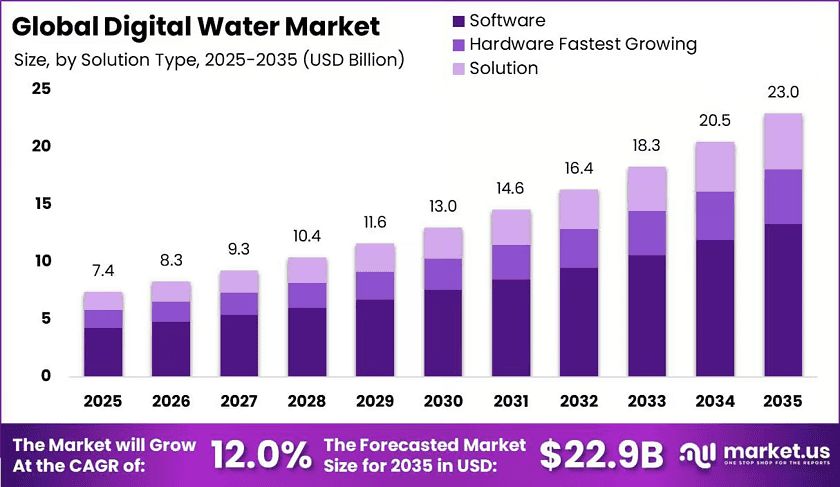
New York, NY – September 15, 2026 – The Global Digital Water Market reached USD 7.4 billion in 2025. Analysts expect this market to reach USD 22.9 billion by 2035, growing at a 12.0% CAGR. North America led the global market in 2025 with more than a 39.0% share. The region generated close to USD 2.8 billion in revenue. Rising water scarcity drives demand for smart water management technology.
Water stress remains the core growth trigger. Around 2.2 billion people still lack safely managed drinking water. Moreover, nearly 4 billion people face severe scarcity for at least one month each year. These service gaps push governments toward data-led water operations.
Drought causes more than USD 307 billion in yearly economic losses. Such damage forces utilities to find leaks and manage pressure early. Therefore, buyers invest in smart meters, digital sensors, real-time monitoring, and automated controls. These tools protect supply and cut avoidable waste.
Closing the global water investment gap needs an extra USD 131 billion to USD 141 billion every year through 2030. Additionally, multilateral development banks approved USD 19.6 billion for water-sector financing in 2024. This funding flow supports steady spending on connected water infrastructure.
Key Takeaways
- The Digital Water Market holds a value of USD 7.4 billion in 2025 and should reach USD 22.9 billion by 2035 at a 12.0% CAGR.
- Software dominated the market with a 58.0% share, driven by the need to reduce non-revenue water losses.
- IoT and Advanced Analytics led the technology segment with a 35.1% share, supported by rising demand for water-efficiency solutions.
- Municipal users held the largest end-user share at 64.0%, driven by urbanization and pressure on aging city water networks.
- North America led the market with a 39.0% share and generated around USD 2.8 billion in revenue in 2025.
➤ Grab the Exclusive Preview of This Premium Research Report Now – https://market.us/report/digital-water-market/request-sample/
Market Segmentation
By Solution Type
Software captured a dominant 58.0% share because utilities must control non-revenue water losses. Networks lose nearly 126 billion cubic metres yearly, worth about USD 40 billion. That lost revenue makes billing, leak, and pressure analytics an easy business case for operators.
Hardware ranks as the fastest-growing device segment. Digital platforms depend on smart meters, sensors, and IoT flow monitors for live data. Moreover, the yearly funding gap of USD 131.4 billion to USD 140.8 billion pushes utilities to fund physical monitoring assets alongside software licences.
By Technology
IoT and advanced analytics held a 35.1% share as farms chase better water efficiency. Agriculture withdraws about 2,673 cubic kilometres yearly, yet requirement efficiency sits near 56%. Consequently, connected sensors across more than 307 million irrigated hectares help users spot waste early.
By End-User
Municipal utilities held a commanding 64.0% share. Roughly 4 billion people, near 55% of the world population, now live in cities. This density raises demand for reliable supply, billing accuracy, and leak control across aging pipe networks.
Industrial buyers form the fastest-growing end-user group. Factory water use could climb toward 22% of global freshwater withdrawals. Therefore, plants need continuous control of cooling, cleaning, production, and wastewater flows. Accurate metering also helps manufacturers meet tighter discharge and quality rules.
Regional Analysis
North America led with a 39.0% share and about USD 2.8 billion in 2025 revenue. In FY2026, the US EPA allocated USD 7.1 billion through State Revolving Fund grants. This public money lowers project risk and speeds utility technology upgrades.
Canada committed USD 115 billion over five years, including USD 54 billion for core infrastructure. Additionally, the EPA plans to mobilize USD 45 billion in non-federal capital by September 2026. Such blended finance widens the buyer base for monitoring and automation platforms.
Europe now grows fastest, helped by strong EU water funding. Cohesion Policy directs around EUR 16.9 billion to water projects through 2027, with roughly EUR 13.2 billion from EU funds. Consequently, demand rises for water-quality sensors, analytics tools, and digital reporting systems.
Drivers
Loss-reduction mandates drive the strongest growth, adding about 2.8% to market CAGR. Utilities using pressure management and leak analytics reported billing recovery gains of 8% to 12%. Better recovery funds further digital spending, creating a repeatable investment cycle for operators.
Utilities also shift from hardware purchases to software subscriptions, contributing near 2.3% CAGR. Software gross margins reach 65% to 72%, against 35% to 40% for hardware deals. Therefore, vendors push cloud analytics, which improves recurring revenue and payback speed.
Use Cases
City utilities apply digital platforms to find hidden pipe leaks fast. Smart meters flag unusual night flow, and analytics rank repair priority. Consequently, crews fix the costliest faults first. Customers also receive alerts about household leaks before bills rise sharply.
Industrial plants use connected monitoring to control process water and effluent quality. Sensors track cooling loops, cleaning cycles, and treatment performance in real time. Moreover, dashboards support reuse decisions and regulatory reporting. Managers therefore cut water purchases without slowing production lines.
Business Opportunities
Predictive maintenance offers the clearest untapped opening. Most analytics still serve reactive leak alerts and billing checks. However, outcome-based pricing linked to avoided failures could lift service margins. Vendors that pool utility data can also train stronger failure models.
Decentralized systems and industrial reuse platforms open a second path. Emerging-market utilities need modular treatment with remote supervision instead of large central plants. Additionally, water-scarce industrial regions reward circular reuse services. Cross-utility data consortiums may unlock further shared value later.
Major Challenges
Talent shortages slow adoption across mature markets. Utilities struggle to fill data-analytics and operational cybersecurity roles, so projects wait for trained operators. Consequently, vendors bundle managed services, training, and remote support to keep deployments moving and protect customer confidence.
Legacy systems create a second barrier. Older SCADA environments resist integration, which complicates data sharing across pumps, meters, and treatment assets. Moreover, connected networks widen cyber risk, and fragmented utility ownership delays decisions. Procurement rules in some regions also block subscription contracts.
Top Key Players in the Market
- Schneider Electric
- Xylem Inc.
- Veolia
- Siemens AG
- ABB
- Bentley Systems
- Innovyze
- Copperleaf Technologies Inc.
- SUEZ
- Itron
- Honeywell
- General Electric
- Autodesk
- Tetra Tech, Inc.
- Jacobs Engineering Group
- WSP
- Hatch Ltd.
- Sweco AB
- Eviden
- Atonix Digital
- Analytical Technology Inc.
Conclusion
The digital water market moves from pilot projects toward standard utility practice. Water stress, aging pipes, and public funding push buyers toward software, smart meters, and connected sensors. Municipal operators lead adoption, while industrial users grow fastest. However, tariffs, skills gaps, and legacy systems still slow delivery. Vendors offering analytics, integration, and managed services should capture the strongest long-term demand.
Discuss your needs with our analyst
Please share your requirements with more details so our analyst can check if they can solve your problem(s)