
Market Overview
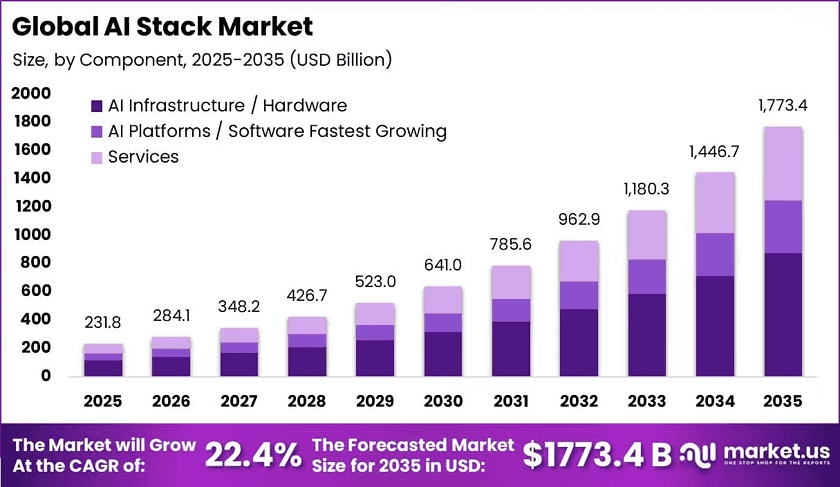
New York, NY – September 09, 2026 – The Global AI Stack Market reached USD 231.8 billion in 2025. Analysts expect the market to grow at a 22.4% CAGR from 2026 to 2035. Consequently, revenue could reach nearly USD 1,773.4 billion by 2035. North America led the global market in 2025 with a 45.8% share and about USD 106.2 billion in revenue.
Growth spans AI chips, cloud infrastructure, data platforms, foundation models, development tools, and business applications. According to the IEA, data-centre electricity use reached about 415 TWh in 2024 and may near 945 TWh by 2030. Moreover, this doubling signals heavy new demand for AI servers, storage, and power systems.
According to Stanford University’s AI Index, global private AI investment hit USD 344.7 billion in 2025, up 127.5% in one year. Around USD 143.2 billion went into infrastructure, models, research, and governance. Additionally, this funding pattern shows buyers now treat AI as core operating capacity.
U.S. private AI investment reached USD 109.1 billion in 2024, nearly 12 times China’s USD 9.3 billion. The United States also used about 45% of global data-centre electricity. Consequently, AI-focused sites can need over 100 MW of power, compared with 10–25 MW for standard facilities.
Key Takeaways
- The Global AI Stack Market reached USD 231.8 billion in 2025 and may hit USD 1773.4 billion by 2035 at a 22.4% CAGR.
- AI Infrastructure and Hardware led the market with a 49.5% share, driven by demand for GPUs, servers, storage, networking, and power systems.
- Cloud-Based Deployment dominated with a 51.9% share, supported by scalable access to AI computing, storage, models, and development tools.
- Infrastructure Layer held a 34.5% share, as chips, servers, networking, cooling, and power equipment form the base of AI systems.
- Machine Learning led with a 30.8% share, supported by forecasting, fraud detection, predictive maintenance, and recommendation systems.
- Customer Service and Chatbots accounted for a 23% share, driven by automation of customer queries, service requests, and support work.
- IT and Telecommunications led with a 24.5% share, supported by AI use in network management, cloud workloads, cybersecurity, and connected services.
- North America led the market in 2025 with a 45.8% share, generating about USD 106.2 billion in revenue.
➤ Download the Detailed Sample Report with TOC, Tables, and Visual Figures – https://market.us/report/ai-stack-market/request-sample/
Market Segmentation
By Component
AI infrastructure and hardware led the market with a 49.5% share. Buyers spend heavily on GPUs, accelerators, servers, high-bandwidth memory, storage, networking, cooling, and power gear. Therefore, this layer earns the largest revenue, because model training needs physical capacity first.
AI platforms and software should grow fastest. Companies now need tools for model building, testing, deployment, governance, and monitoring. Consequently, spending shifts toward recurring cloud services and model-management suites. This move also spreads AI costs across yearly budgets instead of large one-time purchases.
By Deployment
Cloud-based deployment held a 51.9% share because firms rent computing, storage, models, and tools instead of building data centres. In 2025, about 52.74% of EU enterprises with ten or more staff paid for cloud services. Therefore, a wide cloud base already supports AI adoption.
On-premises deployment grows fastest, as large firms and public agencies demand tighter data control and faster response. The UK Government has pledged up to £2 billion for national computing. This includes over £1 billion to expand its AI Research Resource 20 times by 2030.
By Stack Layer
The infrastructure layer held a 34.5% share because chips, servers, storage, networking, cooling, and power must exist before models run. U.S. developers plan a record 86 gigawatts of new generating capacity in 2026. Consequently, this power buildout keeps infrastructure the biggest spending layer.
The model layer grows fastest, as new foundation models arrive quickly. According to Stanford HAI, industry released 87 of 94 notable AI models in 2025. Moreover, this industry lead shows private labs fund most training work, which lifts demand for tuning and licensing.
By Technology Type
Machine learning led with a 30.8% share, supported by fraud detection, demand forecasting, predictive maintenance, and recommendations. These models read normal business data with ease. Therefore, buyers keep paying for data pipelines, training runs, inference capacity, and monitoring tools.
Generative AI grows fastest because it creates text, code, images, and summaries. According to Stanford HAI, 71% of surveyed organizations used it in one business function in 2024, against 33% in 2023. Additionally, this jump shows fast movement from trials into daily work.
By Application
Customer service and chatbots led with a 23% share. These assistants handle account requests, order updates, and service issues at any hour. U.S. Census Bureau research placed virtual agents at 21.6% adoption among AI-using firms, which signals steady demand for hosting and integration software.
Content generation grows fastest, as teams create marketing copy, reports, training material, and software code with AI. U.S. Census Bureau data showed sales and marketing as the top AI function, used by 52% of adopting firms. Consequently, vendors see rising demand for writing and document tools.
By End-User Industry
IT and Telecommunications led with a 24.5% share. According to the ITU, 6 billion people, or 74% of the world population, used the internet in 2025, while mobile subscriptions reached 9.1 billion. Therefore, operators need AI for traffic management, fault detection, and security.
BFSI grows fastest, as banks and insurers apply AI to fraud checks, credit scoring, claims, and compliance. The World Bank reported that 61% of adults in low- and middle-income economies used digital payments in 2024. Consequently, richer transaction data creates more work for AI systems.
Regional Analysis
North America dominated the market in 2025 with a 45.8% share and about USD 106.2 billion in revenue. Stanford’s AI Index reported 40 notable models from U.S. institutions in 2024. Therefore, local innovation keeps demand strong across servers, cloud services, and enterprise software.
Asia Pacific should grow fastest across all regions. The World Bank reported Vietnam’s AI-related exports rising from about 20% of GDP in 2023 to nearly 32% in 2025, while Malaysia moved from 28% to 34%. Consequently, supply chains and local-language demand lift regional adoption.
Drivers
Hyperscale compute buildout drives the strongest growth. Training and inference need GPUs, fast networking, storage, cooling, and power. NVIDIA reported Data Center revenue of USD 193.7 billion in FY2026, up 68%. This surge shows sustained capacity funding, adding roughly 3.2% to baseline growth.
Enterprise AI deployment adds further momentum. European Union statistics show enterprise AI adoption at 19.95% in 2025, up 6.47 percentage points in one year. Moreover, large enterprises reached 55.03%, which means bigger budgets now fund production systems rather than small pilots.
Use Cases
Support teams use AI assistants to answer routine customer questions, check order status, and update account details. These tools work around the clock and pass difficult cases to human agents. Therefore, service teams handle heavier volumes without adding proportional staff.
Software teams use AI helpers to draft code, review changes, and write documentation. Marketing groups apply the same models to product descriptions, campaign copy, and internal reports. Consequently, delivery cycles shorten, and skilled staff spend more time on review and judgement.
Business Opportunities
Governments and regulated industries want sovereign AI platforms with local hosting and national controls. Vendors can offer compliant cloud regions, secure model hosting, and local-language systems. Therefore, providers with regional data centres and audit-ready controls gain a clear advantage in public tenders.
Industry-specific AI stacks create a second strong opening. Banks, hospitals, retailers, and factories need models tuned to their own data and rules. Moreover, packaged workflows shorten deployment time. Consequently, vendors can charge premium prices for ready-to-use vertical solutions.
Major Challenges
Memory and networking supply remains a hard constraint. AI systems depend on high-bandwidth memory, advanced packaging, optical modules, switches, and cables. However, production sits with few suppliers in a small number of countries. Therefore, shipping delays and shortages can push back deployment schedules.
The AI engineering talent gap creates a second barrier. Companies struggle to hire people who can build, secure, and monitor production models. Moreover, salary competition raises project costs. Consequently, many buyers slow rollouts or lean on managed services and partner teams.
Top Key Players in the Market
- NVIDIA Corporation
- Microsoft Corporation
- Alphabet Inc. (Google)
- Amazon Web Services, Inc.
- OpenAI
- Anthropic PBC
- Meta Platforms, Inc.
- IBM Corporation
- Databricks, Inc.
- Snowflake Inc.
- Palantir Technologies Inc.
- Hugging Face
- Oracle Corporation
- Intel Corporation
- Advanced Micro Devices, Inc.
- Cisco Systems, Inc.
- Salesforce, Inc.
- SAP SE
- Siemens AG
- Hewlett Packard Enterprise Development LP
- Dell Technologies Inc.
- Super Micro Computer, Inc.
- Baidu, Inc.
- Alibaba Cloud
- Tencent Holdings Ltd.
- Huawei Technologies Co., Ltd.
- Cohere Inc.
- Mistral AI
- Stability AI Ltd.
- Together AI
- CoreWeave, Inc.
Conclusion
The Global AI Stack Market shows broad expansion across hardware, cloud platforms, models, and business applications. North America leads today, while Asia Pacific gains speed through manufacturing strength and digital growth. Moreover, cloud access lowers entry barriers for smaller firms. However, power supply, component shortages, and skills gaps still shape delivery timelines. Therefore, vendors that pair reliable capacity with governance tools will win lasting demand.
Discuss your needs with our analyst
Please share your requirements with more details so our analyst can check if they can solve your problem(s)