
Market Overview
New York, NY – September 23, 2026 – The Global Robotics In Disaster Management Market reached USD 28.4 billion in 2024 and is projected to reach USD 126.3 billion by 2034. The supplied market estimate indicates a 16.1% CAGR from 2025 to 2034. North America led the market with a 42% share and generated USD 11.9 billion in revenue during 2025.
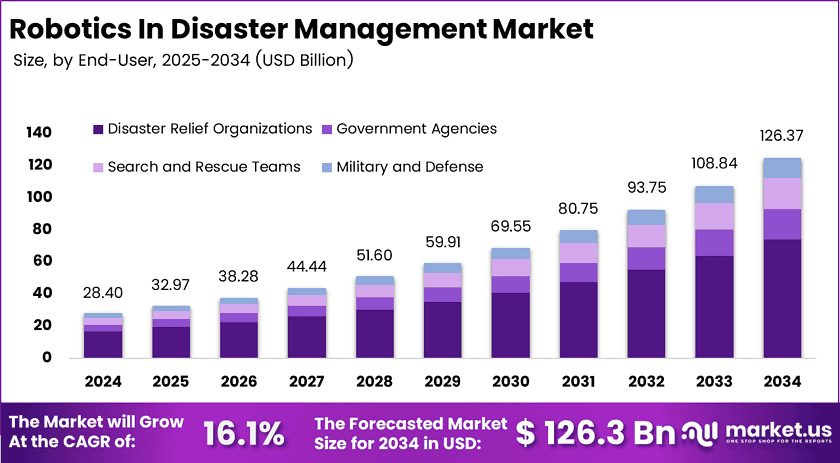
Disaster losses are increasing the need for advanced emergency technology. The supplied analysis cites UNDRR estimates of USD 70 billion to USD 80 billion in average annual direct disaster costs. These losses show why public agencies invest in faster assessment, stronger preparedness, and systems that protect frontline personnel.
FEMA made USD 1.008 billion available through its fiscal 2025 Homeland Security Grant Program, including USD 553.5 million for high-risk urban areas. Consequently, public safety agencies can improve communications, geospatial awareness, and deployable response capabilities. These investments can also support robotic platforms during complex local emergencies.
Governments and relief teams use robotic systems to enter damaged buildings, survey flood zones, inspect critical assets, deliver supplies, and locate survivors. Moreover, robots reduce direct exposure for responders working near fire, unstable debris, contaminated water, and damaged power systems. These capabilities help agencies make faster decisions when conditions limit human access.
Key Takeaways
- The market reached USD 28.4 billion in 2024 and is expected to reach USD 126.3 billion by 2034. forecast to expand at a 16.1% CAGR from 2025 through 2034.
- Ground-based robots led the type segment with a 62.7% share, reflecting their usefulness across unstable debris and enclosed sites.
- Search and rescue operations led the application segment with a 48.9% share because agencies prioritize rapid survivor location.
- Disaster relief organizations led the end-user segment with a 42.8% share due to their frontline role in humanitarian operations.
- North America led the regional market with a 42% share and USD 11.9 billion in revenue.
➤ Access the Exclusive Sample Report Featuring Full TOC, Data Tables & Figures – https://market.us/report/robotics-in-disaster-management-market/request-sample/
Market Segmentation
Ground-based robots led the type segment with a 62.7% share because they navigate rubble, tunnels, industrial sites, and unsafe structures. These platforms carry heavier sensors, gas detectors, cameras, and robotic arms. Moreover, longer operating time helps rescue teams maintain situational awareness while keeping personnel farther from dangerous areas.
Aerial robots support rapid mapping, thermal surveys, and searches across isolated locations where roads are blocked. Underwater robots inspect flooded infrastructure, ports, dams, and submerged debris. Additionally, these systems expand emergency coverage across air and water environments. Agencies can combine their data with ground platforms to improve field coordination.
Search and rescue operations led the application segment with a 48.9% share because teams must identify survivors and safe access routes quickly. Robots provide video, sound, thermal imaging, and location information in dangerous conditions. Consequently, command teams can prioritize rescue actions with clearer information and lower responder exposure.
Disaster relief delivery, infrastructure inspection, and reconnaissance create additional demand for emergency robotics. Delivery platforms move essential items through disrupted areas, while inspection systems assess roads, bridges, power networks, and buildings. Moreover, surveillance tools provide updated field intelligence that supports recovery planning and resource allocation across affected communities.
Disaster relief organizations led the end-user segment with a 42.8% share because they coordinate humanitarian missions across major emergencies. Their teams need portable platforms for mapping, search, logistics, and field awareness. Additionally, robotic tools help these organizations work across wide areas while managing difficult access conditions and limited staff capacity.
Government agencies, military and defense groups, and search and rescue teams also increase demand for robotic emergency systems. Government bodies manage public infrastructure and response budgets, while defense groups provide specialized capabilities. Therefore, suppliers can serve varied users through rugged platforms, training programs, maintenance services, and integrated command software.
Regional Analysis
North America dominated the Robotics in Disaster Management Market with a 42% share and USD 11.9 billion in revenue during 2025. The United States drives demand through emergency agencies, defense programs, utilities, fire departments, and urban search teams. Moreover, advanced suppliers and technical partners strengthen regional deployment capacity.
Asia Pacific combines high disaster exposure with a major robotics manufacturing base. China accounted for 54% of global robot installations in 2024, according to the supplied analysis. This production scale supports access to components and engineering skills. However, the supplied data does not verify that Asia Pacific is the fastest-growing region.
Drivers
Government preparedness procurement drives market growth because agencies increasingly replace short pilot projects with permanent response fleets. The supplied analysis estimates that this factor adds about 1.4% to forecast CAGR. Consequently, suppliers can build recurring revenue through training, maintenance, mission support, software updates, and multiyear service agreements.
Rising climate-disaster intensity also supports demand for safer response technology. Emergency teams need tools that work during floods, wildfires, storms, and earthquakes. Moreover, responder safety priorities encourage agencies to use remote platforms before sending people into high-risk locations. This shift supports wider adoption of drones, mobile robots, and robotic data systems.
Use Cases
Search and rescue teams use ground robots to inspect collapsed buildings, tunnels, and debris fields before personnel enter. Cameras, thermal sensors, and gas detectors provide valuable information from dangerous areas. Moreover, robotic platforms help teams locate survivors and assess structural risks while reducing direct exposure for emergency workers.
Infrastructure operators use aerial and underwater systems to inspect damaged roads, bridges, dams, ports, and power assets. These platforms collect imagery and mapping data across difficult terrain. Consequently, recovery teams can identify priority repairs faster, coordinate resources better, and restore essential services with stronger field information.
Business Opportunities
Routine beyond-visual-line-of-sight operations offer a major opportunity as aviation rules become clearer across key markets. Operators could supervise multiple autonomous drones during large emergencies. Moreover, expanded long-range operations can improve coverage, reduce labor requirements, and support service models that deliver recurring revenue to robotics providers.
Robotics-as-a-service models can help municipal and regional agencies access advanced equipment without major upfront purchases. Suppliers can bundle platforms with maintenance, training, software, and mission support. Consequently, agencies can scale capabilities as risks change, while providers create longer customer relationships and more predictable service revenue.
Major Challenges
Damaged communication networks create a major operating challenge for emergency robots. Robots depend on command links, mapping feeds, and telemetry during critical missions. However, disasters can damage terrestrial networks or overload available systems. Suppliers must therefore develop mesh networks, offline mapping, local computing, satellite backhaul, and autonomous return features.
Battery limits and harsh terrain also restrict robot performance during long missions. Aerial platforms need frequent charging, while ground systems face mud, rubble, heat, water, and damaged structures. Additionally, agencies need trained operators who can coordinate systems across multiple teams. These factors increase costs and complicate reliable field deployment.
Top Key Players in the Market
- Honda
- SuperDroid Robots
- BlackDog
- Husarion
- Tmsuk
- VECNA Technologies
- Sarcos Robotics
- Boston Dynamics
- OC Robotics
- Foster-Miller
- Rovenso
- ANYbotics
- ROBOTSYSTEM
Conclusion
The Robotics in Disaster Management Market is growing as agencies seek safer, faster, and more informed emergency operations. Ground platforms, aerial systems, and inspection technologies support rescue, relief, and recovery missions. Moreover, public procurement, climate risks, and responder safety will strengthen demand. Suppliers that improve connectivity, durability, training, and service delivery can build strong positions across global emergency response markets.
Discuss your needs with our analyst
Please share your requirements with more details so our analyst can check if they can solve your problem(s)