
Market Overview
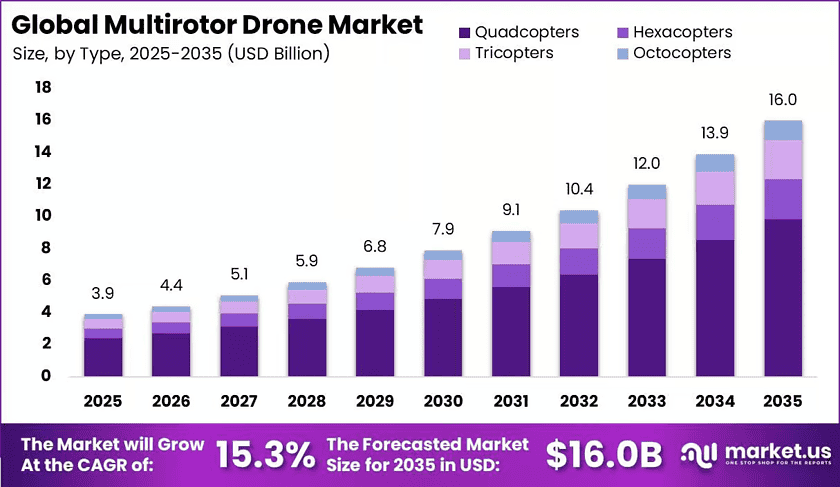
New York, NY – October 29, 2026 – The Global Multirotor Drone Market reached a value of USD 3.9 billion in 2025. Analysts project it will grow at a CAGR of 15.3% from 2026 to 2035 and reach about USD 16.0 billion. Therefore, the market is on track to grow about four times over the next ten years. North America led the market in 2025 with more than 40.7% of the share and about USD 1.5 billion in revenue.
Additionally, farming creates strong demand for these drones. According to the USDA, the United States had about 1.9 million farms covering nearly 880 million acres in 2022. The average farm covered 463 acres. Large farms like these need drones to check crops, find irrigation problems, and spray fields with precision.
Construction also offers a major opportunity. According to the U.S. Census Bureau, U.S. construction spending reached an annual rate of USD 2.1 trillion in June 2025. Non-residential projects made up about USD 1.2 trillion of that total. Therefore, builders use hovering drones to inspect sites and capture detailed images of unsafe areas.
However, commercial flights show the clearest sign of demand. According to the FAA, Part 107 operators flew more than 16.6 million drone flights in 2024 and held 405,682 remote-pilot certificates. Meanwhile, the Department of Defense requested USD 9.4 billion for unmanned aircraft in FY2026. This budget shows that defense demand will stay strong.
Key Takeaways
- The Multirotor Drone Market was worth USD 3.9 billion in 2025 and should reach USD 16.0 billion by 2035 at a 15.3% CAGR.
- Quadcopters led the type segment with a 61.5% share because they are stable, carry payloads well, and cost less.
- Aerial photography led applications with a 41.3% share, driven by real estate, tourism and media use.
- Commercial end-use held the largest share at 45.5%, supported by growing registration and certification systems.
- North America led the market in 2025 with a 40.7% share and USD 1.5 billion in revenue.
Multirotor Drone Market Segmentation
By Type
Quadcopters led the type segment with a 61.5% share. Their four-rotor design gives them steady flight, easy control, and a low purchase price. Moreover, they take off vertically and hover in tight spaces. Consequently, operators pick quadcopters for routine commercial jobs that need fast setup and little effort.
Additionally, according to the FAA, the commercial small drone fleet reached 842,460 units in 2023. Photography and real estate accounted for about 600,300 of those units, or 81.9%. These jobs depend on steady hovering, which explains why quadcopters stay ahead of hexacopters, tricopters, and octocopters.
By Application
Aerial photography led applications with a 41.3% share. Real estate firms, tourism boards, film crews and event planners use drones in place of costly cranes or helicopters. According to the U.S. Bureau of Labor Statistics, the country had 53,630 photographers in 2023. This large group of professionals forms a ready customer base for drone imaging.
Moreover, mapping, surveying, surveillance, and inspection keep adding demand. According to the European Commission, Europe’s drone services market could reach about EUR 14.5 billion and support nearly 145,000 jobs by 2030. Therefore, image-based services should become everyday business tools across the region.
By End-Use
Commercial users led end-use with a 45.5% share. Businesses use drones again and again for property images, site surveys, inspections, and security. According to Transport Canada, the country had 111,362 registered drones in May 2025. These numbers show that formal rules help commercial fleets grow, along with military, government and consumer use.
By Payload
Camera and imaging systems led payloads with a 55.2% share. Thermal, multispectral and high-resolution cameras collect detailed data for mapping, farming and emergency response. According to the U.S. Geological Survey, thermal imagery found drainage lines at 20 of 29 sites. Consequently, buyers are investing more in advanced sensors, control systems, and tracking systems.
Regional Analysis of Multirotor Drones
North America held a 40.7% revenue share in 2025, generating about USD 1.59 billion. According to the FAA, the U.S. commercial small-UAS fleet should grow from about 1.1 million to 1.5 million aircraft by 2030. Therefore, demand for payloads, batteries, software, and maintenance should keep rising.
However, Asia Pacific should be the fastest-growing region during the forecast period. The region has strong electronics manufacturing and growing drone use in farming, infrastructure, and inspection. Moreover, China supplies key motors, flight controllers, imaging systems, and battery parts. Consequently, Japan, India, South Korea and Australia can scale production and adoption quickly.
Key Growth Drivers
Commercial fleet growth is the strongest driver and adds about 2.4% to the CAGR. Repeat inspection and mapping work turns one-time purchases into regular fleet replacement. Moreover, the FAA expects about 400,000 new commercial aircraft by 2030. This growing installed base directly supports the overall growth outlook.
Additionally, demand for industrial visual data adds about 1.8% to the CAGR worldwide. Clear rules also help adoption. For example, the FAA requires registration above 0.5 pounds, and Transport Canada requires it from 250 grams. Consequently, more enterprises are moving drone programs into formal and well-managed operations.
Use Cases
Utility companies use multirotor drones to inspect power lines, towers, and pipelines. Drones hover close to these assets and capture clear images without putting workers on climbing duty. Therefore, inspection teams find faults earlier, cut downtime, and improve worker safety. Moreover, regular flights let teams track how assets change over time.
Farmers use drones to check crop health, find irrigation problems, and spray fields with precision. Thermal and multispectral cameras spot stressed plants before damage spreads. Consequently, growers apply water and chemicals only where they are needed. Additionally, this targeted approach lowers input costs and supports more sustainable farming.
Business Opportunities
Drone-as-a-service platforms offer strong future upside. Many asset owners still buy hardware or hire single flights instead of signing long-term data contracts. However, subscription models bundle dispatch, maintenance, analytics, and compliance into one service. Therefore, providers can build steady recurring revenue and use their fleets more efficiently.
Autonomous dock networks create another strong opening. Drone-in-a-box systems launch, land, and recharge with little human help. Moreover, these docks support regular patrols for security, inspection, and emergency response. Consequently, companies serving North America and Asia Pacific can sell connected hardware, software and monitoring services together.
Major Challenges
Magnet supply concentration is a serious operating challenge. Brushless motors and gimbal actuators need rare-earth magnets that come mostly from China. However, recent export controls have made lead times and material supply less certain. Therefore, manufacturers must find other suppliers and hold more stock to avoid production delays.
Battery limits also slow wider use. Multirotor drones use a lot of power to hover, which shortens flight time and range. Consequently, operators need spare batteries, frequent landings, and extra planning for long missions. Additionally, complex airspace rules and cybersecurity checks raise operating costs for many fleets.
Top Key Players in the Market
- DJI (Da-Jiang Innovations)
- Parrot SA
- Skydio Inc.
- Autel Robotics
- Yuneec International
- Intel Corporation
- AgEagle Aerial Systems Inc.
- Delair
- Quantum Systems
- Hubsan
Conclusion
The multirotor drone market has strong growth ahead, driven by commercial fleets, farming, construction, and defense demand. Quadcopters, aerial photography, commercial users, and imaging payloads lead their segments, and North America leads by region. However, trade restrictions, magnet supply risks, and battery limits remain real hurdles. Therefore, companies that build service models and secure supply chains will capture the most value.
Discuss your needs with our analyst
Please share your requirements with more details so our analyst can check if they can solve your problem(s)